
“Painting is a process of discovery, constantly offering new interpretations to artist and viewer alike.”
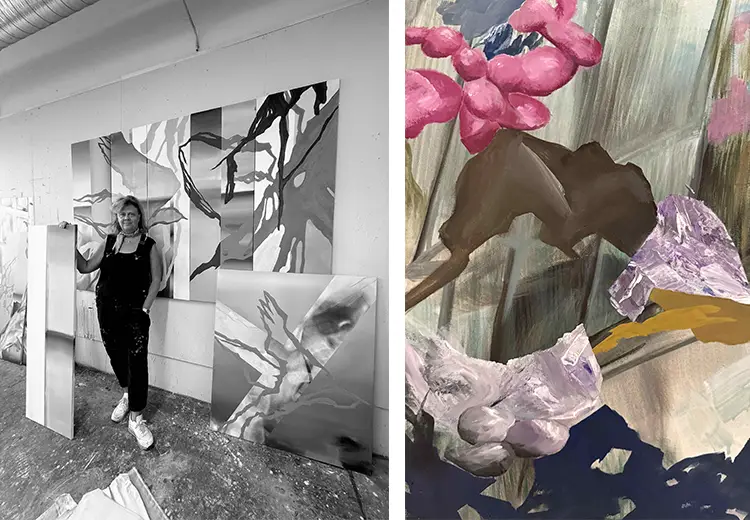
Between Architecture and Abstraction: Origins of a Painter’s Language
Brigitte Puschmann’s journey as an artist is not marked by a single shift, but rather by a continuous unfolding of her relationship with structure, space, and the elusive nature of transformation. Dividing her time between Germany and Austria, Puschmann creates work that is acutely attuned to how perception is shaped by both internal and external environments. Her early education in interior design at the UK’s Rhodec International Art College sharpened her awareness of spatial dynamics and visual balance, though it was her Fine Art studies that ultimately defined her creative trajectory. Having recently completed her graduation in Fine Art, Puschmann is now pursuing her Master’s degree at the Academy of Fine Arts in the class of Professor Markus Lüpertz. This academic evolution reflects a deepening engagement with abstraction and a continuing refinement of her visual language.
What distinguishes Puschmann’s practice is her insistence on transformation, not only as a subject but as a working method. Her studies at the International Summer Academy Salzburg, and more recently under Markus Lüpertz, encouraged her to move beyond the measured logic of design and embrace the expressive ambiguity of painting. Her approach is anchored in the idea that reality is never fixed. Instead, it shifts depending on viewpoint, mood, and the passage of time. This philosophical stance is embedded in her handling of color, gesture, and geometry, which often suggests a world in flux where interpretation is never singular and meaning continuously evolves.
In her Timelessness series, Puschmann explores how abstract forms and surface treatment can generate a sense of suspended temporality. “Alongside my ongoing focus on setting surface and color into a sense of dynamism, it was the feeling of timelessness that preoccupied me in these works,” she reflects. These paintings pose fundamental questions. What makes a work timeless. How do we recognize the timeless within a moment that is constantly shifting. The works construct illusions of space and objecthood without relying on figuration, offering a quiet tension between permanence and impermanence. In this way, timelessness becomes a natural counterpoint to her overarching concern with transformation. While transformation implies change, flow, and ephemerality, timelessness points toward underlying structures that endure. Her art, shaped by the belief that life reveals order even in chaos, functions as a visual diary of change while also seeking moments where form, emotion, and perception crystallize into something lasting.

Brigitte Puschmann: The Inner Mechanics of Abstraction
At the core of Brigitte Puschmann’s style lies a compelling tension between intuitive freedom and precise compositional strategy. Her paintings often suggest both landscape and memory, yet ultimately resist categorization. Working primarily with acrylic, she constructs visual spaces where color fields, angular geometries, and fluid brushwork intersect. Each canvas becomes a site where chaos and control coexist. Organic brushstrokes stand in contrast to sharp-edged forms, creating a dialogue between emotional spontaneity and deliberate visual order. This duality reflects her ongoing inquiry into the unpredictable relationship between perception and internal experience.
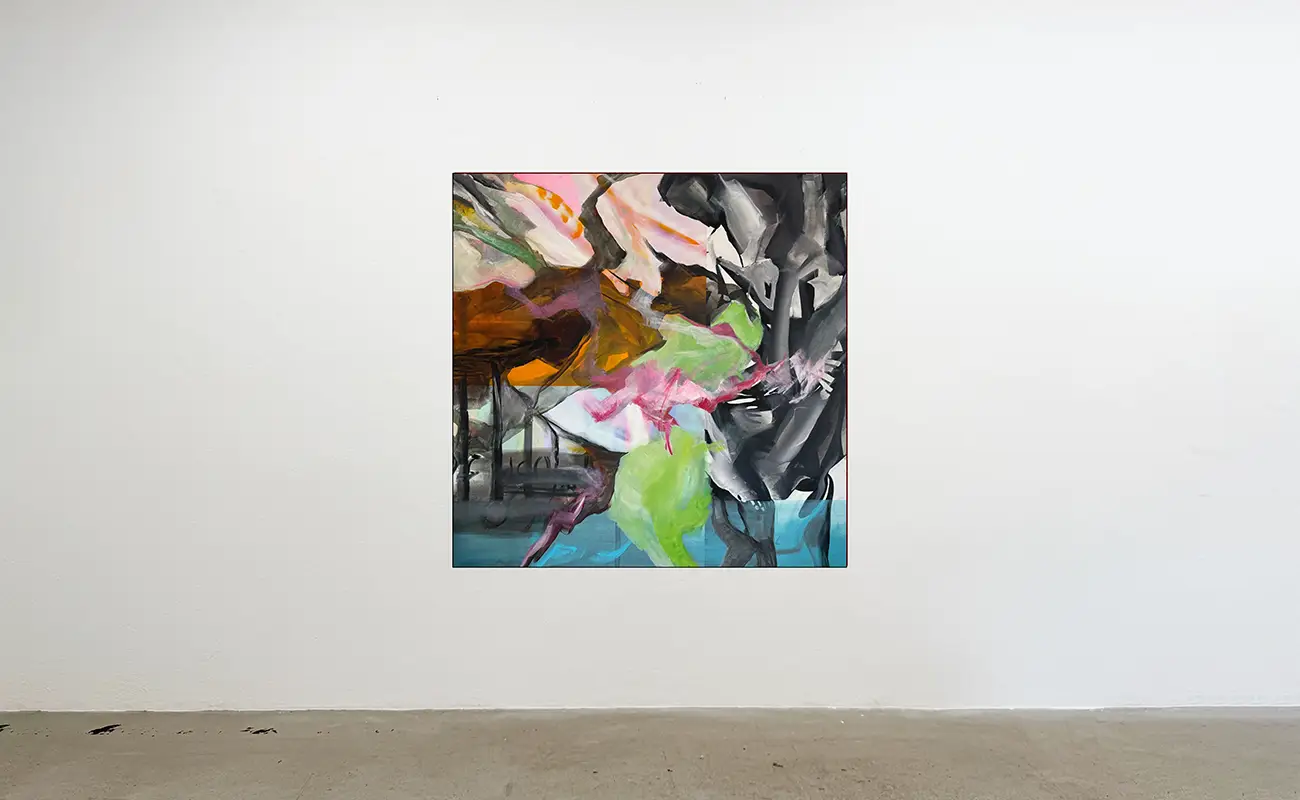
A key example of her thematic and formal concerns can be found in History NL 25-26800, executed in acrylic on canvas. This work encapsulates her interest in ambiguity and transformation. At first glance, the painting appears to hover between states of becoming and disintegration. Forms emerge only to dissolve again, as if caught within a suspended moment of flux. A palpable tension exists between gestural immediacy and structural coherence, suggesting that the work prioritizes process over resolution. Puschmann treats the surface as an open field where each mark carries weight, and where visible layers of revision and experimentation are integral to the final image. Rather than concealing her process, she allows it to remain exposed, lending the work a sense of transparency and vulnerability.
This painting, like much of her broader oeuvre, demonstrates an artist who is not satisfied with visual beauty alone. Puschmann seeks something more fundamental. Her work maps an internal landscape through the act of painting itself. Layered colors, translucent veils, and moments of structural rupture suggest concerns that are not merely aesthetic but existential. Abstraction becomes a means of rendering presence tangible, transforming fleeting emotions and transient thoughts into a lasting visual language. As a result, her paintings feel both deeply personal and broadly resonant, capturing the complexity of navigating between inner and outer worlds.

Gestural Terrain and Structural Drift
Puschmann’s paintings often operate at the intersection of gestural intensity and spatial fragmentation. Her compositions unfold like abstract terrains, places that exist nowhere geographically yet feel emotionally familiar. Through her control of opacity and translucency, she builds surfaces that evoke geological layering or atmospheric shifts. In one area, brushstrokes appear solid and sculptural, while in another they dissolve into softened washes. This interplay sustains visual movement across the canvas. These transitions are carefully orchestrated, maintaining rhythm and cohesion even within moments of heightened visual turbulence.
Color functions as one of Puschmann’s most powerful tools. Her palette moves from earthy ochres and mossy greens to sharp bursts of acid yellow and vibrant violet. These tones rarely remain static. Instead, they interact through layering and overlay, producing luminous effects that recall shifting light or the instability of memory. Surface treatment further deepens this emotional resonance. Thick impastos sit beside transparent veils, sharp linear interruptions cut across softer curves, and forms oscillate between stability and collapse. This coexistence of opposing forces allows her work to speak about conflict, transformation, and reconciliation without resorting to figuration.
Viewing her paintings is an active experience. The viewer is invited to adjust focus, interpret spatial signals, and remain open to ambiguity. Foreground and background frequently merge or exchange roles, while forms that initially appear solid begin to dissolve through sustained observation. This instability of perspective introduces a cinematic quality. Rather than functioning as static images, her paintings feel like fragments drawn from a larger, unseen sequence. It is this sense of motion within stillness, and flux held within form, that defines the emotional impact of her work and situates her practice within the contemporary discourse of abstraction.

Brigitte Puschmann: Expanding the Canvas into Space
While Puschmann’s paintings command attention through their layered surfaces and emotional density, her creative ambitions extend beyond the canvas. She is currently focused on a large-scale installation project titled Infinity Cloud, which brings together more than one hundred individual components. The project is conceived as an immersive spatial environment in which viewers are not passive observers but active participants within an unfolding visual field. She envisions the installation as a three-dimensional translation of the ephemeral and ever-shifting qualities present in her paintings. The search for an institution or venue capable of accommodating the project’s full scale is ongoing, reflecting her commitment to expanding the boundaries of her practice.
Her daily working rhythm is shaped by a conscious separation between administrative responsibilities and studio work. When logistical tasks take precedence, she deliberately steps away from painting in order to preserve the mental clarity required for creative immersion. This division underscores her belief that painting demands a specific form of presence, one that cannot coexist with constant distraction. Her process therefore unfolds in periods of focused, uninterrupted engagement with materials, allowing intuition to guide decision-making. This disciplined approach ensures that each work emerges from an internal necessity rather than external pressure.
Despite the challenges of balancing studio practice with project development, Puschmann remains deeply committed to the evolution of her visual language. Her ongoing studies with Markus Lüpertz provide a framework for critical exchange and experimentation, encouraging flexibility and openness to transformation. Influences such as Gerhard Richter and Robert Rauschenberg are evident not only in her visual sensibility but also in her willingness to traverse boundaries. She moves fluidly between styles, between painting and installation, and between internal vision and external form. With each new body of work, Puschmann continues to refine a practice that is both deeply personal and firmly engaged with contemporary abstraction.