
“We are the philosophers of the solid matter, using it to express ideas and transmit meaning through form and essence.”
Foundations of a Sculptural Vision
Bogdan Murariu’s artistic identity emerges from a life shaped by early immersion in visual culture, disciplined education, and sustained philosophical inquiry. Raised in a household where art was not an abstract concept but a daily presence, his formative years unfolded among studio routines, finished works displayed at home, and frequent encounters with exhibitions and museums. This constant exposure trained his perception long before formal study began, nurturing an intuitive understanding of form, proportion, and visual meaning. Art was never distant or ceremonial for him; it was a lived experience that quietly structured his way of observing the world and interpreting physical reality.
This intuitive grounding was later strengthened through rigorous academic training at the George Enescu University of Arts in Iași, one of Romania’s most established centers for artistic education. The intellectual climate of this institution, combined with Romania’s deeply layered cultural history, provided Murariu with a profound sense of continuity between ancient traditions and contemporary practice. Romania’s position as a cultural crossroads between East and West has generated a visual heritage informed by Neolithic civilizations and later historical influences, all of which shaped Murariu’s sensitivity to symbolism and structure. His awareness of Constantin Brancusi’s legacy further reinforced the importance of essential form and universal meaning within sculptural practice.
Beyond art history and studio training, Murariu’s background includes intensive study in mathematics and physics during high school, disciplines that refined his spatial reasoning and structural awareness. This analytical foundation supports his understanding of three dimensional construction and balance. Complementing this rational framework, practices such as meditation, Qigong, and martial arts introduced a heightened awareness of internal dynamics and energetic flow. Together, these experiences formed a holistic foundation in which logic and intuition operate in dialogue, informing a sculptural language that seeks equilibrium between physical mass and inner intention.

Bogdan Murariu: Harmony, Geometry, and the Search for Freedom
The decision to become an artist was not experienced by Murariu as a dramatic turning point but as a natural continuation of his upbringing and personal inclinations. Art represented a path toward freedom, understood not only as creative independence but as a state in which intellect and spirit operate without constraint. For him, sculpture becomes a means to reconnect with this freedom through direct engagement with nature and material. The act of carving, shaping, and refining matter mirrors an internal process, allowing ideas to unfold through physical resistance and tactile feedback.
Harmony stands at the center of Murariu’s artistic philosophy. He consistently seeks balance between opposing elements such as solidity and openness, tension and calm, precision and intuition. This pursuit extends beyond aesthetics into social relationships and the human connection with the natural environment. Geometry plays a critical role in achieving this balance, functioning as both a conceptual guide and a practical instrument. Rather than imposing rigid order, geometric principles allow Murariu to organize contrast, ensuring that opposing forces coexist within a coherent structure.
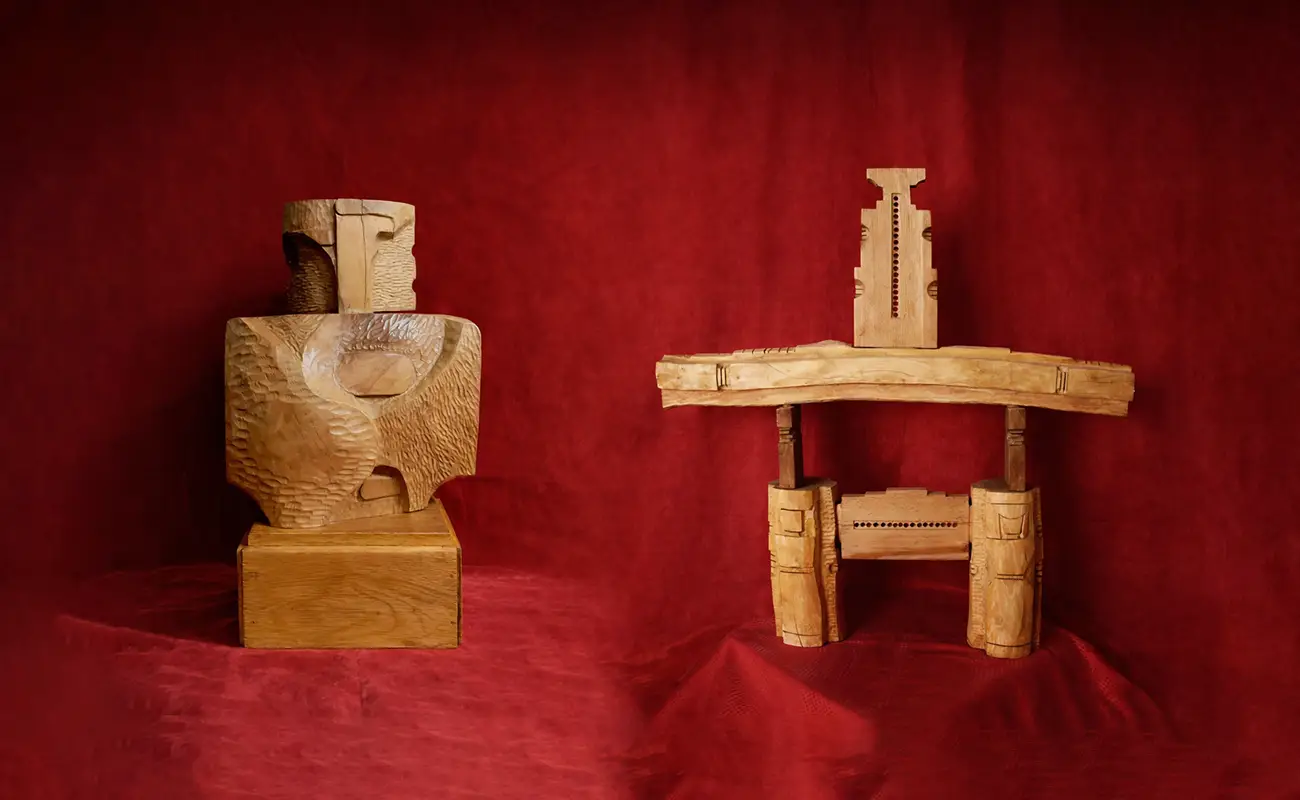
His sculptural style reflects this synthesis through forms that integrate anatomical suggestion, abstract construction, and symbolic clarity. Geometry supports the expressive potential of his works without overshadowing their emotional resonance. Each sculpture becomes a negotiation between contrasting impulses, encouraging viewers to consider harmony as an active process rather than a static ideal. Through this approach, Murariu articulates a vision of sculpture that privileges thoughtful construction while remaining open to introspection and personal interpretation.

Philosophical Lineages and Cultural Dialogues
Murariu often characterizes sculptors as thinkers who employ solid matter to communicate ideas, a perspective that aligns his practice with philosophical inquiry. Influences drawn from ancient Greek thought to contemporary philosophy inform his understanding of art as a vehicle for meaning rather than decoration. Taoist philosophy, in particular, has offered principles that resonate deeply with his approach to composition, balance, and the relationship between opposites. These ideas encourage a sculptural language where tension is not resolved but sustained in a productive equilibrium.
Historical artistic traditions have also shaped Murariu’s visual vocabulary. His engagement with pre Columbian sculpture, especially the achievements of Toltec and Aztec cultures, introduced him to monumental clarity and symbolic abstraction. These influences coexist with the enduring impact of Constantin Brancusi, whose pursuit of essence and universal symbolism remains a guiding reference. Brancusi’s emphasis on distilled form affirmed Murariu’s interest in reducing visual language to its most meaningful components without sacrificing depth.
Additional inspiration can be traced to Henry Moore, whose exploration of space as an active participant in sculpture reinforced Murariu’s own interest in the dialogue between mass and void. Years spent living in an Arab country further expanded his sensibility, fostering a heightened attention to detail and ornamental nuance derived from Persian and Arab cultural traditions. Rather than blending these influences indiscriminately, Murariu allows them to inform specific aspects of his work, creating a layered practice shaped by sustained observation and cultural exchange.

Bogdan Murariu: Material Practice and Meaningful Forms
Murariu’s daily working process reflects a commitment to both discipline and variation. He often alternates between carving and drawing, allowing two dimensional studies to inform sculptural decisions and vice versa. This rhythm prevents stagnation and encourages continual reassessment of form and concept. Current projects focus on groups of sculptures developed through extensive sketching and analysis of circular lines, rotational bodies, and geometric structures. These preparatory stages are not preliminary exercises but integral components of the creative process, shaping the final physical outcome.
Among his works, “The Cello-woman” holds particular personal significance. Carved in white marble, the sculpture belongs to a series dedicated to music and embodies a principle drawn from Taoist philosophy. The figure merges anatomical volumes with the contours of a cello, uniting musician and instrument into a single entity. This fusion represents a moment of complete mastery, achieved after years of disciplined practice, when the distinction between performer, skill, and sound dissolves. The sculpture communicates this transformation through unified form rather than narrative detail.
Material choice remains central to Murariu’s expression, with wood, marble, and bronze each offering distinct possibilities for structural exploration. His practice emphasizes carving as a dialogue between matter, space, and meaning, allowing voids and volumes to interact dynamically. Based in Muscat, Oman, Murariu continues to develop works that negotiate physical presence and conceptual depth, inviting viewers to engage with sculpture as an experience of balance, reflection, and attentive observation.