
The Architect Who Unbuilt the Walls
The story of Antonio Muñiz begins not in a gallery, but in a modest room in Chihuahua, México, where a nine-year-old boy painted the four enclosing walls of his mother’s house. This first act of creation planted the seed of artistic inquiry in Muñiz, whose work now moves fluidly between the corporeal and the intangible. From those early brushstrokes, his impulse toward freedom was clear: an early realization that conventional boundaries were at odds with his deeper instincts. That clarity, sharpened over time, would eventually guide him away from structured disciplines and toward a more intuitive form of making.
Muñiz pursued architecture in San Diego, earning a BA in 1996 from the New School of Architecture. There, he learned to interpret space with deliberate balance, to design with mathematical clarity, and to think structurally. Yet within those lessons lay an opposing tension—the very rigidity that would later drive him to abandon architecture as his primary medium. Painting, with its freedom from formal rules and constraints, became his sanctuary. Unlike blueprints, which demand precision and permanence, painting offered him the freedom to wander, to experiment, and to let form follow feeling. It gave him a language to articulate everything that architectural grids could not hold.
A transformative moment came in 2006 when Muñiz met Rodrigo Pimentel, a prominent Mexican painter known for his post-war and contemporary works. The mentorship that followed became a cornerstone of Muñiz’s evolution. Through hours of conversation and shared artistic rituals, Pimentel reframed his understanding of form and meaning. A single line, Pimentel argued, could contain multitudes—it could unravel into motion, memory, and metaphor. Under this guidance, Muñiz stepped confidently into abstraction, drawing influence from automatism and the subconscious. What emerged was not only a shift in aesthetic, but a new philosophy: that structure could be undone, and from that undoing, a more fluid truth could surface.

Antonio Muñiz: Painting in the Language of Smoke
Muñiz’s primary technique, fumage, does not begin with control but with surrender. Smoke, unpredictable and ephemeral, drifts across the canvas, creating marks that cannot be fully anticipated. For Muñiz, this process reflects a deeper pursuit—the desire to inhabit a space where chaos and control coexist without hierarchy. Each painting begins in this dialogue between chance and response. The smoke leaves its imprint, and only then does Muñiz engage, layering color and gesture in a response that is neither entirely planned nor entirely instinctive. This balance animates his work, giving it a sense of movement even in stillness.
The act of burning carries symbolic weight in his process. It is not merely a means of mark-making, but a ritualistic act—one that severs ties to rigidity and expectation. Through fire, Muñiz clears the canvas of presumption and enters what he calls La Zona Gris, a conceptual space free of polarity or judgment. Here, decisions are not made in reaction to external expectations, but from a place of internal alignment. The gray zone is not indecision, but invitation. It is the space where intention and accident meet, where the boundaries between the conscious and subconscious dissolve. Within this ambiguity, Muñiz finds clarity.
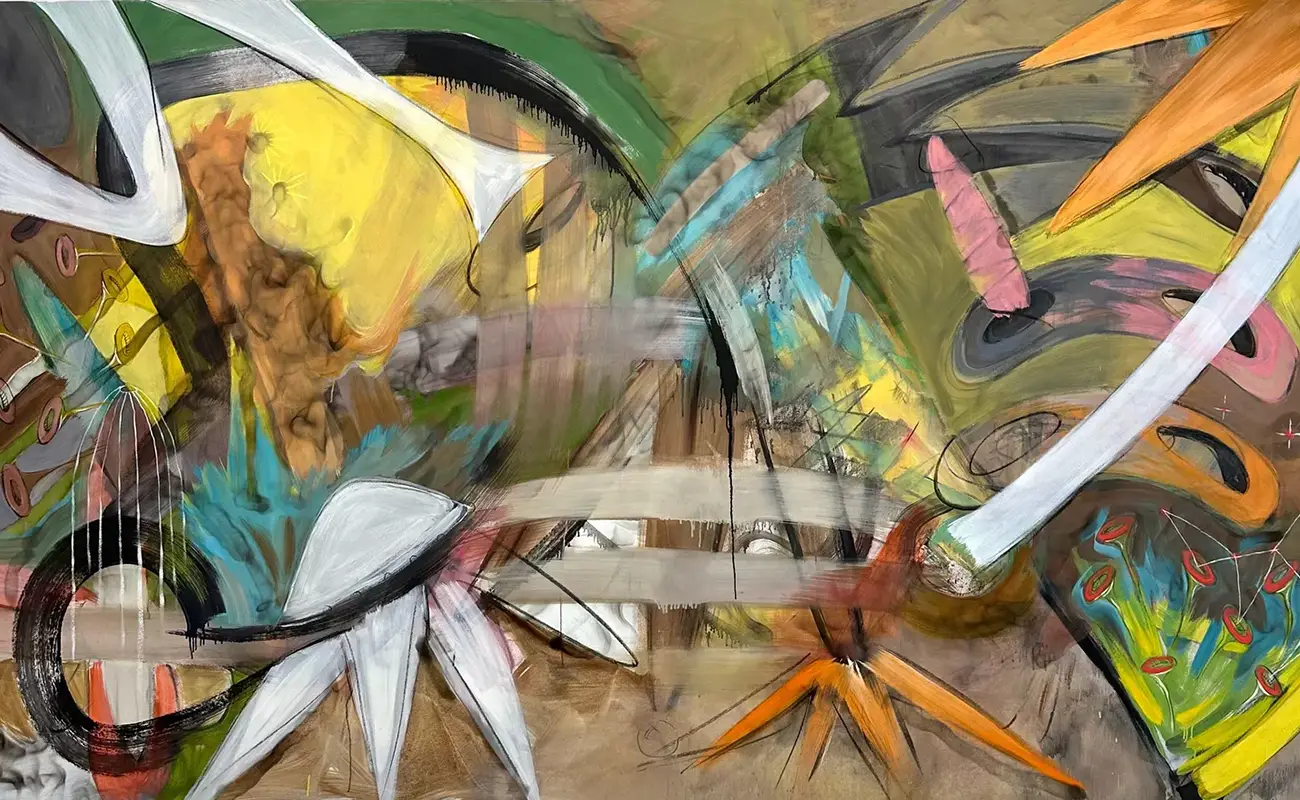
His paintings are not representations but thresholds. They do not depict scenes so much as invite experience. Figures flicker in and out of abstraction. Shapes emerge, only to dissolve into mist. Time itself feels distorted, layered through motion and memory. Muñiz embraces the idea that a painting can be a portal, an entry point into other ways of seeing and being. Color, smoke, and gesture become tools not of depiction, but of transformation. Viewers are not asked to interpret, but to encounter—to let themselves be changed by the ambiguity, the movement, and the unresolved beauty that fills his work.

The Motion of Color, The Stillness of Fire
There is a physicality to Muñiz’s work that speaks to his training in architecture, but it has been subverted and abstracted beyond recognition. While echoes of structure still appear—grids, fragments, and occasional alignments—they are constantly being overtaken by movement. The energy of his compositions is not static, but fluid. It pulses across the surface in vibrant contradictions: jagged gestures collide with soft gradients; saturated hues hover near desaturated voids. Acidic greens, luminous blues, and ochre tones rise out of smoky grays, creating a visual rhythm that never settles into predictability. Each canvas feels like a living system, breathing in color and exhaling form.
Muñiz’s handling of paint and smoke reveals a refined sensitivity to the metaphysical. His surfaces seem to hover between dissolution and emergence, capturing what exists just before materialization—or just after disappearance. This in-between state is where his work resonates most deeply. His compositions are landscapes not of places, but of states of awareness. They evoke internal terrains where logic gives way to feeling, and where perception itself becomes elastic. The viewer is not guided but invited to linger, to allow the painting to unfold slowly and without linear resolution.
There is a distinctly Surrealist lineage that courses through Muñiz’s practice. Artists like Roberto Matta and Remedios Varo have clearly left their mark, not just in aesthetic terms, but in conceptual depth. Matta’s biomorphic abstractions and Varo’s alchemical symbolism provide a generative foundation for Muñiz’s inquiries. Yet his work is not nostalgic. It reactivates these influences through a contemporary lens, rooted in his own lived experience and philosophy. Rather than recreate surrealist motifs, he reinterprets their impulse: the urge to access the unconscious, to represent the unrepresentable, and to treat art as a site of transformation rather than decoration.

Antonio Muñiz: Between Vision and Vapor
At the heart of Muñiz’s work is a fascination with paradox. Smoke becomes structure, gesture becomes meditation, and ambiguity becomes the clearest message. This oscillation is not merely thematic—it is embedded in the material choices themselves. Fumage, by its very nature, resists permanence. It forces the artist to respond to what cannot be predicted. Yet within this impermanence, Muñiz constructs works that feel grounded, intentional, and resonant. Each canvas becomes a negotiation between dissolution and form, between what is seen and what is sensed. It is this delicate balance that gives his paintings their magnetic pull.
His use of La Zona Gris as a conceptual framework underscores the philosophical underpinning of his practice. In this gray zone, absolutes are suspended. It is not a void, but a space rich with potential—a conceptual clearing where opposites cease to compete and begin to coexist. Within it, Muñiz finds the freedom to allow contradictions to breathe. This conceptual space mirrors the physicality of his work, where color and line remain in constant flux. By painting from this zone, Muñiz resists easy interpretation and instead fosters a mode of seeing rooted in presence, curiosity, and non-duality.
Ultimately, Antonio Muñiz’s art offers more than aesthetic experience—it offers entry into a condition of awareness that is rare in a world obsessed with clarity and categorization. His work asks the viewer not to seek meaning, but to experience complexity without reduction. Fire and smoke are not metaphors here—they are collaborators. Through them, Muñiz explores the intersections of destruction and creation, control and surrender, clarity and ambiguity. The result is a body of work that does not resolve, but resonates. Each painting is both question and answer, a visible echo of the invisible forces that shape our perception, our memory, and our inner lives.