
The Gentle Theatre of Anthropomorphic Storytelling
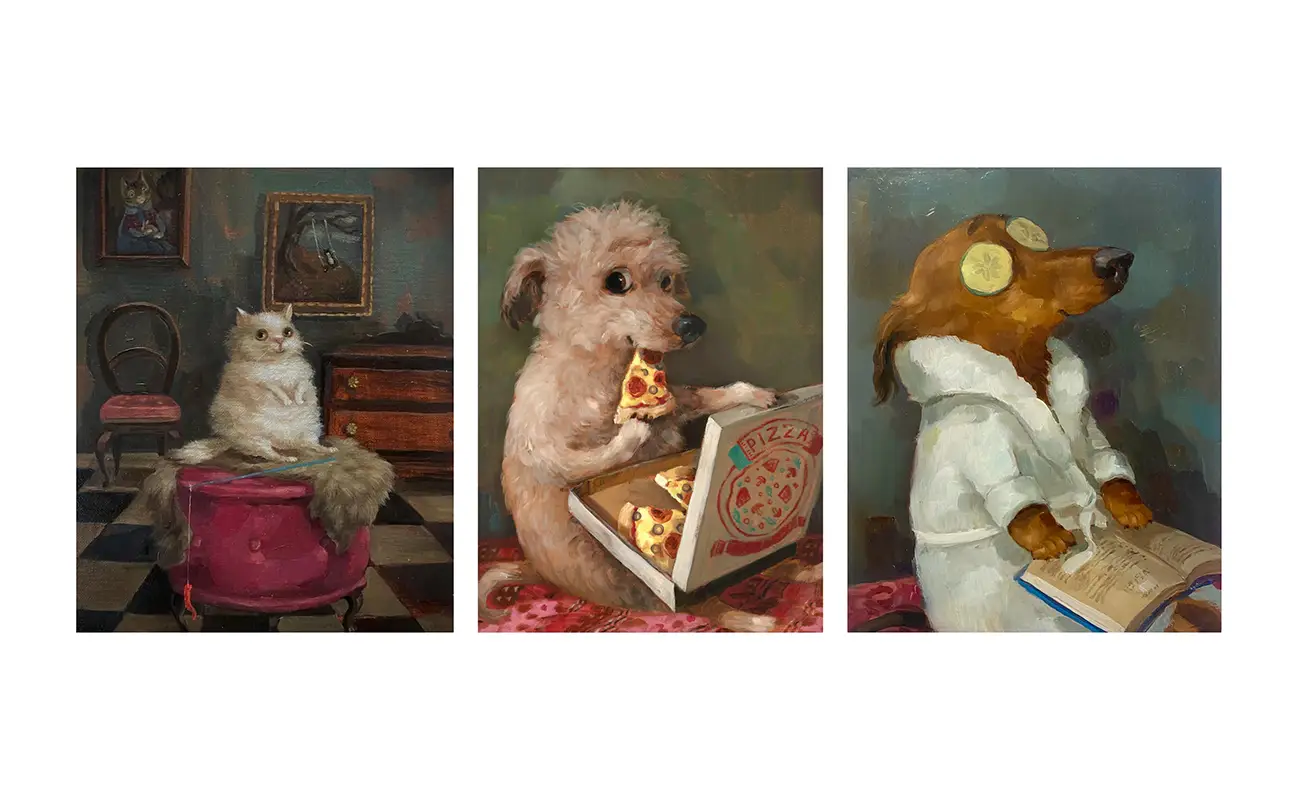
A sense of immediate familiarity greets viewers encountering the work of Alison Friend, a British artist whose paintings occupy a distinctive position within contemporary figurative art. Born in 1973 in the United Kingdom, Friend has built a practice centered on animals portrayed with unmistakably human presence, yet her work resists novelty for novelty’s sake. Instead, her paintings feel rooted in observation, memory, and a deep affection for the quiet drama of everyday life. Cats and dogs sit, wait, snack, sulk, or stare outward with expressions that feel uncannily personal, inviting viewers to recognize fragments of themselves within furred protagonists. This emotional accessibility has become one of the defining strengths of her practice and a key reason her work resonates so broadly across audiences and cultures.
Friend’s artistic voice did not emerge in isolation. Her early life in South Yorkshire, particularly in Doncaster, shaped her sensitivity to domestic environments and intimate moments. Raised as an only child by older parents, she spent much of her childhood drawing, often in solitude, often guided by watching her father paint animals in his garden shed. Those formative experiences established two lifelong constants in her work: a devotion to animals as emotional stand-ins for human stories, and an understanding of art as a conduit for connection. Painting was never merely an activity for Friend; it became a language through which feeling, comfort, and shared experience could be communicated without explanation.
Over time, this instinct matured into a professional practice that bridges popular appeal and painterly discipline. Friend’s paintings are neither ironic commentaries nor sentimental caricatures. They function instead as small theatrical stages where gesture, posture, and setting convey narrative possibility. Each image suggests a larger story unfolding beyond the frame, allowing viewers to participate imaginatively. This balance between clarity and openness has helped position Friend as an artist whose work is approachable yet layered, capable of sustaining prolonged attention without sacrificing warmth or humor.

Alison Friend: Tradition Reimagined Through Animal Portraiture
At the core of Alison Friend’s visual language is a deliberate conversation with European portrait painting traditions. Her oil paintings draw clear influence from historical approaches associated with Old Master portraiture, particularly in composition, palette, and pose. Figures are frequently positioned in three-quarter views, seated with composed stillness, their bodies arranged in ways long associated with formal human portraiture. Yet the subjects themselves are unmistakably contemporary animals, often engaged in habits that feel gently rebellious against the formality of the style. This contrast produces a tension that is both humorous and thoughtful, grounding her work in art history while firmly situating it in the present.
Friend’s technical decisions play a critical role in maintaining this balance. Careful attention to fur, texture, and lighting ensures that her animals feel tangible rather than illustrative. Backgrounds are chosen with equal consideration, often suggesting domestic interiors that echo real lived spaces rather than fantastical settings. These environments anchor the characters in believable worlds, preventing the paintings from tipping into parody. The result is a sense of authenticity that allows viewers to accept improbable scenarios with ease, whether a dog enjoys a carefully placed treat or a cat gazes outward with aristocratic indifference.
A notable example of this approach is Macarons for Josephine from 2024, a painting depicting a small dog savoring a macaron. While the subject matter carries an inherent sweetness, the execution elevates it beyond novelty. The careful handling of oil paint, the composed posture of the figure, and the restrained palette lend the scene a quiet dignity. Rather than presenting the animal as a joke, Friend offers Josephine as a character with interior life, caught in a moment of indulgence that feels recognizably human. This capacity to merge empathy, humor, and painterly seriousness defines much of Friend’s most compelling work.

Memory, Loss, and the Quiet Architecture of Joy
Beneath the charm of Alison Friend’s paintings lies a deeply personal emotional foundation shaped by memory and loss. The death of her father when she was eight years old left an absence that art quietly filled. Drawing and painting became ways to process grief and to offer comfort, not only to herself but also to her mother. As a child, Friend created cartoons of neighborhood animals to make her mother laugh during a difficult period, discovering early that her ability to create images could directly influence the emotional state of others. This realization continues to inform her practice, where the act of making art is inseparable from the desire to bring happiness.
Many subtle details within Friend’s paintings serve as private anchors to her past. Recurring interiors, furnishings, and decorative motifs reflect spaces she remembers from childhood, including wallpaper patterns drawn from her mother’s home. These elements function less as explicit autobiography and more as emotional residue, lending the works a sense of lived history. Viewers may not recognize the source of these details, yet they contribute to the atmosphere of familiarity that permeates her paintings. Nostalgia, in Friend’s hands, becomes a structural component rather than a theme, shaping how scenes feel rather than what they depict.
This emotional undercurrent explains why her work resonates so strongly with audiences seeking comfort without sentimentality. Friend’s animals are not exaggerated symbols of happiness; they are characters who appear capable of boredom, indulgence, contemplation, and mild dissatisfaction. By allowing space for these quieter emotional registers, Friend acknowledges the complexity of joy itself. Happiness, in her paintings, is not constant exuberance but a series of small, meaningful moments. This perspective reflects a lifetime understanding of art as a means of coping, connecting, and sustaining emotional well-being.

Alison Friend: Craft, Discipline, and an Expanding International Presence
Alison Friend’s career is marked by an unusual breadth of experience that has strengthened her artistic discipline. After graduating from Nottingham Trent University in 1996 with a degree in Fine Art specializing in Printmaking, she entered a stonemasonry apprenticeship with Nottingham City Council. In doing so, she became the first woman employed by the city in that role, navigating a physically demanding and traditionally male-dominated field. The rigor and resilience required during this period informed her work ethic and reinforced a respect for craftsmanship that continues to shape her painting practice today.
Following her time as a stonemason, Friend lived in the United States between 2001 and 2007, an experience that expanded her sense of possibility and professional ambition. Upon returning to the United Kingdom, she established herself as a children’s book illustrator, eventually illustrating more than twenty titles for major publishers including HarperCollins, Nosy Crow, Hodder Children’s, Usborne, Little Tiger Press, Alfred Knopf, and Artisan. While illustration brought professional success, the constraints of commissioned work left her eager for a more personal form of expression. That opportunity emerged during the Covid pandemic, when time and circumstance allowed her to focus intensively on oil painting.
Since then, Friend’s paintings have attracted international collectors and have been exhibited widely across the United Kingdom, Europe, Asia, Australia, and the United States. Her exhibition history includes major fairs and institutions such as the London Art Fair, British Art Fair, Royal Academy Summer Exhibition, Frieze Seoul, Art Jakarta, Context Art Fair in Miami, and solo exhibitions in Los Angeles and New York. Based in the Lake District, where she continues to work primarily at night in her home studio and in Manchester, Friend remains committed to a practice grounded in observation, discipline, and emotional generosity. Her growing international presence reflects not a departure from her origins, but a widening circle of connection formed through quietly powerful images.