
“My paintings are about ordinary human stories shown in an abstract way, and I feel great at it.”

Shaping an Artistic Voice Through Change and Displacement
Agnieszka Widerska’s artistic journey is inseparable from the profound shifts that have shaped her personal life, education, and environment. Born in western Poland in 1991, she initially pursued an academic path in the humanities, completing her degree before art became a central force in her life. This educational background fostered a sensitivity to narrative, symbolism, and social context, all of which later surfaced in her visual practice. When she began creating abstract works two years after graduating, her earliest pieces were made with simple school crayons on ordinary printer paper. Even at that stage, she instinctively recognized abstraction as her natural mode of expression, despite limited technical experience. What mattered was not polish but the urge to translate internal states into visual form, a principle that continues to guide her work today.
Her relocation to the United Kingdom in 2018 marked a decisive turning point, both personally and artistically. The move disrupted her routines and, for several years, halted her creative output altogether. This pause, however, was not an absence of growth but a period of accumulation. New social environments, unfamiliar professional paths, and encounters with people from different cultural backgrounds gradually reshaped her perspective. When she eventually returned to painting, the work reflected a transformed inner landscape. The experiences of adaptation, uncertainty, and rediscovery became embedded in her abstract language, allowing her paintings to function as records of transition rather than static images.
Over time, these layered experiences have solidified art as an essential part of Widerska’s life. She no longer views creation as a separate activity but as an extension of living, shaped by faith, daily interactions, and emotional memory. The shift from a gloomy and isolating adolescence toward a more open and engaged adulthood is echoed in the energy of her compositions. Art, for her, is not an escape from reality but a way to remain attentive to it, translating ordinary human presence into visual narratives that resonate beyond literal depiction.

Agnieszka Widerska: Abstract Narratives of Human Life
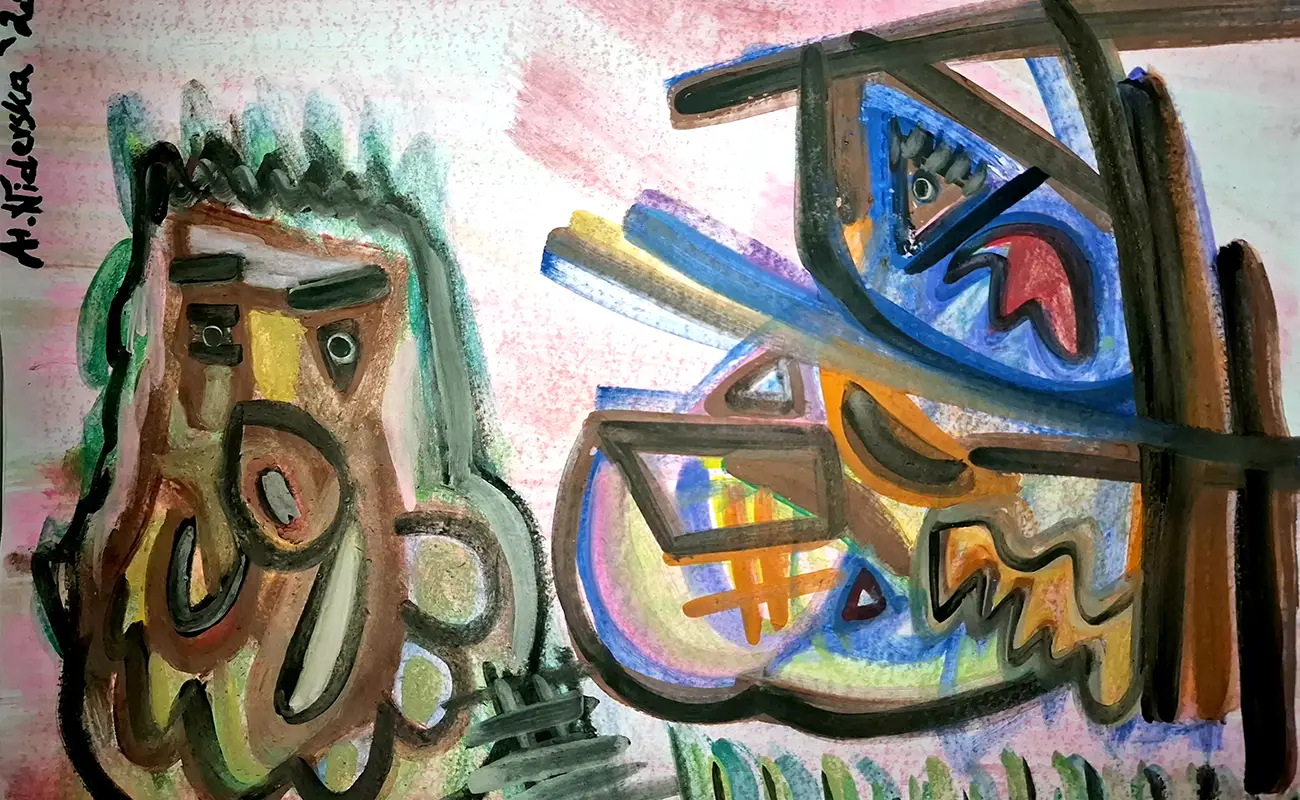
At the core of Agnieszka Widerska’s practice lies a sustained fascination with human stories and the emotional weight they carry. Although her work is firmly rooted in abstraction, it consistently points back to lived experience. Faces, figures, and symbolic forms often appear without being fully defined, suggesting people rather than portraying them directly. This approach allows her to address universal themes such as loss, celebration, conflict, and connection without anchoring them to specific identities. Ordinary individuals, fleeting encounters, and shared social moments become catalysts for visual exploration, transformed into color, line, and rhythm.
Her paintings frequently respond to meaningful dates and collective experiences, including holidays, anniversaries, and widely recognized social events. These temporal markers provide a framework within which personal emotion and communal memory intersect. By translating such moments into abstract compositions, Widerska emphasizes feeling over description, inviting viewers to project their own associations onto the work. The absence of literal imagery does not obscure meaning; instead, it opens space for interpretation, allowing each piece to function as a mirror for the viewer’s own experiences.
Despite the openness of her abstraction, Widerska approaches her subject matter with confidence and clarity of intention. She believes strongly in her ability to convey human presence through nonfigurative means, and this conviction gives her work a sense of assurance. Her paintings do not seek validation through complexity but through sincerity. By trusting abstraction as a communicative tool, she positions emotion as a shared language, one capable of bridging differences in background, belief, and perspective while remaining deeply personal.

Faith, Influence, and the Evolution of a Visual Language
Spiritual belief plays a significant role in shaping Widerska’s creative process and outlook. She openly acknowledges her faith as a source of inspiration, guiding both the act of creation and the themes that surface in her work. This influence does not function as dogma or instruction but as an internal compass, encouraging reflection, humility, and openness. Importantly, she does not expect viewers to share her beliefs in order to engage with her art. Instead, she welcomes dialogue and difference, viewing her paintings as spaces where varied perspectives can coexist without exclusion.
Alongside faith, her artistic influences reveal a strong affinity for expressive modernism. She cites figures such as Karel Appel, Pablo Picasso, and Paul Klee as important references, drawn to their freedom of form and emotional directness. Additional inspiration comes from artists like André Masson, Jean Dubuffet, and Pierre Alechinsky, whose works prioritize instinct, gesture, and raw expression. These influences are not imitated but absorbed, contributing to a visual language that values spontaneity and psychological intensity over refinement.
Equally influential are the chapters of her own life, from childhood and adolescence to adulthood shaped by migration and professional change. Each phase contributes emotional material that finds its way into her paintings. The result is a practice that evolves organically, responding to lived reality rather than adhering to a fixed aesthetic program. Her abstraction remains flexible and responsive, capable of holding joy, grief, faith, and uncertainty within the same visual field.

Agnieszka Widerska: Memory, Process, and Artistic Ambition
One of the most significant works in Agnieszka Widerska’s oeuvre is deeply tied to personal loss and remembrance. Titled Angel with a Gun, the painting was created in August 2025 to mark seven months since her father’s death in January of the same year. Executed on A3 paper using watercolors, the piece serves as both tribute and emotional reckoning. The image invokes an angelic figure holding a weapon, a symbol that captures the complexity of her father’s personality as she remembers it. Warmth, unpredictability, strength, and tenderness coexist within the composition, reflecting a life that ended suddenly yet left a lasting imprint.

This work exemplifies how Widerska transforms private grief into abstract symbolism without diminishing its emotional specificity. Rather than offering a literal portrait, she distills memory into gesture and form, allowing the painting to communicate loss through atmosphere and contrast. The piece stands as a testament to her belief that abstraction can carry narrative weight, preserving intimacy while remaining open to broader interpretation. It also underscores her commitment to using art as a means of processing significant life events rather than separating creation from emotion.
Her daily practice reflects this same integration of life and art. When inspiration arises, she paints to music, working primarily with markers, dry pastels, and watercolors, while occasionally exploring acrylic or oils. Finished works are shared across digital platforms and accompanied by personal reflections on her blog, where she writes about both art and life experiences. Looking ahead, Widerska aspires to exhibit in professional galleries and expand her presence in art publications. These ambitions reflect not a departure from her current path but a desire to extend the conversation her work has already begun.