“I don’t paint animals; I paint their spirit.”
A Practice Reawakened
For Andra Rojas Leal, painting did not begin with a professional decision. It began much earlier, in Caracas, through a childhood surrounded by musicians, painters, museums, and the habit of looking closely. Born María Alejandra Rojas Leal and known as Andra since childhood, she grew up with art as part of everyday life. Her uncle, Elio Leal, became a particularly important guide. Trained in art and active as a teacher at secondary school and university level, he took Rojas Leal and her sisters through museums, cultural spaces, and historic sites across the city. He also taught her techniques that remain part of her practice today, while encouraging her to trust her own instincts.
Drawing and painting came naturally to her. Colors, pencils, and paints were favorite gifts, and she could spend hours absorbed in shifts of shadow, surface, and tone. Yet that early attraction to art did not immediately become a career. Rojas Leal became a mother at twenty and moved to Belgium at twenty-five. Building a life in a new country brought different responsibilities, and painting gradually receded from daily life. The pause lasted for years, but the underlying connection remained intact. Art had been deferred rather than abandoned.
That return came after the pandemic, when she joined a painting workshop at a friend’s gallery. The experience was unexpectedly familiar. The movement of her hand, the brushes, the canvas, and the mixing of color felt instinctive, as though a long-unused part of her life had suddenly become available again. She left with a simple conviction: she had to paint again. The moment opened the path toward Andr.arte, the artistic identity she formally established in May 2021, and gave structure to a practice now grounded in texture, expressive color, movement, and the emotional force she finds in nature.

Andra Rojas Leal: Building a Language Through Matter
Rojas Leal began again without forcing herself into a fixed style. She bought basic materials, experimented, and allowed each work to reveal what suited her. Early paintings went to family and friends, followed by the first unexpected offer to buy a work, then another. Those sales showed that viewers were responding to something in the paintings. A decisive invitation soon followed from the hospital where she works, which offered space for an exhibition accessible to patients, staff, and visitors. Numerous works sold, and the experience confirmed how much she valued placing her paintings in direct contact with an audience.
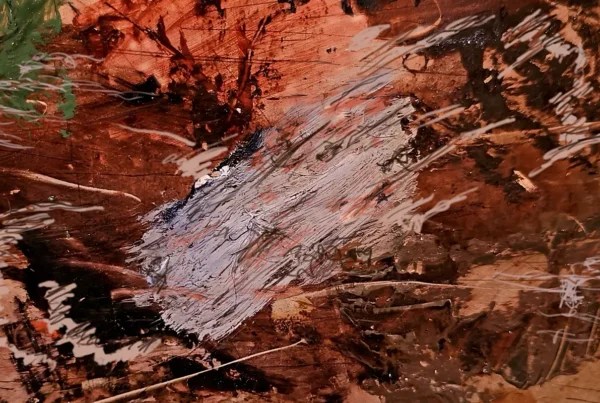
Experimentation gradually led her toward the physical possibilities of paint. Palette knives became especially important, along with layered surfaces, relief, and the way changing light activates textured passages. Her paintings now move between figurative and abstract approaches, often allowing recognizable forms to emerge from energetic fields of color and material. She describes the work as contemporary figurative expressionism with an abstract foundation, a useful description for a practice in which subject and surface remain inseparable. The image may be identifiable, but the painting is built through gesture, texture, contrast, and accumulated matter rather than literal description alone.
This approach is especially visible in her recurring interest in animals. Birds, felines, and horses appear not simply because of their forms, but because of the qualities she associates with them. Birds can carry freedom and joy; felines suggest strength and instinct; horses convey power and nobility. Her phrase, “I don’t paint animals; I paint their spirit,” captures the distinction. Representation is the starting point, not the final objective. Across her Terra, Wild, and Abstract collections, Rojas Leal uses color, texture, and movement to translate the energy she perceives in the natural world into a subjective visual language.

Caracas, Memory, and the Spirit of Place
The 2021 painting Caracas occupies a special position within that development. Created near the beginning of her renewed artistic journey, the acrylic on canvas brings together personal history, national memory, and the gestural techniques becoming central to Andr.arte. Rojas Leal was born in Caracas and has now lived in Belgium for 23 years, a country for which she expresses deep gratitude. Venezuela, however, remains inseparable from her identity. In this work, the macaws that have become a vivid part of the Caracas landscape allow her to address that bond through a subject associated with movement, color, and freedom.
Macaws can be seen flying freely across Caracas, and for Rojas Leal they embody joy and life as much as place. Against the uncertainty, instability, and hardship she associates with Venezuela, their flight took on additional emotional weight. She wanted the painting to carry the colors of her country without turning the composition into a literal flag. Instead, color disperses through movement, splashes, texture, and an eruption of material around the bird. The macaw does not sit passively within the image. It appears to move through the canvas, animated by the physical energy of the surrounding field.
Rojas Leal made the work with brushes, palette knife, splashes, and other gestural techniques, combining direct imagery with a heavily worked surface. Its significance is also inseparable from timing. While painting Caracas, she was reconnecting with the city where she was born and with the part of herself that had once found such ease in painting. The work therefore holds two beginnings at once: a return to her roots and the emergence of Andr.arte. She has chosen not to sell the original. For her, it carries memories and personal meaning that cannot be reduced to a price, making it a permanent marker of artistic renewal.

Andra Rojas Leal: Painting Toward a Larger Horizon
Nature remains one of the principal forces behind Rojas Leal’s work. She is drawn to the intensity of sunrise and sunset skies, the calm and depth of the sea, and the distinct presence she senses in animals. Her admiration for Vincent van Gogh and Claude Monet is connected to an interest in how color and light can communicate something beyond literal appearance. Another influence comes from her life outside the studio. Working as a geriatric nurse brings her into close contact with vulnerability, death, and heightened emotion. She does not define her artistic identity through nursing, but the profession has sharpened her awareness of time and of beauty found in ordinary experience.
Her working process reflects that combination of intention and openness. In her home studio, she usually begins with a general idea and a palette, chooses the format, prepares her materials, and puts on music. Music functions as part of the creative environment, helping her disconnect from other demands and enter the rhythm of the work. She avoids rushing. Texture is built gradually, colors are allowed to interact, and the painting can change as it develops. Passion, for Rojas Leal, is something she wants visible in technique, color, material, and movement. Viewers have often recognized that energy, which she considers one of the most rewarding responses to her work.
Since establishing Andr.arte, Rojas Leal has participated in solo and group exhibitions in Belgium and internationally, experiences that have allowed her to meet collectors and art professionals while refining her visual language. She sees Andr.arte as a long-term project rather than a temporary extension of her nursing career. Growth matters, but not at the cost of changing identity to follow trends or increase sales. She intends to keep developing the Terra, Wild, and Abstract collections and to continue exhibiting at a measured pace. One ambition sits further ahead: a gallery of her own, conceived not only as a place to show paintings but as a space where the wider experience of Andr.arte can be shared.