“I don’t particularly want to illustrate jazz. I want the picture to behave like jazz.”
Rhythm Before Representation
Gerardus Cornielje Baron von Sachsen works where visual art, jazz and poetry meet without surrendering their distinct languages. The Dutch-born artist, poet and professional jazz musician now lives and works in Wertheim, Germany, bringing decades of cross-disciplinary experience into images driven by colour, rhythm and improvisation. Having travelled and worked in more than sixty countries, he draws on an extensive store of cities, people, architecture, literature, music and memory. Rather than treating these influences as separate references, Gerardus allows them to collide within compositions that carry the density and unpredictability of lived experience.
Music is fundamental to the way he sees. His professional training as a jazz musician taught him to begin with structure while remaining alert to intuition, accident and spontaneous variation. He transfers that principle directly into image-making, approaching a composition much like an improvising musician approaches a piece: the framework matters, but its purpose is to create conditions for discovery. Rhythm, syncopation, repetition, tension and dissonance therefore become visual concerns rather than musical metaphors applied after the fact.
Poetry gives his practice a different kind of pressure. Gerardus is drawn to experiences that resist direct explanation, including longing, memory, alienation, sensuality, melancholy and Federico García Lorca’s idea of duende. Painting offers him a way to make those states visible through gesture, colour and visual rhythm. Although visual art accompanied his writing and music for years, it gradually became an independent language. His central question now concerns what happens when painting ceases to describe music and begins to act with music’s freedom.

Gerardus Cornielje Baron von Sachsen: Making the Image Swing
Gerardus’s current practice combines digital drawing and painting with an analogue sensibility. He works primarily with a Wacom Intuos Pro tablet and Rebelle 8 Pro, using the software’s simulation of physical paint to pursue texture, gesture, layering and unpredictable interactions. Selected works can later receive hand-worked or mixed-media elements. The digital environment is not treated as a route toward polished perfection. Instead, it gives him a responsive field in which marks can accumulate, distort, disappear and return, preserving the sense of risk that he values in physical media and live music.
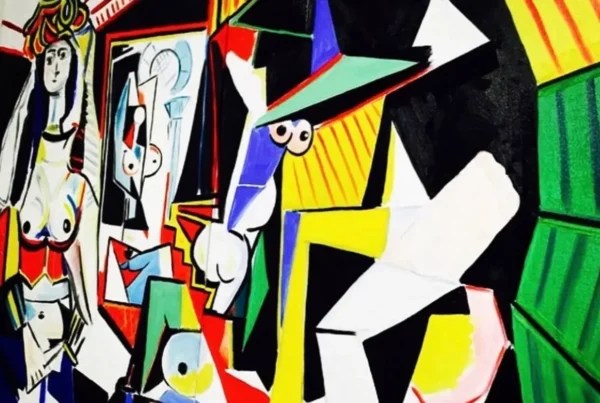
That approach is especially visible in his Jazz & the City and Bebop works. Intense, at times Fauvist colour shares the surface with fragmented figures, forceful black lines and densely layered arrangements. Musicians and instruments appear beside architecture and typography, merging and separating as if each element were an independent voice inside an ensemble. The figure remains recognizable, yet it is rarely allowed to settle into a stable illustrative role. Faces, bodies, lettering and urban structures compete for attention, producing a visual experience based on simultaneity.
His influences help explain the breadth of this language without reducing it to a single lineage. Gerardus feels an affinity with Picasso, Matisse and Fauvism, alongside the imaginative worlds of Bosch, Dalí, Escher, Klimt, Dürer and Gustave Doré. Literary touchstones include Lorca, Baudelaire, Rimbaud, Rilke and Georg Trakl. Jazz, however, remains the most immediate influence. Decades of playing saxophone taught him that improvisation is not an absence of discipline. It becomes possible when a language has been learned deeply enough for the expected sentence to be abandoned without losing coherence.

The Wild Bunch and the Logic of Improvisation
The Wild Bunch marks an important shift in Gerardus’s development because it records the moment he stopped trying to depict a jazz performance and allowed the painting itself to improvise. Musicians, instruments and bodily fragments overlap, dissolve and re-form across the image. A saxophone, face, bass or gesture may be briefly legible before becoming absorbed into another configuration. Recognition is provisional, which keeps the eye moving instead of allowing it to rest on a single subject.
Spontaneous black lines operate almost like musical notation freed from the stave, while fields of yellow, red, blue and green establish their own pulse. Gerardus created the work digitally with a Wacom Intuos Pro Medium and Rebelle 8 Pro, repeatedly building layers of drawing, colour, distortion and painterly intervention. The process mirrors the work’s subject at a structural level. Each addition responds to what is already present, while erasure and alteration keep the composition open to unexpected turns.
For Gerardus, the work also embodies jazz’s central paradox: apparent freedom depends on an underlying sense of structure. The Wild Bunch can initially register as chaotic, yet sustained looking reveals relationships, repetitions and counter-rhythms. That balance between order and disruption is more important to him than literal depiction. His goal is not to make a picture about jazz but to create one that behaves like jazz, with multiple voices occupying the same space and finding coherence through tension rather than uniformity.

Gerardus Cornielje Baron von Sachsen: Cities as Polyphonic Memory
Gerardus’s daily process begins without a fixed destination. A figure, photograph, memory, musical phrase or relationship between colours can provide the first impulse, but he resists deciding too early what the finished image should become. Compositions develop through drawing, painting, distortion, erasure and layering. Figurative passages may remain intact while others fracture or dissolve. Particularly valuable are the moments when an apparent mistake injects unexpected energy, a possibility he learned through jazz not to fear or immediately correct.
Travel supplies another major source of visual material. After working and travelling in more than sixty countries, Gerardus carries an internal archive shaped by changing environments and encounters. Cities hold particular fascination because they contain many narratives at once: advertisements, faces, architecture, traffic, loneliness, music and pieces of conversation. His paintings adopt a comparable logic, placing elements together that may initially seem unrelated and allowing their proximity to generate rhythm. Urban experience becomes less a backdrop than a model for how an image can be organized.
This thinking drives Jazz & the City: Digital Art with an Analogue Theme, his expanding project on the relationship between jazz improvisation and contemporary urban experience. In November 2026, twenty works from the series are scheduled to enter a year-long exhibition in Wertheim, Germany. Gerardus intends to push the visual language further at larger scale, loosening the borders between musician, city, memory and abstraction. The ambition follows the same principle that guides his individual compositions: establish enough structure to hold the work together, then leave sufficient space for the unexpected to change its course.
You can learn more about Gerardus on Singulart and Art Helper.