“For me, the unknown is not necessarily something to fear; it can also be an invitation.”

Where Light Becomes a Question
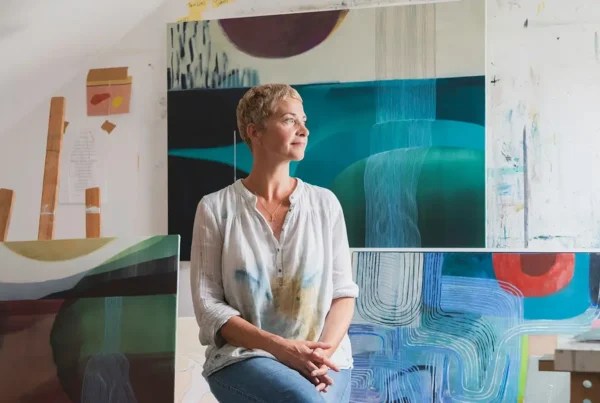
Tanyah Jackson builds paintings around a difficult proposition: an image can show less and still reveal more. Originally from South Africa and now based in the United States, she approaches contemporary painting through a visual sensibility first sharpened by formal training in fine art, particularly photography and drawing. Those disciplines remain present in her attention to framing, atmosphere, tonal contrast, and the construction of an image. Yet Jackson is not interested in visibility alone. Her work turns toward internal experience, memory, spiritual encounter, and wonder, asking how something sensed but not fully explained might take visual form.
South Africa continues to inform the way she responds to landscape, light, and color. For Jackson, a place can carry an atmosphere that exceeds its physical features, and that idea has become central to her work. Water, forests, changing illumination, and the pull between movement and stillness recur throughout her paintings. Rather than treating nature as scenery, she uses it as a threshold, a setting where perception can shift and where the familiar can open onto questions that resist easy answers. The resulting images move between recognizable forms and abstraction, often appearing suspended between emergence and disappearance.
That openness is deliberate. Jackson wants the viewer to encounter more than a finished composition. She leaves enough visual and interpretive space for personal recognition, allowing layered surfaces, flowing forms, and luminosity to suggest rather than dictate meaning. At the center of her practice is a question she returns to repeatedly: how can a painting hold an experience that language cannot fully contain? Her answer is not a fixed symbol or narrative, but a method of making in which light and darkness, hiddenness and revelation, become active forces within the image. As Jackson puts it,
“Light is more than something that illuminates creation; it is part of the mystery of creation itself.”

Tanyah Jackson: Learning to Trust a Way of Seeing
Jackson did not grow up assuming she would become an artist. She initially hoped to study theatre, and when that path did not work out, art became her next choice. Even after entering formal study, she did not identify with the idea of effortless talent. She was not the child who was always drawing, and she often felt she had to work harder than those around her. That early uncertainty became significant because it shifted her attention away from technical ease and toward the deeper question of what an artist notices, pursues, and refuses to ignore.
A lecturer helped change the direction of Jackson’s development by recognizing something beyond technical ability. What the lecturer saw was a particular way of looking at the world and a willingness to push further into the creative process. Jackson was encouraged to trust that perspective and follow the questions that arose from it. The effect was lasting. Art became less about producing beautiful images and more about examining life’s mysteries, including experiences that cannot be explained or translated cleanly into words. That distinction still shapes the emotional and conceptual structure of her paintings.
Leonardo da Vinci became an important influence for similar reasons. Jackson is drawn less to his visual style than to the range and persistence of his curiosity. His investigations of nature, anatomy, light, water, movement, science, and invention suggest to her a mind unwilling to separate artistic practice from larger questions about existence. His notebooks, with their constant probing beneath appearances, resonate with her own instinct to remain with uncertainty. She is less interested in identifying what something is than in asking what else might be present, what remains unseen, and what might emerge through sustained attention.

The Invitation Inside the Unknown
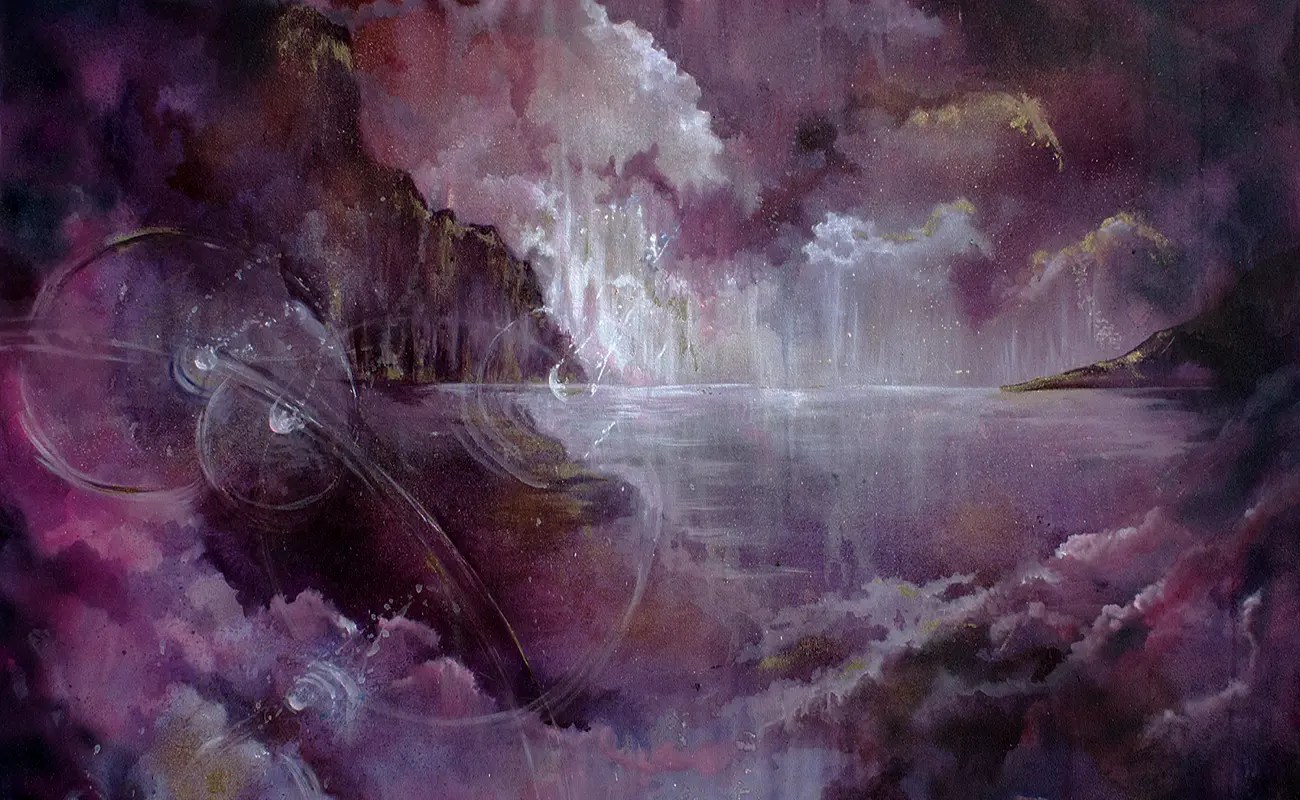
That approach becomes especially clear in Into the Unknown, completed in August 2023. The 48 by 60 inch mixed media acrylic painting on canvas belongs to Jackson’s Komorebi collection, a body of work concerned with the interplay of light and shadow and with the possibility that contrast can reveal rather than conceal. In the painting, a path of water moves through a forest and draws the eye toward increasing light, but the destination remains obscured. Jackson wanted to create the sensation of standing at the edge of something not yet visible. The title names that tension, while resisting the assumption that uncertainty must be threatening.
For Jackson, the unknown can function as an invitation. The painting considers the relationship between what is known and hidden, both within human experience and within her understanding of the Divine. She is attentive to the desire for certainty before action, yet the work proposes that meaningful discovery often begins where certainty ends. Light does not erase shadow, and shadow does not weaken light. Instead, each makes the other more perceptible. That coexistence gives the painting its emotional weight and reflects Jackson’s belief that difficult or concealed parts of experience should not simply be rejected.
The work was accompanied by 1 Corinthians 2:10–11, a passage concerning the Spirit searching the deep things of God. For Jackson, the verse connects with the idea of an interior landscape whose depths cannot be reached through surface observation alone. Spiritual life is not separate from her studio concerns. Scripture and her relationship with God shape the questions she brings to themes of revelation, beauty, hiddenness, light, and the human soul.
“I often wonder what it means to create in response to the Creator, the One who brings light into darkness and gives form to what was unseen,”
Jackson says. Into the Unknown gathers those concerns into a single visual passage, using landscape not to provide an answer but to create a place where uncertainty, trust, and perception can coexist.

Tanyah Jackson: Painting Toward Presence
Jackson’s studio practice begins before paint reaches the surface. She spends significant time observing and contemplating, waiting for a moment of revelation while an image or idea develops internally. The process is intuitive, but not simply spontaneous. Once she starts working, intention meets discovery, and the painting can disclose possibilities she could not have planned at the outset. She builds through layers, allowing forms and light to emerge gradually. A key moment arrives when the work begins to carry an atmosphere of its own, no longer feeling like a set of decisions but like a presence with which she is in conversation.
This working method mirrors the subjects that recur across her practice. Light emerging from darkness, thresholds, water, presence, memory, and unseen dimensions of human experience are not isolated motifs but connected ways of approaching perception. Jackson often positions the viewer near a transition, where one state seems to be giving way to another. Recognizable imagery may remain available, yet it is rarely closed or fully defined. That balance gives her paintings their sense of suspension. They appear to be becoming visible in real time, asking the viewer to stay with ambiguity rather than rush toward a single interpretation.
Jackson is now interested in giving these recurring ideas more space through a sustained body of work rather than treating each painting as an isolated object. She wants to continue developing the relationships among light, darkness, water, thresholds, presence, and what cannot be directly seen. The larger ambition remains experiential: to make work that slows perception and rewards extended looking. Instead of presenting the painting as a statement to be decoded, she imagines it as an encounter. The image may show the viewer something, but its deeper function is to return a question, inviting attention toward what might be waiting beneath the surface.