Architecture Without a Fixed Point
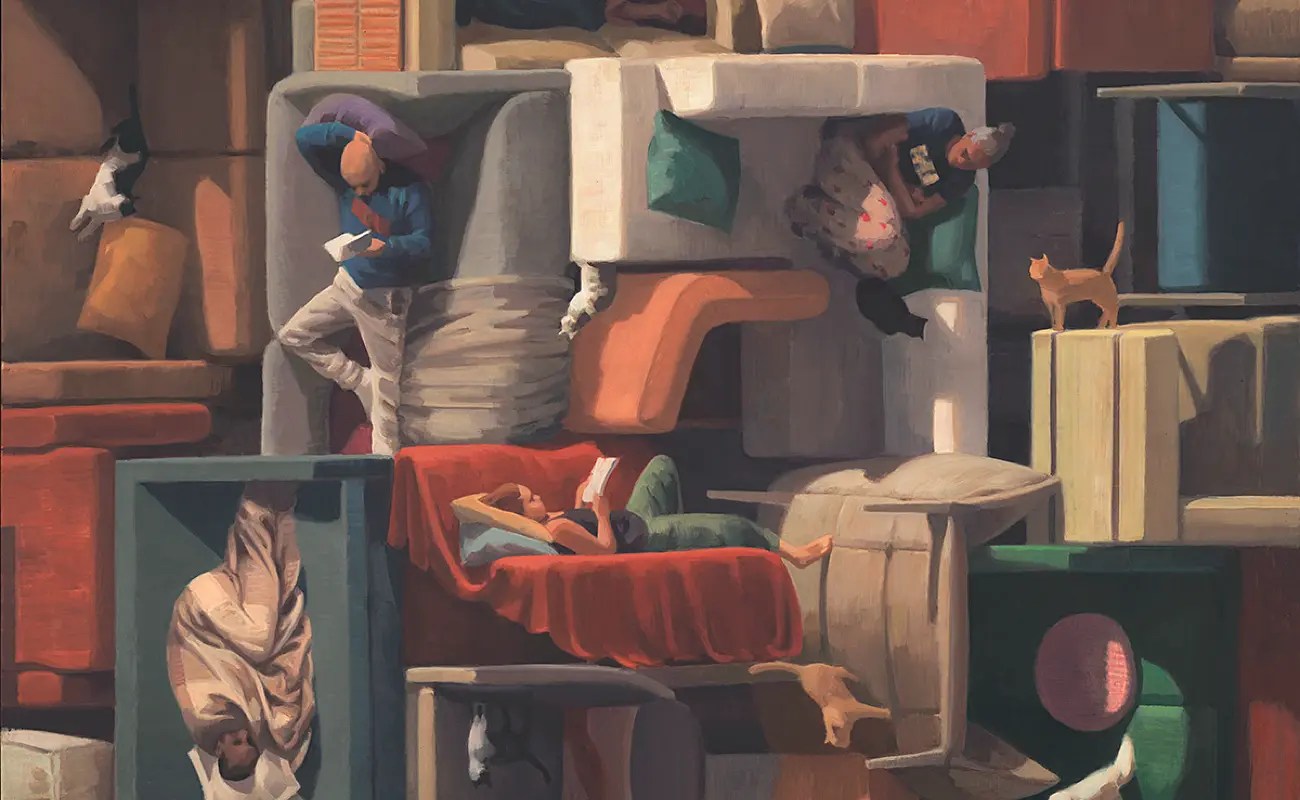
Cinta Vidal paints worlds that appear impossible yet remain curiously familiar. Buildings rotate across multiple axes, staircases answer to conflicting gravitational pulls, and domestic rooms coexist without agreeing on which direction is upright. Within these unstable structures, people continue with ordinary life. They read, rest, converse, tend plants, or gaze outward, seemingly unconcerned by the spatial contradictions surrounding them. The effect extends beyond visual ingenuity. Vidal uses architecture and altered gravity to examine how people can occupy the same physical environment while perceiving it from profoundly different positions.
Born in Barcelona in 1982, Vidal has lived since childhood in Cardedeu, near the city. Drawing entered her life early in an environment where art already mattered. At sixteen, she joined the Castells Planas scenography workshop in Santa Agnès de Malanyanes, following a path her sister had previously taken. Working with Josep and Jordi Castells introduced her to professional stage painting and helped establish painting as her vocation. She later studied illustration at Escola Massana in Barcelona, while her experience in theatrical scenography continued to shape how she understood scale, perspective, atmosphere, and constructed space.
The workshop provided an unusually physical education in painting. Vast backdrops for theatre and opera were laid horizontally, allowing painters to walk across their surfaces and work with long brushes. Producing convincing environments at that scale required control of perspective, chiaroscuro, texture, proportion, and time. It also encouraged Vidal to reconsider the conventional hierarchy between figure and setting. Onstage, performers usually carry the narrative while painted scenery establishes the world around them. Years spent constructing those surroundings sharpened her interest in architecture and landscape as active presences capable of carrying psychological meaning themselves.

Cinta Vidal: Giving Difference Its Own Gravity
Vidal’s independent practice evolved gradually from drawing toward an increasingly painterly language. Her earlier works combined pronounced illustration with areas of flat color. Over time, she strengthened chiaroscuro, removed visible outlines, developed more complex illumination, and gave greater attention to small details. That progression eventually produced the gravity-defying compositions for which she became widely recognized in the mid-2010s. Vidal has referred to these images as “un-gravity constructions,” a concise description of spaces whose internal logic remains precise even when conventional physical laws disappear.
Gravity is more than a formal trick within these compositions. People, houses, furniture, roads, trees, balconies, and architectural fragments can each possess an independent orientation, creating several coherent spaces inside one image. No single viewpoint resolves their contradictions. Instead, viewers must negotiate competing systems of up and down, each internally convincing but incompatible with the others. Vidal connects this visual condition to perception itself. Individuals inevitably encounter their surroundings from particular positions, unable to inhabit every perspective simultaneously. Her altered architecture gives that limitation a tangible form.
The calm behavior of her figures makes this idea especially clear. They do not respond to their fractured environments as disasters. Someone may sit comfortably on a sofa while another person occupies a perpendicular plane; elsewhere, figures read, talk, hang clothes, stand on balconies, or simply move through daily routines. Their proximity does not guarantee shared experience. Vidal has repeatedly addressed the distance that can exist between people who are physically close and the need to accept differences in thought and perception. Rather than forcing her figures into a common orientation, she allows several realities to coexist within the same structure.

Domestic Memory Inside Impossible Spaces
For all their architectural complexity, Vidal’s paintings retain an intimate connection to everyday life. Furniture plays an important role, and many objects draw upon memories of her grandparents’ home. Chairs, tables, cabinets, lamps, sofas, books, dishes, and other familiar possessions lend warmth to environments that might otherwise feel purely conceptual. Their recognizability also heightens the spatial dislocation. A room may defy gravity, but the objects inside it belong to ordinary routines and remembered domestic spaces. Architecture therefore becomes both an intellectual structure and a container for private experience.
Cats contribute a quieter presence. Vidal’s lifelong familiarity with them and her fascination with their independent, observant behavior have made them recurring inhabitants of her compositions. Often they seem even less troubled by spatial contradictions than the human figures. Their composure suits paintings in which instability is presented not as catastrophe but as a condition of existence. Small gestures and incidental activities perform a similar function, shifting attention from architectural spectacle toward the lives occurring within it. The impossible structure catches the eye, while these details determine much of its emotional temperature.
Her influences further clarify this balance between construction and atmosphere. Comparisons with M. C. Escher are understandable given the manipulation of perspective, and Vidal admires his command of optical construction. She has nevertheless distinguished her motivation from his, explaining that her altered gravity developed through an interest in human relationships rather than an attempt to extend Escher’s approach. Her references also include Caravaggio and Vermeer for their handling of light, Edward Hopper for his conjunction of architecture and psychologically isolated figures, and Hayao Miyazaki and Studio Ghibli for their environments. Across those points of reference, space is never merely background.

Cinta Vidal: From Painted Panels to Public Walls
The disciplined geometry of Vidal’s work begins well before the final painted surface. She starts with a paper sketch structured through vanishing lines, then considers illumination and the placement of forms. Preparing and sanding wood and transferring the composition are relatively mechanical steps, but painting introduces greater flexibility. Light and emerging forms can redirect later choices, allowing intuition to operate within an exacting framework. Wood panels have remained particularly important, used with acrylic and, in many works, oil. Canvas, paper, screen printing, and three-dimensional wooden constructions have also allowed her to pursue related questions through different materials and formats.
Murals offered a natural extension rather than a radical change of scale. Vidal already knew how to paint enormous theatrical surfaces before working extensively in public space, but muralism introduced a different set of circumstances. Weather, logistics, collaboration, passersby, and the architecture surrounding a wall all affect the process. She regards muralism as democratic because viewers can encounter it without entering a gallery, while also insisting that public work should respond to its location. At the Honolulu Museum of Art, she incorporated references to objects and cultures represented in the collection. For Universitas at UIC Barcelona, figures, books, computers, architectural elements, and academic references portray the university as a place where knowledge is created and shared.
Her paintings have continued to shift between urban complexity and private interiority while preserving architecture as their central organizing force. The Concrete body of work examined rigid built structures alongside the vulnerable everyday lives protected within them, using illuminated homes and transitional light to consider refuge, family, neighborhood, and community. Later interiors have turned further toward psychological withdrawal, placing people together in rooms while their attention moves toward memory, thought, or stillness. Across international exhibitions, museum projects, residencies, and murals in Europe, Asia, Australia, and North America, Vidal has sustained the same essential tension. Her spaces connect and divide simultaneously, asking viewers to accept several orientations without searching for one privileged position from which every difference disappears.