Landscapes Remembered Rather Than Recorded
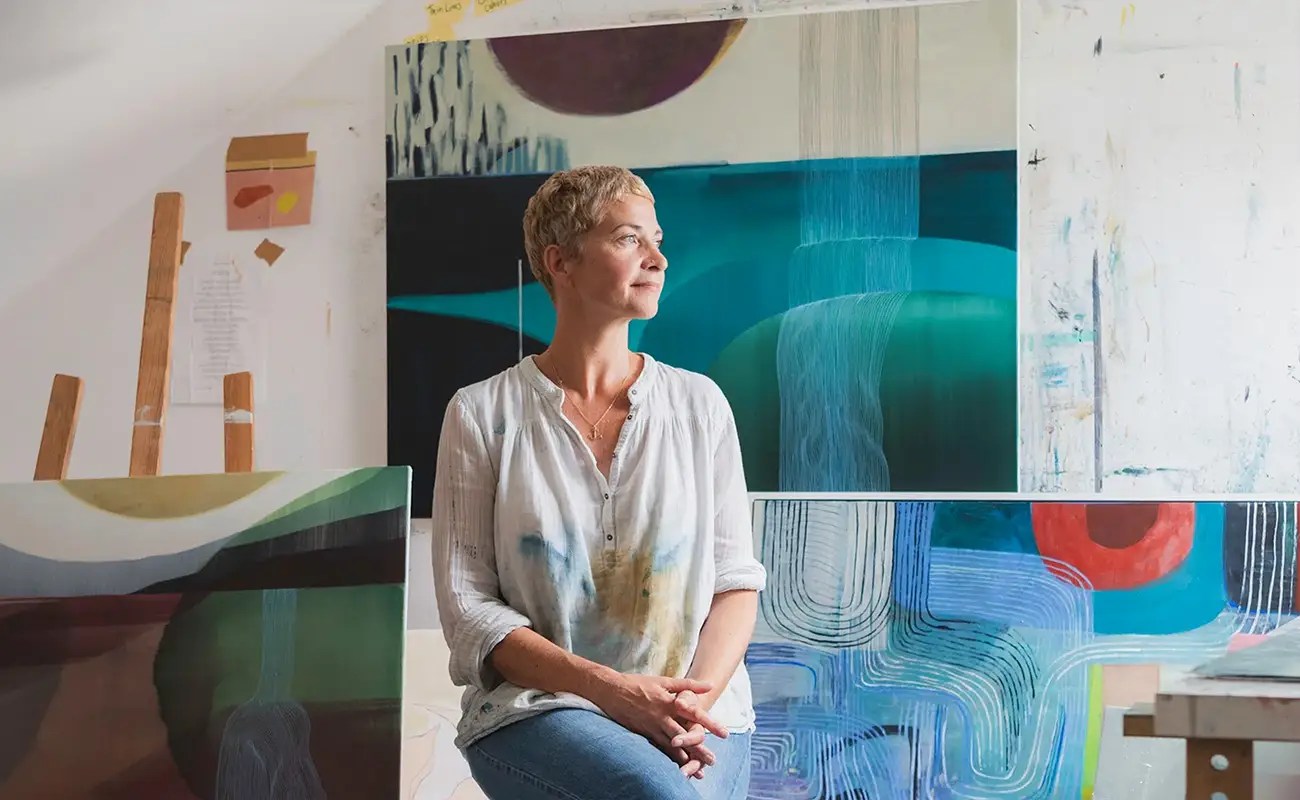
Louise Body paints landscapes that seem familiar without belonging to one identifiable place. Coastlines, horizons, water and geological forms emerge through translucent colour, simplified shapes and recurring lines, then drift toward abstraction. Working primarily from memory, the British painter is less interested in documenting what a landscape looks like than in considering what remains after it has been experienced. Her paintings examine memory, transformation and perception through environments that hover between the recognizable and the imagined.
Born in Southend-on-Sea in 1974 and now living and working in Hastings on England’s south coast, Body has maintained a long connection with the sea. Art was equally present from childhood. Both of her grandmothers were artists, her parents attended art school, and one grandmother had a garden studio where Body was allowed to use oil paints and canvases. After growing up in Surrey, she moved to Brighton at seventeen for an Art Foundation course before studying Fine Art at Nottingham Trent University, graduating in 1996.
Travel followed university, including a year in India that strengthened her independence and attraction to adventure, beauty and expansive horizons. Her professional life, however, did not immediately settle into painting. Body supported her creative practice through various jobs before establishing a wallpaper company in 2003. That apparent diversion became an important part of her visual education, sharpening an understanding of pattern, repetition, colour and surface that would eventually return to painting in altered form.

Louise Body: From Pattern to Paint
Body’s wallpaper and textile practice developed into a substantial design career. Her work was commercially manufactured and shown at international trade fairs, while collaborations included projects with Paul Smith and Dr. Martens. Her Garden Birds wallpaper entered the permanent wallpaper collection of the Victoria and Albert Museum. Fine Art training distinguished her approach within interiors, while years spent designing printed surfaces gave her a disciplined sensitivity to how shapes, colours and patterns interact.
Those lessons remain visible in her paintings. Simplified forms and blocks of colour establish strong compositional structures, while repeated marks can create the visual rhythm associated with printed pattern. The connection is never merely decorative. Design provides an underlying order that Body can disrupt through layering, translucency and revision. The resulting images often retain a print-like clarity while carrying the uncertainty and atmospheric depth of remembered places. Her two professional disciplines have therefore become less separate with time.
In 2020, Body closed her wallpaper business and committed herself to painting full-time. It marked a return to the medium in which she had originally trained, now informed by nearly two decades of experience with textiles, wallpaper and commercial design. Her paintings have since entered private collections internationally and appeared in exhibitions including a solo presentation at the Old School Gallery in Northumberland and group exhibitions at Cambridge Contemporary and The Art Buyer in London. Her work has also appeared in Elle Decoration and Coast Magazine, while King & McGaw produces a print range available through retailers including John Lewis.

Beneath the Visible Surface
Living beside the sea has profoundly shaped Body’s way of seeing. She is particularly drawn to the uninterrupted horizon, that deceptively simple division where water meets sky. Its scale reminds her of the vastness of the world and the relative smallness of the individual within it. Changing marine light, tidal movement and shifts in the colour of the water provide a constantly evolving visual environment. Sea swimming intensifies that relationship by placing her physically within the landscape rather than at a distance from it.
Yet Body does not paint particular views. She avoids relying on photographs or preparatory sketches, preferring to let places pass through memory before they reach the canvas. Different coastlines can merge, while factual geography gives way to sensations of tranquillity, nostalgia, openness and possibility. A viewer might recognize the feeling of a coast without being able to locate it. This ambiguity is central to her approach because memory itself is unstable, changing through time and emotion rather than preserving experience intact.
Her process gives that idea a physical form. Working primarily in acrylic on canvas or board, Body takes advantage of the medium’s quick drying time to construct successive layers. Translucent glazes allow earlier shadows, shapes and marks to remain partly visible, while brushes and scrapers help her build, obscure and alter the surface. She rarely starts with a predetermined final image. A single finished work may contain five or six previous compositions beneath it, with unsuccessful arrangements and abandoned decisions becoming part of the painting rather than material to be erased completely.

Louise Body: Between Waking and the Sea
For Body, those buried paintings carry the history of the finished image. Earlier marks may disappear almost entirely, yet they continue to influence what is built above them. The process functions as a visual metaphor for memory: certain details remain sharp, others fade, and fragments of the past unexpectedly surface through what came later. Change is therefore present not only in the subject of the landscape but in the physical construction of each work. Tides, erosion, weather and seasonal shifts find their painterly counterparts in covering, revealing, revising and rebuilding.
Some paintings move further from recognizable geography into dream-like territory. Repetitive lines can recall waves while also suggesting the recurring movement of thoughts and dreams. Body describes an interest in the place between waking and sleeping, where familiar forms become unstable and landscapes can feel otherworldly. Her influences help illuminate this balance between structure and suggestion. She cites Wilhelmina Barns-Graham and Victor Pasmore among significant postwar British influences, while Paul Klee was the first artist she remembers responding to as a child. She also admires Hilma af Klint, Frida Kahlo and Prunella Clough for qualities including abstraction, colour, pattern, restraint and enigmatic mark-making.
Body’s paintings have also found lives beyond gallery walls. One of her seascapes was selected for the cover of Ian McEwan’s What We Can Know, published by Penguin, where its horizon, marine light and bold colour became part of a wider graphic composition. The collaboration reflects the openness that runs throughout her practice. Her landscapes begin with personal experience but resist being fixed to a single location or interpretation. Drawing together the structural intelligence of design, the accumulated surfaces of painting and a lifelong relationship with the coast, Body creates images in which places are not preserved exactly as they were. They survive as memory does, layered, altered and continually reconstructed.