“All her painted and drawn artworks are linked by an interest in the found object, and binding the ordinary to the extraordinary.”

A Practice Shaped by Observation and Imagination
Debra Rushfeldt has built an artistic career that stretches across decades of experimentation, refinement, and creative transformation. Born in Calgary, Alberta, she pursued formal studies at the Alberta College of Art and Design and the Banff Centre, later expanding her artistic perspective through summer studies with Parsons in Japan. Throughout her career she has exhibited widely, taught workshops, and contributed to arts organizations, establishing a reputation as a committed cultural participant as well as a practicing artist. Since 2002, she has lived in Nakusp, British Columbia, where the landscape of the Arrow Lakes region provides an ongoing source of inspiration. The natural surroundings of this mountain community are not simply a backdrop to her work. They actively inform the imagery, atmosphere, and emotional tone that define much of her creative output. From realism-based charcoal drawings to detailed acrylic paintings and public murals, her work demonstrates a sustained fascination with the relationship between observation and imagination.
The development of Rushfeldt’s artistic language reveals an enduring interest in connecting everyday experience with something more mysterious and transformative. Her charcoal drawing practice grew significantly after receiving a Columbia Basin Trust Major Project Award in 2010, a grant that encouraged the creation of artwork focused on life in the West Kootenays. These drawings emerged from personal engagement with place, translating familiar environments into carefully rendered images that reflect both emotional attachment and close attention to detail. Alongside drawing, she cultivated a prolific mixed media assemblage practice informed by found objects, decorative traditions, and collected materials. The physical process of arranging, editing, and altering surfaces became central to her methodology. Rather than presenting fixed meanings, the resulting works encourage viewers to form their own connections between disparate elements, creating interpretations that remain open and personal.
Equally significant is the way Rushfeldt’s experiences outside the studio have informed her artistic direction. A lifelong appreciation for textiles, decorative arts, travel, and community engagement has expanded the range of visual references that appear throughout her work. Her achievements over the past decade include solo exhibitions in major public galleries, appearances on PBS Northwest Profiles, multiple Columbia Basin Trust awards, and the creation of a large public mural depicting a western toad for the Village of Nakusp. These accomplishments demonstrate both professional recognition and a deep commitment to sharing art with diverse audiences. At the same time, she continues to operate Debra Rushfeldt Studio Gallery, maintaining a daily creative practice rooted in curiosity, observation, and an enduring appreciation for the natural environment that surrounds her.

Debra Rushfeldt: The Rise of a Magic Realist Ecosystem
A major evolution in Rushfeldt’s work has been her embrace of magic realism, a direction that combines faithful observation of nature with imaginative storytelling. Her recent paintings occupy a distinctive space where ecological awareness and fantasy coexist without conflict. Forests, wetlands, insects, amphibians, flowers, and water become participants in narratives that feel believable despite their impossible circumstances. The western toad has emerged as a central figure within this visual universe, serving as both protagonist and guide through worlds that appear familiar yet subtly transformed. Rushfeldt applies traditional painting methods with remarkable precision, using saturated earth tones and intricate surface detail to establish environments that feel tangible and immersive. Once this believable foundation is established, unexpected events unfold. Ordinary creatures adopt unusual roles, improbable encounters occur, and the boundaries between reality and invention become increasingly fluid.
One of the defining qualities of these paintings is the artist’s ability to present extraordinary events in a calm and convincing manner. Rather than relying on spectacle, she integrates imaginative elements directly into natural settings, allowing them to appear entirely at home within the landscape. This approach gives her work a sense of quiet wonder. Viewers encounter animals that behave like thoughtful individuals, carrying histories, motivations, and personalities. The resulting narratives invite reflection rather than demanding explanation. Through this balance of realism and invention, Rushfeldt creates a visual language that celebrates curiosity and the possibility that hidden stories may exist within even the most overlooked corners of nature. Amphibians, insects, and small woodland creatures are elevated from supporting details to central characters whose experiences carry emotional and symbolic significance.
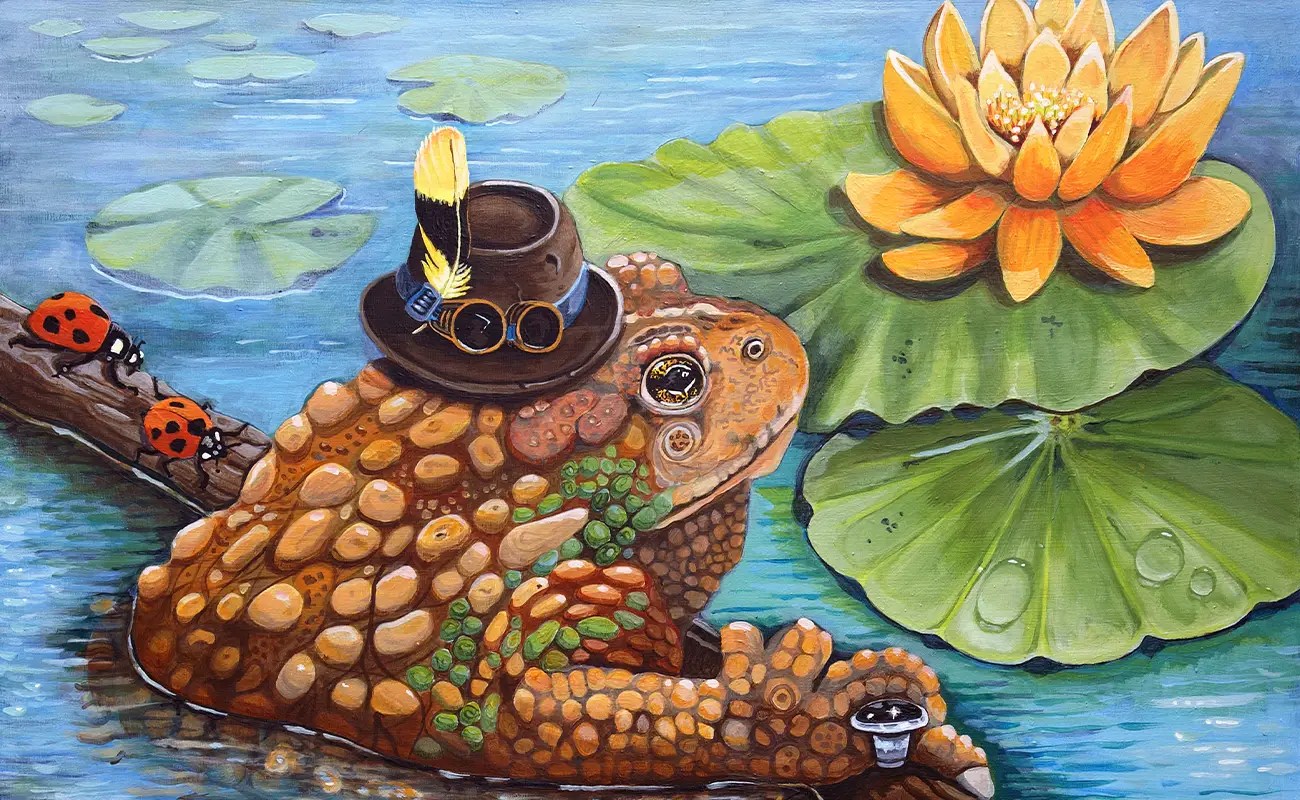
The atmosphere of these paintings is further enriched through color and texture. Mossy greens, warm ochres, rust tones, deep browns, luminous blues, and violet accents combine to create scenes that seem suspended between daylight and dream. Forests glow with subtle energy, while water, bark, flowers, and stone are rendered with careful attention to their physical qualities. Particularly distinctive is the treatment of animal surfaces, especially the recurring toads. Rather than depicting skin as a uniform texture, Rushfeldt builds it from countless individual forms that resemble pebbles, seeds, gemstones, or fragments of mosaic. This method generates visual rhythm and complexity, making each creature appear connected to the landscape itself. The effect reinforces a central theme running throughout her work: the profound interconnectedness of living things and the environments they inhabit.

Narratives of Toads, Grasshoppers, and Transformative Encounters
Among Rushfeldt’s most ambitious ongoing projects is a series of acrylic paintings inspired by her years as curator and coordinator of the BASScamp Gallery at the Shambhala Music Festival. Rather than producing a direct representation of festival culture, she translates its atmosphere into an imaginative narrative infused with humor, affection, and symbolic meaning. At the center of this unfolding story are two recurring characters: Esso the Steampunk Toad and Mr. Grasshole the grasshopper. Their adventures begin with a mysterious Magic Basket discovered in the forest, an encounter that changes the course of their lives and sets a larger narrative into motion. Each painting extends the story introduced in the previous work, creating a visual sequence in which memory, altered perception, and unexpected choices shape the experiences of the characters. Through this evolving structure, Rushfeldt merges storytelling with fine art in a way that encourages sustained engagement.
The appeal of these characters lies in their balance of whimsy and psychological depth. Although they are animals, they function as individuals whose actions and expressions suggest inner lives. They travel, contemplate, explore, and respond to situations with recognizable emotions. This anthropomorphic quality recalls narrative illustration traditions while remaining firmly grounded in contemporary painting practice. Rushfeldt avoids turning her characters into simple symbols. Instead, they become participants in complex environments where transformation is always possible. A grasshopper may pause in contemplation, a toad may assume the role of traveler or observer, and ordinary objects may acquire unexpected significance. These moments encourage viewers to consider broader questions about perception, identity, and the relationship between imagination and experience.
Beyond the charm of the narratives, the series reflects a deeper engagement with themes of ecological awareness and interconnected existence. By placing small creatures at the center of elaborate stories, Rushfeldt shifts attention toward forms of life that are often ignored or undervalued. Toads, insects, lichens, and wetland habitats become worthy of sustained observation and admiration. Their presence encourages a reconsideration of what constitutes significance within the natural world. The paintings suggest that wisdom, resilience, and beauty can be found in places frequently overlooked. Through humor and visual richness, Rushfeldt invites audiences to recognize the complexity of ecosystems and to appreciate the intricate relationships that bind together landscapes, animals, and human imagination.

Debra Rushfeldt: Connecting the Ordinary and the Extraordinary
Across painting, drawing, assemblage, and mural work, a consistent thread links Rushfeldt’s diverse body of work: a fascination with transforming familiar subjects into sources of wonder. Her assemblage practice demonstrates this particularly clearly. Influenced by found objects, collected materials, textiles, and decorative traditions, these works emerge through a process of selection, adjustment, and continual refinement. Objects that might otherwise remain disconnected are brought together in carefully balanced compositions. Through these arrangements, viewers are encouraged to identify relationships between elements that initially appear unrelated. The resulting works do not prescribe a single interpretation. Instead, they function as invitations to active looking, prompting audiences to construct personal meanings from the visual evidence before them. This openness reflects a broader philosophy present throughout her practice, one that values curiosity and discovery over fixed conclusions.
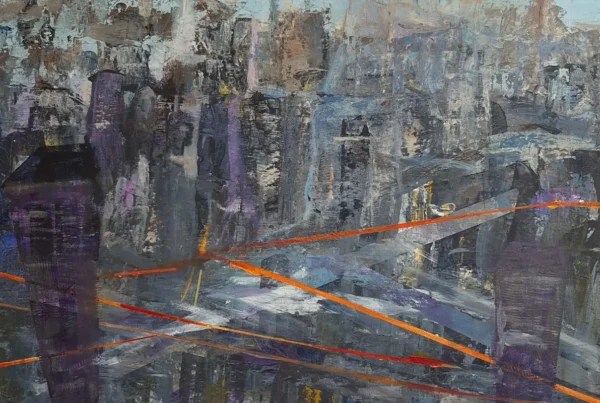
The same impulse appears in her realism-based charcoal drawings. While rooted in direct observation, these works move beyond straightforward documentation. Inspired by her emotional connection to the landscapes and communities of the West Kootenays, the drawings transform familiar scenes into images that resonate on both personal and universal levels. Fine detail and technical skill establish a strong sense of place, yet the works also communicate atmosphere, memory, and lived experience. By combining precision with sensitivity, Rushfeldt demonstrates that realism can function as a vehicle for emotional expression rather than mere representation. The drawings stand alongside her paintings as evidence of an artist deeply engaged with the environments she inhabits and the stories embedded within them.
Recognition of Rushfeldt’s achievements continues to grow because her work offers something increasingly valuable: a reminder that wonder can emerge from close attention. Whether creating a monumental mural of a western toad, building narratives around forest creatures, producing charcoal drawings inspired by regional life, or assembling found materials into evocative compositions, she consistently reveals hidden possibilities within the familiar. Her art proposes that the ordinary world contains layers of meaning waiting to be noticed. Through technical skill, imaginative storytelling, and a sustained commitment to the natural environment, she has developed a body of work that celebrates beauty, connection, and the enduring mystery of the living world. Audiences encountering her creations are invited to look more carefully, think more expansively, and recognize the extraordinary dimensions of everyday experience.