
“Images are not substitutes for reality but its counterpart.”

Echoes Carried by Images
Yezi Lou creates art from the charged space between what is remembered and what can no longer be fully reached. Based in New York, she works as a visual artist and writer, shaping a practice that considers painting as a method of image making rather than a simple act of representation. Her work moves through belonging, cultural nostalgia, absence, and the unstable nature of memory, drawing from personal photographic archives, films, found images, and cultural symbols. Through these sources, Lou studies how images carry emotional weight across distance, especially when people, places, and histories become altered by migration and time. Her paintings do not present images as replacements for reality. Instead, they treat images as active counterparts to lived experience, shaped by the ongoing exchange between what has happened and how it is later seen, stored, altered, and recalled.
Lou’s background in Wenzhou continues to shape the emotional and visual structure of her work. Growing up in a city marked by rapid industrial growth and China’s wider economic transformation, she witnessed how objects could become markers of status, desire, and social position. In that environment, material goods were never neutral. They influenced relationships, reflected ambition, and carried social meanings beyond their practical use. This early awareness of objects as cultural signals remains central to her practice. In her paintings, images and things often become containers for memory, longing, and the friction between personal history and collective change. Rather than treating nostalgia as softness or sentiment, Lou approaches it as a layered condition shaped by distance, class, migration, and the complicated emotions attached to cultural inheritance.
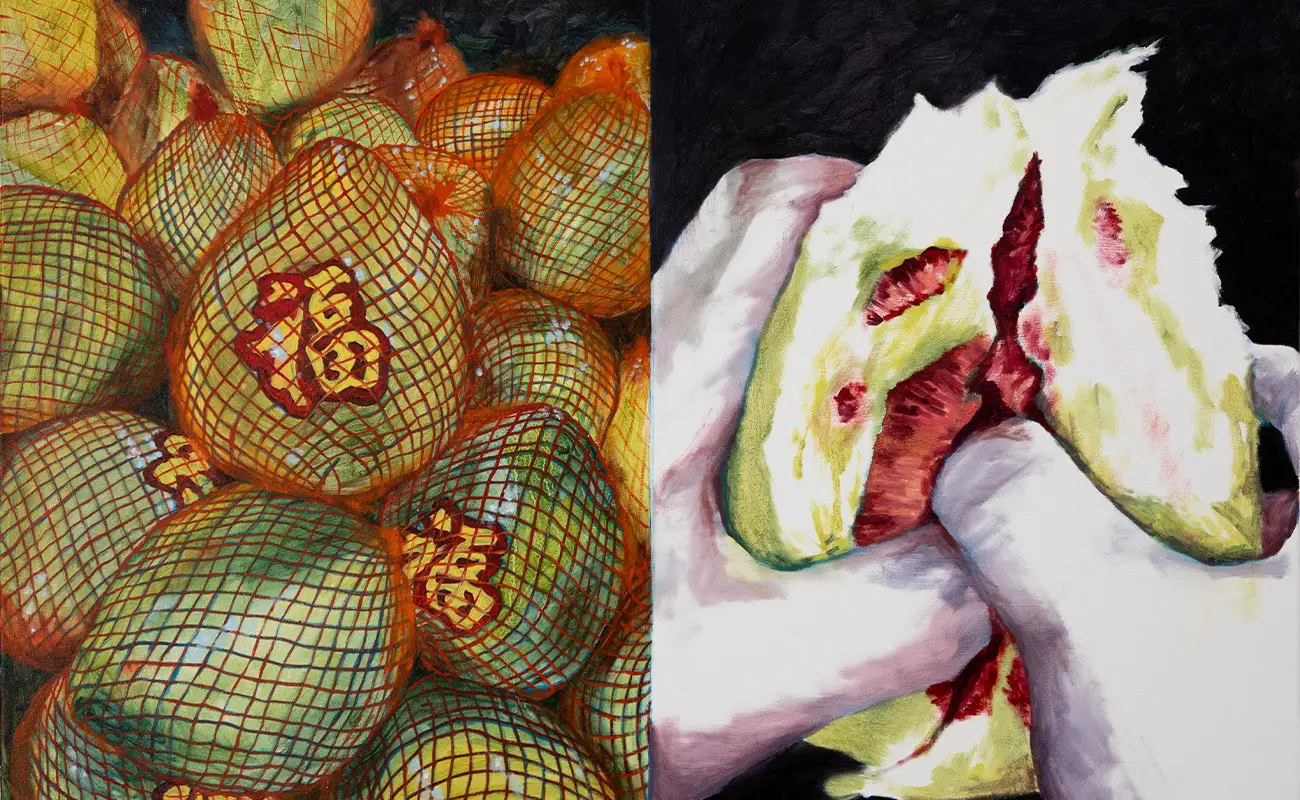
Her work is also guided by daily perception. What she sees, touches, tastes, and encounters in ordinary life becomes part of the visual field from which her paintings emerge. In a world saturated with circulating images, Lou searches for traces of the self within that constant flow. Painting becomes a way to reconsider what has been seen, forgotten, or partially remembered. Her use of figurative language, subtle distortion, artificial color, and layered imagery creates scenes where recognition and estrangement appear together. These works may feel familiar at first, yet they resist fixed meaning. Instead, they hold fragments of personal and collective history in suspension, allowing memory to appear as something visual, unstable, and always changing.

Yezi Lou: Belonging Through Fragments
For Lou, memory is not a reliable archive of the past. It is closer to a visual process, one shaped by migration, displacement, and the passing of time. The images people carry of homes, families, objects, streets, films, and cultural signs are continually revised by new experiences. This understanding gives her paintings their emotional complexity. They do not attempt to preserve a single truth about identity or place. Instead, they examine how belonging is formed through images and how those images influence the way people understand themselves. Her work asks how distance changes perception, how absence sharpens certain details, and how imagination fills the spaces where memory begins to fade.
This concern becomes especially clear in Yellow Pages, an ongoing series begun in 2025. The project started when Lou discovered a thick Chinese language Yellow Pages directory discarded on the street. Although the object seemed obsolete, it remained active and updated, containing thousands of listings for Chinese immigrant owned businesses across Southern California. For Lou, the directory became more than a printed record of commerce. It offered a dense visual field of names, advertisements, services, languages, and traces of community life. Through painting, collage, and drawing, she reassembles these materials into portraits, fragmented letters, and narrative scenes. The series reflects shifting East Asian diasporic identities in the United States while also speaking to her own increasingly unfamiliar relationship with cultural belonging.
Yellow Pages does not function as sociological documentation, nor does it present itself as a direct memoir. Its strength lies in the way it moves between public record and private feeling. The advertisements Lou works with once served practical purposes, connecting businesses with customers and communities with resources. In her hands, they become visual fragments charged with memory, displacement, and cultural texture. The series maps the emotional residue of migration without reducing it to a simple story. Part of Yellow Pages is currently on view in Specimens at A/W Space in Nanjing, China, extending the project across another geographic and cultural context. Through this work, Lou transforms discarded printed matter into a layered meditation on visibility, community, and estrangement.

Images That Refuse to Stay Still
Lou’s paintings often resist the comfort of clear narrative. They are records of encounters, but they do not behave like direct evidence. Instead, they gather impressions, distortions, and fragments into compositions that feel both intimate and unsettled. Her use of artificial color suggests that memory is not a natural or transparent process. It is shaped, tinted, interrupted, and sometimes made strange. Figurative elements may appear, but they are often surrounded by ambiguity, giving viewers enough recognition to enter the work while denying them a single conclusion. This tension between access and uncertainty allows her paintings to reflect the experience of living between cultures, images, and versions of the self.
Her attention to cultural nostalgia is equally complex. Nostalgia in Lou’s work is not only a longing for the past. It is also a response to the way cultural symbols shift when they are carried across borders or encountered from afar. A familiar advertisement, object, photograph, or color can become unstable when separated from its original context. It may evoke home while also revealing how difficult home is to define. This is where Lou’s practice gains its quiet force. She understands that belonging is not simply inherited. It is assembled through memory, language, objects, images, and repeated acts of looking. Her paintings make that assembly visible without forcing it into certainty.
The artist’s writing background adds another dimension to her visual practice. Although her paintings are image based, they often carry the pressure of language, especially in works that involve directories, letters, advertisements, and cultural signs. Text appears not only as information but as texture, rhythm, and evidence of social life. In Yellow Pages, for example, printed language becomes a material through which histories of migration and commerce can be reimagined. Lou’s sensitivity to both image and text allows her to treat painting as a site where perception, memory, and imagination meet. The result is a practice that feels deeply aware of how contemporary identity is shaped through both visual overload and emotional absence.

Yezi Lou: From Machine Vision to Human Attention
Lou’s next project turns toward surveillance webcam imagery gathered from publicly accessible camera networks around the world. These images are produced continuously, yet they are often barely seen. They exist in a strange condition of abandonment, generated without intention, sustained attention, or memory. Originally tied to security and control, such images can lose their intended purpose when detached from active monitoring. Lou is interested in what happens when these anonymous records of public and private visibility are reconsidered through painting. By choosing images made through automated vision, she extends her investigation of image circulation into a new field shaped by technology, accessibility, and authorship.
Painting offers Lou a way to slow these images down. Surveillance feeds operate through machine time, generating endless visual data without pause or reflection. Painting, by contrast, requires duration, attention, and embodied looking. By translating fleeting webcam imagery into painted form, Lou shifts the image from automated capture into human perception. This act changes the status of the source material. What may have once been ignored becomes subject to care, selection, and interpretation. The project asks whether attention can transform an abandoned image into something newly meaningful. It also raises questions about who makes an image, who sees it, and how meaning changes when a picture no longer serves its original function.
Across her practice, Lou returns to the unstable relationship between image and experience. Whether working with family archives, found materials, cultural symbols, business directories, or surveillance feeds, she is drawn to images that carry traces of life while remaining incomplete. Her paintings do not resolve the distance between memory and reality. They hold that distance open, allowing viewers to sense how identity is shaped by what is preserved, what is lost, and what is repeatedly reimagined. Through this sustained attention to belonging, absence, and visual memory, Yezi Lou offers a thoughtful and resonant vision of contemporary painting, one in which images become active sites of emotional, cultural, and historical negotiation.