Surfaces That Remember More Than They Reveal
Stefan Heyer stands within contemporary painting as an artist who turns abstraction into an emotional language of uncommon depth. A German painter working in Catalunya, Spain, he has built a practice centered on layered gestures, shifting forms, and surfaces that seem to carry their own histories. His canvases rarely present a single statement. Instead, they feel alive with contradiction, where fragments appear, fade, and return in altered form. This gives the viewer the sense of witnessing something still in motion rather than something complete and settled. Through this openness, Heyer addresses themes that reach beyond biography, including shared memory, uncertainty, desire, and the ways people construct meaning from incomplete experience. His paintings invite attention because they do not explain themselves quickly. They reward patience, asking the eye to move through veils of color, interrupted marks, and traces that hint at earlier decisions. In a period when images are often immediate and disposable, his work insists on duration, reflection, and emotional participation from those who encounter it.
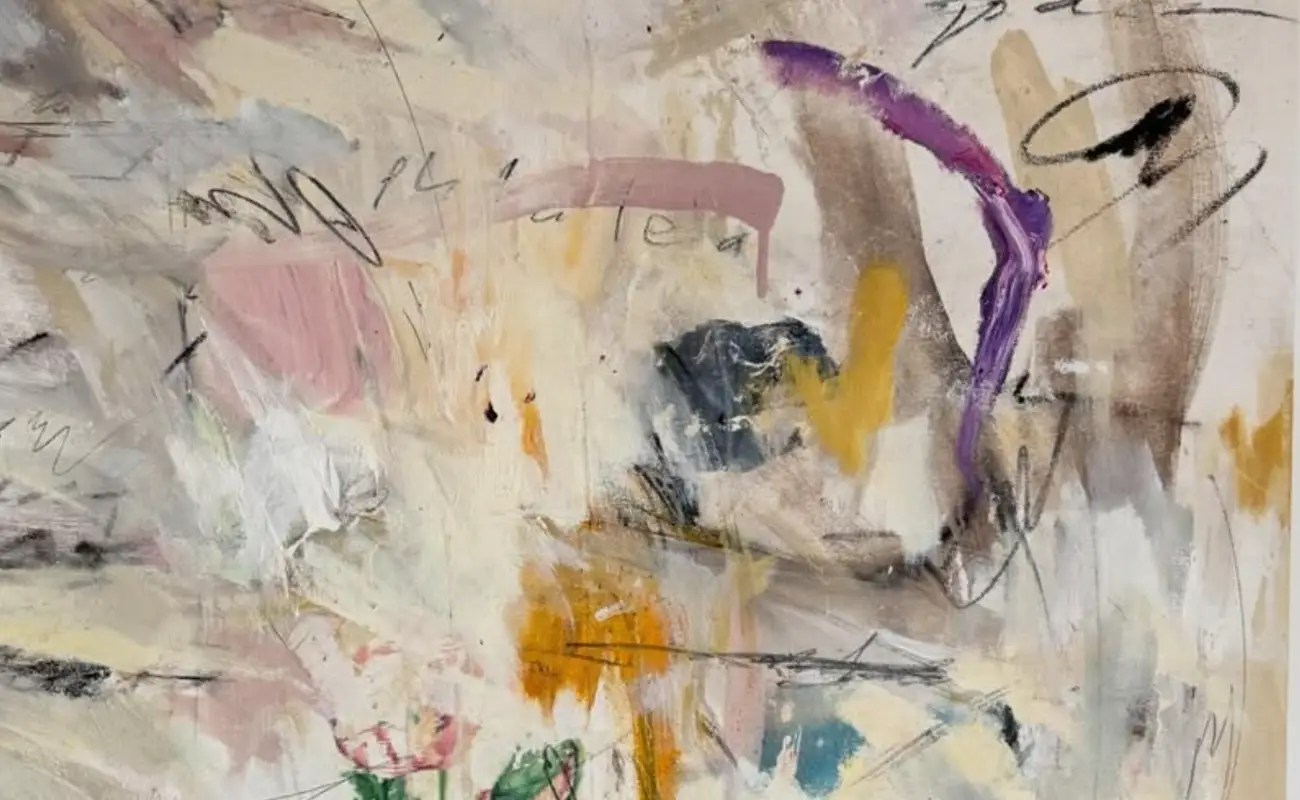
The material presence of Heyer’s paintings plays a major role in their impact. Layers of oil paint, acrylic, crayon, pencil, marker, and transferred photographic elements build dense visual fields where one action collides with another. He may scrawl words, bury passages under fresh pigment, scrape back surfaces, or allow drips to remain as evidence of movement. Because of this, the canvas becomes less a neutral support and more a site of accumulation. Every mark suggests another beneath it, and every concealment implies something hidden but not erased. This sense of buried activity gives the paintings a pulse that feels intensely human. Memory rarely arrives in orderly sequence, and Heyer’s surfaces mirror that reality. They hold interruption, revision, hesitation, and sudden confidence all at once. Even when no recognizable image remains, the viewer senses the presence of former structures. What survives is not narrative clarity but emotional residue, which can often be more powerful than literal description.
Although his work is abstract, it is not detached from the world. Heyer draws inspiration from pop culture, politics, architecture, philosophical inquiry, and the pressures of postmodern life. These sources do not appear as straightforward illustrations. Rather, they are absorbed into the visual atmosphere of the paintings, where remnants of the collective and the personal mingle without hierarchy. Architectural hints may rise beside ghostlike forms, while symbolic marks or partial text suggest communication interrupted. This method allows the paintings to remain open while still carrying contemporary tension. They can feel urban, reflective, restless, wounded, or unexpectedly tender depending on how the viewer enters them. Such flexibility explains why his work resonates across different contexts and audiences. Pieces from his practice have entered private collections around the world, and galleries in Europe and the United States have represented his work. Yet beyond geography or market presence, the lasting force of his paintings lies in their ability to hold complexity without reducing it.

Stefan Heyer: The Discipline of Instinct
Heyer’s process begins without the security of preparatory sketches, a choice that places decision-making at the center of creation. He works directly on canvas, allowing the composition to emerge through action rather than through a fixed plan. This approach gives each painting the feeling of unfolding in real time. Gestures are made, challenged, obscured, or intensified as the surface develops. What matters is not the execution of a prior blueprint but responsiveness to what the work demands in the moment. Such a method requires both courage and discipline. Spontaneity alone would lead to chaos, while excessive control would drain vitality. Heyer occupies the charged space between those extremes. He accepts accident but does not surrender to it. He permits disorder yet continually reshapes it. This dynamic tension grants his paintings their energy. The viewer senses movement, risk, and revision within the final image, as though the canvas still carries echoes of each turning point that brought it into being.
Found imagery often serves as an early catalyst in this process. Heyer has used photographic material connected to industrial settings, architecture, and figurative sources, transferring such elements to canvas through analogue means. These references are foundations rather than endpoints. Once embedded into the surface, they are subjected to layers of paint and drawing that transform them beyond direct recognition. A wall may become atmosphere, a figure may dissolve into rhythm, and a document of place may become an emotional climate. This transformation is crucial to understanding his practice. He does not preserve images as facts. He uses them as starting matter from which something less literal and more psychologically charged can grow. Additional materials, including textured components such as dried plants, may enter the work, extending the tactile complexity of the surface. Through these accumulations, the painting becomes neither picture nor collage in any simple sense. It becomes an evolving field where references survive only as echoes.
Heyer has described his paintings as “inner landscapes,” and that phrase offers a key to the balance he achieves between instinct and structure. These works do not depict geography in the conventional sense. Instead, they suggest emotional terrain shaped by recollection, tension, longing, and change. Broad gestures may read like weather systems, while small marks function like private signals scattered across a shifting ground. The artist’s control appears in compositional balance, pacing, and the strategic withholding of certainty. Large energetic passages are often countered by quieter zones where the eye can rest before moving again. Colors may flare, then recede into muted layers. A dramatic mark may be partly hidden, making concealment as expressive as revelation. This is why his abstractions feel inhabited rather than decorative. They carry the logic of lived experience, where clarity and confusion coexist. In Heyer’s hands, instinct is never careless, and control is never rigid.

Echoes of Music, Ruin, and Renewal
One of the most compelling ways to understand Heyer’s art is through its relationship to music. His paintings do not speak through literal language, yet they communicate with remarkable emotional force. Rhythm appears in repeated gestures, pauses emerge in quieter passages, and contrast functions like shifts in tone or tempo. Dense clusters of marks may create visual crescendos, while thin translucent layers can feel like sustained notes fading into space. This musical quality helps explain why viewers often respond before they can articulate why. The paintings operate through sensation first and interpretation later, if interpretation comes at all. Heyer values this condition because it keeps the work alive. Rather than dictating a message, he allows response to vary from person to person. Each viewer may notice different harmonies, tensions, or memories within the same canvas. In that sense, meaning is not delivered from artist to audience in one direction. It is completed through encounter, attention, and imagination.
Color is central to this experience. Heyer often moves between tenderness and volatility through unexpected combinations of hues. Soft pinks may sit beside acidic yellows, earthy ochres may meet bruised reds, and chalky whites may interrupt richer fields of pigment. Green can suggest growth in one work and unease in another depending on context. These relationships keep the emotional register unstable in the most productive sense. Nothing remains fixed for long. A passage that first appears buoyant may reveal melancholy after sustained looking, while a darkened area may suddenly feel protective rather than threatening. Such shifts are part of the intelligence of his palette. He understands color not as decoration but as atmosphere, pressure, memory, and psychological weather. Because many layers remain visible at once, earlier chromatic choices continue to influence later ones. The result is a complex vibration where past and present occupy the same surface.
Themes of ruin and renewal often hover around the edges of Heyer’s paintings. Architectural fragments, worn textures, and spectral traces can suggest spaces marked by time, conflict, or abandonment. Yet these signs are rarely bleak in a final sense. They are accompanied by gestures of rebuilding, flashes of brightness, and fresh movement that imply continuation after damage. This dual presence gives the work a contemporary relevance. Modern life frequently feels shaped by collapse and reconstruction, loss and adaptation, overload and reinvention. Heyer captures these conditions without turning them into slogans. He allows viewers to feel them instead. Even when references to politics or alienation are present, they remain woven into the painting rather than announced. That subtlety is a strength. It respects complexity and avoids simplification. His canvases become places where fracture and hope remain in conversation, neither canceling the other nor claiming complete victory.

Stefan Heyer: A Universal String Pulled Tight
Heyer once stated, “I want to pull a universal string,” and this phrase clarifies the ambition beneath his practice. He is not interested only in private expression, nor solely in formal experimentation. He seeks points of contact that can move across borders of language, nationality, class, and personal history. That goal carries particular weight when considered alongside his own path. Coming from a working-class background, he developed as a self-taught painter while supporting himself through various jobs. His route into art was built through persistence rather than institutional ease. Before dedicating himself fully to painting in 2008, he worked in fashion as an art and creative director. That experience likely sharpened his understanding of image, composition, and surface, yet his later painting practice moved toward slower and more searching forms of communication. The universal string he speaks of is therefore not abstraction for its own sake. It is connection achieved through feeling, material presence, and shared uncertainty.
The independent spirit that shaped Heyer’s development can also be linked to the DIY culture of the 1980s and 1990s, whose values of self-invention and resistance to gatekeeping left a lasting mark on many creative lives. Instead of rushing toward premature visibility, he appears to have favored the gradual construction of a personal language. That patience is evident in the maturity of his surfaces, where complexity arises from sustained labor rather than novelty alone. Every buried passage suggests time invested, reconsidered, and transformed. Such commitment stands apart in a culture that often rewards speed. His exhibitions across European cities including Hamburg, Berlin, Vienna, and Brussels, along with solo presentations such as those at Mono Gallery and Gudbergnerger in Hamburg, reflect recognition earned through long development. Yet even with growing international attention, the paintings themselves remain grounded in inquiry rather than spectacle. They continue asking difficult visual questions instead of repeating solved formulas.
What finally distinguishes Heyer is his refusal of closure. Many artworks seek to resolve tension, summarize meaning, or lead the viewer toward a predetermined conclusion. His paintings choose another path. They remain open enough to be revisited, reinterpreted, and emotionally reactivated over time. This quality gives them durability. A canvas encountered today may feel entirely different years later because the viewer has changed. Heyer leaves room for that evolution. Showing and hiding become equal gestures, remembering and forgetting become intertwined actions, and silence can speak as clearly as assertion. In this sense, his work mirrors life more honestly than art that pretends certainty. It accepts that people live among fragments, shifting contexts, and unresolved questions. By transforming those conditions into compelling visual form, Stefan Heyer creates paintings that do more than occupy walls. They become spaces where experience can gather, break apart, and begin again.