Signals in the Nightscape
Yoon Hyup stands among contemporary artists who have forged a visual language so distinctive that a few lines and dots can announce authorship immediately. Born in Seoul in 1982 and now based in New York City, he has built a practice that converts movement, sound, and urban atmosphere into vibrant compositions of rhythm and balance. His paintings, sculptures, and installations often appear simple at first encounter, yet they contain a carefully tuned sense of pace, spacing, and emotional temperature. Repeated marks become streets, pulses become windows, and color becomes memory. Through this method, he does not describe cities in a literal sense. Instead, he captures the sensation of being inside them, where crowds flow, lights flicker, and every corner carries its own tempo. That approach has made his work widely recognizable across continents. Whether shown in a gallery or encountered in public space, his images communicate optimism, momentum, and clarity while preserving the complexity of modern life within a refined abstract structure.
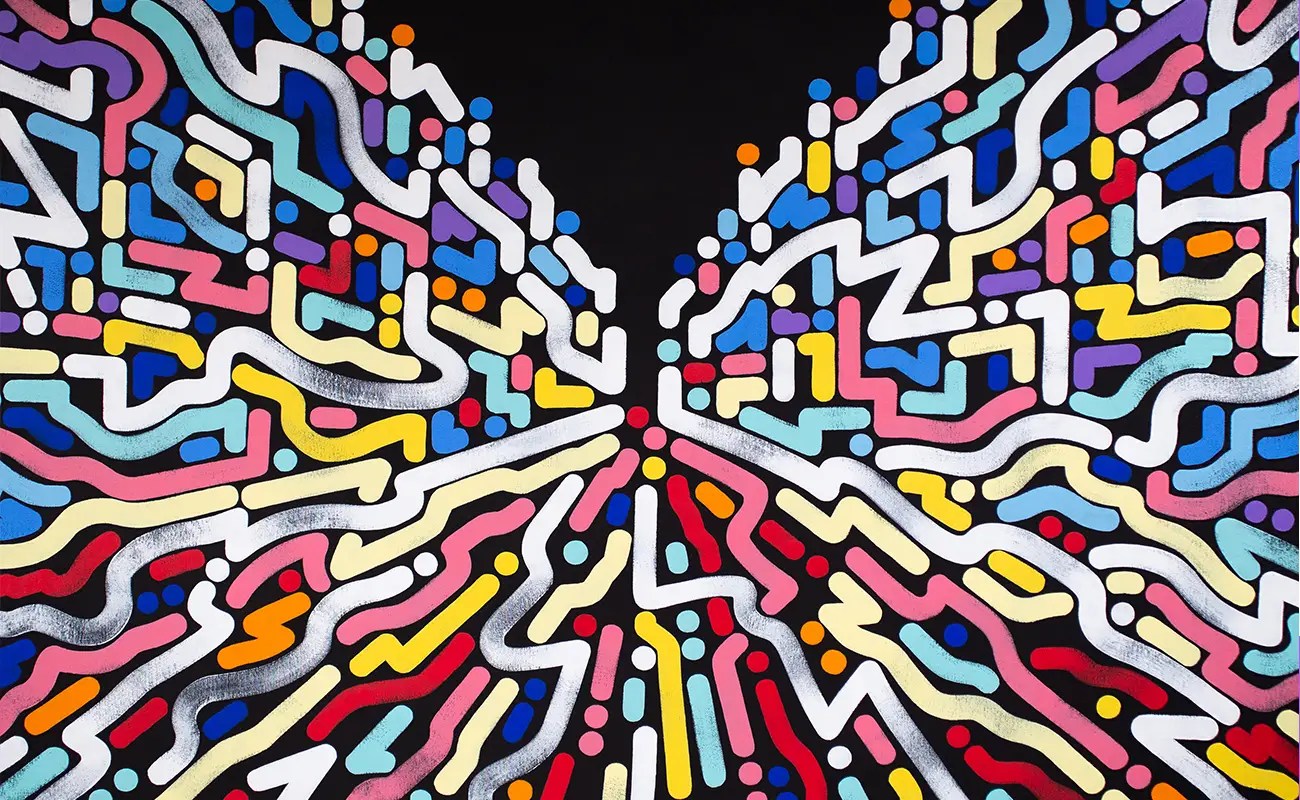
The strength of Hyup’s art lies in how modest visual elements are transformed into expansive experiences. Rounded bars, dotted accents, and bands of color can suggest skylines, traffic streams, waterfront horizons, or neighborhoods glowing after dark. Yet these references remain open rather than fixed, allowing viewers to project their own memories of movement through streets and public spaces. This flexibility gives his work broad emotional reach. Someone who knows Seoul may sense one atmosphere, while another viewer recalls New York, Tokyo, or London. Such openness reflects the artist’s understanding that cities are made not only of buildings but of perception, rhythm, and fleeting impressions. He often uses repetition and variation to generate energy across the surface, so the eye travels as if following a route through illuminated avenues. Even in still images, motion remains present. The result is art that feels active and alive, never frozen, always inviting another look to discover subtle changes in cadence and balance.
Across painting, sculpture, and installation, Hyup extends this same language into different forms without losing coherence. A canvas can hold concentrated atmosphere, while a sculpture allows rhythm to occupy real space and interact with viewers physically. Installations enlarge his ideas further, turning environments into fields of movement and color. This consistency across mediums reveals a mature artistic vision rather than a reliance on one technique. Harmony and coexistence are recurring themes, expressed through marks that remain distinct yet function together as a larger whole. Individual dots and lines keep their identity, but they also contribute to collective motion. That principle mirrors the life of cities themselves, where separate lives intersect within shared systems. Hyup’s art therefore carries social resonance without relying on direct narrative. It suggests that complexity can produce beauty when shaped through balance and responsiveness. In an era often defined by noise and fragmentation, his compositions offer a persuasive image of connected energy made visible through disciplined invention.

Yoon Hyup: From City Energy to Studio Precision
Hyup’s development outside conventional academic pathways is central to understanding his voice. Largely self-taught, he emerged through street culture and practical experience rather than formal institutional training. Since the early 2000s, he has worked across murals, live painting, and studio production, building knowledge through repetition, experimentation, and observation. This independent route helped preserve a sense of directness in his art. Instead of inheriting a fixed doctrine, he shaped methods responsive to real environments, changing surfaces, public encounters, and the immediacy of performance. Such origins remain visible in the confidence of his mark making and in the way his compositions feel simultaneously controlled and spontaneous. Street culture also gave him an understanding of scale, visibility, and public rhythm, all of which continue to inform his gallery work. Even when painting in the studio, there is often a sense that the image could expand outward onto architecture or urban infrastructure. His career demonstrates how alternative pathways can produce lasting sophistication and international relevance.
Skateboarding has played an especially meaningful role in Hyup’s perspective. Through it, he experienced the city not as a static map but as a living terrain shaped by balance, momentum, obstacles, and possibility. Moving through streets on a board changes one’s relationship to pavement, slope, texture, and speed, and these bodily experiences echo throughout his compositions. Lines glide, pause, accelerate, and redirect much like a rider navigating space. This connection between physical movement and visual rhythm helps explain why his paintings feel inhabited by motion even when entirely abstract. Skateboarding culture also values improvisation, resilience, and individual style, qualities that align closely with his artistic process. Rather than overstate perfection, Hyup allows subtle irregularities and shifts to generate character. Those slight deviations function like turns, jumps, or changes in pace. They prevent the work from becoming mechanical and keep the surface alert. In this sense, movement is not merely a theme in his art but a foundational way of thinking.
Music forms another lasting framework within Hyup’s practice. He has compared his process to improvisational performance, where each mark responds to the present moment instead of following a rigid prewritten formula. This musical attitude can be felt in the pacing of his compositions. Dots strike like percussion, elongated shapes move like melodic phrases, and color changes create tonal shifts akin to changing mood in a song. Jazz is an especially useful comparison because structure and freedom coexist there, just as they do in his paintings. The artist sets parameters, then works responsively within them. Such an approach gives the images freshness and immediacy while preserving compositional order. Viewers often sense that the painting has unfolded over time rather than being assembled mechanically. This temporal quality matters greatly. Hyup’s works are not only things to look at, but experiences that suggest duration, sequence, and pulse. They invite the eye to travel across the surface the way the ear follows rhythm through music.

Between Heritage and Global Streets
While deeply rooted in contemporary urban culture, Hyup’s work also reflects an awareness of traditional Korean aesthetics and symbolic uses of color. This dimension adds depth to compositions that might otherwise be read only through the lens of street art or modern abstraction. Clarity of arrangement, measured balance, and the meaningful deployment of hue can all be connected to broader cultural inheritances. Yet these references are never presented as nostalgia or decoration. Instead, they operate within a thoroughly contemporary vocabulary that also draws from global city life, nightlife, design culture, and modern image systems. The result is neither purely local nor generically international. It is a layered identity where multiple influences remain visible without competing for dominance. Such equilibrium has become one of Hyup’s strongest achievements. He demonstrates that cultural specificity and cosmopolitan experience can enrich one another. His paintings therefore speak to audiences across regions while retaining personal and historical grounding that prevents the work from becoming anonymous.
This dialogue between East and West is especially evident in how Hyup balances restraint with exuberance. Some compositions rely on open space, clean organization, and careful intervals between marks, while others surge with dense clusters of color and rapid directional flow. These contrasting tendencies create tension and vitality. They also mirror the experience of modern cities, where calm moments and sensory intensity often exist side by side. Hyup handles this contrast elegantly, ensuring that energetic passages never collapse into confusion and that quieter passages never become empty. The viewer senses both discipline and joy. Such balance may explain why his work moves comfortably between museum walls, private collections, commercial collaborations, and public commissions. It can satisfy formal scrutiny while remaining instantly approachable. In a global art landscape where many images compete for attention through excess, Hyup often achieves impact through measured confidence. His compositions know when to speak loudly and when to let silence amplify surrounding color and rhythm.
Color deserves special attention within this cultural synthesis because Hyup uses it as emotional architecture rather than surface embellishment. Electric blues can suggest night air or reflective water, warm yellows may recall windows and traffic light, reds bring urgency, while pinks and violets soften the tempo with atmospheric warmth. Frequently these hues appear against dark grounds, creating the sensation of illumination after sunset. This nocturnal brightness is one reason many viewers associate his work with memory and atmosphere rather than documentary description. Cities after dark often feel more symbolic than literal, and Hyup captures that psychological shift. The familiar becomes cinematic, ordinary routes become luminous paths, and architecture dissolves into rhythm. By allowing color to carry mood, he extends abstraction into lived feeling. The viewer may not identify a specific place, yet can recognize the emotional truth of passing through a city alive with possibility. That achievement places Hyup among artists who understand color as experience itself.

Yoon Hyup: A Global Language of Collaboration and Presence
Over two decades, Hyup has built a substantial international exhibition history spanning Asia, Europe, and the United States. Solo presentations have appeared in Paris, Hong Kong, Seoul, London, Tokyo, Milan, and New York City, reflecting both sustained demand and broad cultural resonance. Group exhibitions and art fairs have further extended his visibility through events such as Art Basel Hong Kong, The Armory Show, Frieze Seoul, and ART SG. These platforms are significant because they place artists before collectors, curators, critics, and global audiences in highly competitive contexts. Hyup’s continued presence within them indicates more than novelty. It suggests durability and a visual language capable of speaking across different art scenes. His inclusion in collections such as the Lotte Museum of Art and OAR Contemporary Art Museum reinforces that standing. Institutional acquisition often signals confidence in long-term relevance, and in Hyup’s case it acknowledges a body of work that has remained coherent while adapting to new scales, formats, and international settings.
Beyond galleries and museums, Hyup has become widely recognized through collaborations with major global brands including Dior, Tiffany & Co., Valentino, Apple, Nike, Uniqlo, Disney, and Maison Kitsuné. Such partnerships can be artistically shallow when imagery is merely applied as decoration, yet Hyup’s language adapts unusually well because it is already built from clarity, rhythm, and immediate visual recognition. His marks can animate retail environments, products, campaigns, or architectural surfaces without losing identity. This capacity speaks to the versatility of his practice. He understands how art can function in contemporary culture across many touchpoints while preserving authorship. Importantly, these collaborations have also introduced his work to audiences who may not encounter contemporary art through traditional institutions. A passerby entering a store, purchasing a garment, or seeing a campaign image can still experience his sensibility. In that sense, Hyup expands the circulation of art beyond specialist spaces and demonstrates how visual integrity can survive within commercial frameworks.
Large-scale public projects further reveal the immersive power of his ideas, including a six-meter interactive sculpture installation at Shanghai Times Square. Works of this kind translate his two-dimensional rhythms into shared civic experience. Instead of viewing from a distance, people move around the structure, encounter it unexpectedly, and become part of its changing visual relationships. Public art also places a higher demand on accessibility, durability, and spatial intelligence, all areas where Hyup’s concise language proves effective. Lines, dots, and color can communicate quickly while rewarding prolonged attention. Whether on canvas, in a plaza, or through design partnerships, he consistently turns rhythm and optimism into visible form. That consistency is perhaps the clearest measure of his achievement. Across shifting contexts, scales, and audiences, the core message remains intact: modern life, with all its speed and density, can still be organized into moments of harmony, pleasure, and collective energy.