The Studio as an Unwritten Stage
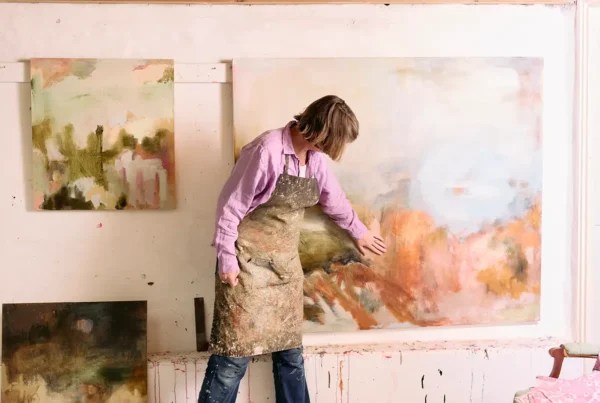
Gary Komarin has built a career around uncertainty, turning the act of painting into an encounter rather than a plan. Born in New York City to a Czech architect father and a Viennese writer mother, he inherited two powerful traditions: structure and language. Those influences can be sensed throughout his art, where disciplined composition meets suggestion, wit, and emotional openness. Komarin has often described himself less as a commander than as a stagehand who prepares the setting so that drama can appear on its own terms. That statement offers a key to his practice. His paintings are not rigidly designed in advance. Instead, they emerge through action, revision, hesitation, and surprise. Viewers are invited into that living process, where marks seem to test themselves and colors appear to negotiate their own place. The result is work that feels immediate yet seasoned, playful yet serious, and contemporary while carrying echoes of older artistic conversations that still matter today.
He has repeatedly explained that he paints to discover what he is going to paint. This philosophy separates his work from approaches driven by illustration or fixed narrative. For Komarin, the image is something uncovered through labor rather than imposed at the outset. Such an attitude demands courage because it allows failure to remain visible. He has even suggested that the strongest paintings are often those that fail the most, meaning that risk opens possibilities perfection cannot provide. In his studio, uncertainty becomes a productive force. Surfaces are pushed, interrupted, rebuilt, and tested until something independent begins to occur. When a painting seems to answer back, he regards that moment as success. This exchange between artist and object gives his canvases unusual vitality. They feel less like statements delivered from above and more like records of discovery, where decisions remain active and every gesture carries the memory of alternatives that could have happened instead.
Komarin’s place within post painterly abstraction is significant because he has refused to treat abstraction as a closed historical style. Many artists inherited that language as a set of solved problems, but he has used it as a flexible instrument capable of fresh emotion and meaning. His pictures often suggest forms without fixing them, allowing viewers to sense objects, symbols, landscapes, or private signs without certainty. That openness expands what painting can contain. Rather than narrowing interpretation, abstraction in his hands creates room for memory, humor, tension, and recognition that never fully settles. Critics have noted how his images can seem timeless, as though they belong both to the present and to some earlier visual memory. This balance helps explain his lasting appeal. Komarin does not merely continue a tradition. He renews it by proving that paint, when handled with honesty and nerve, can still surprise both maker and audience.

Gary Komarin: Materials of Urgency and Grace
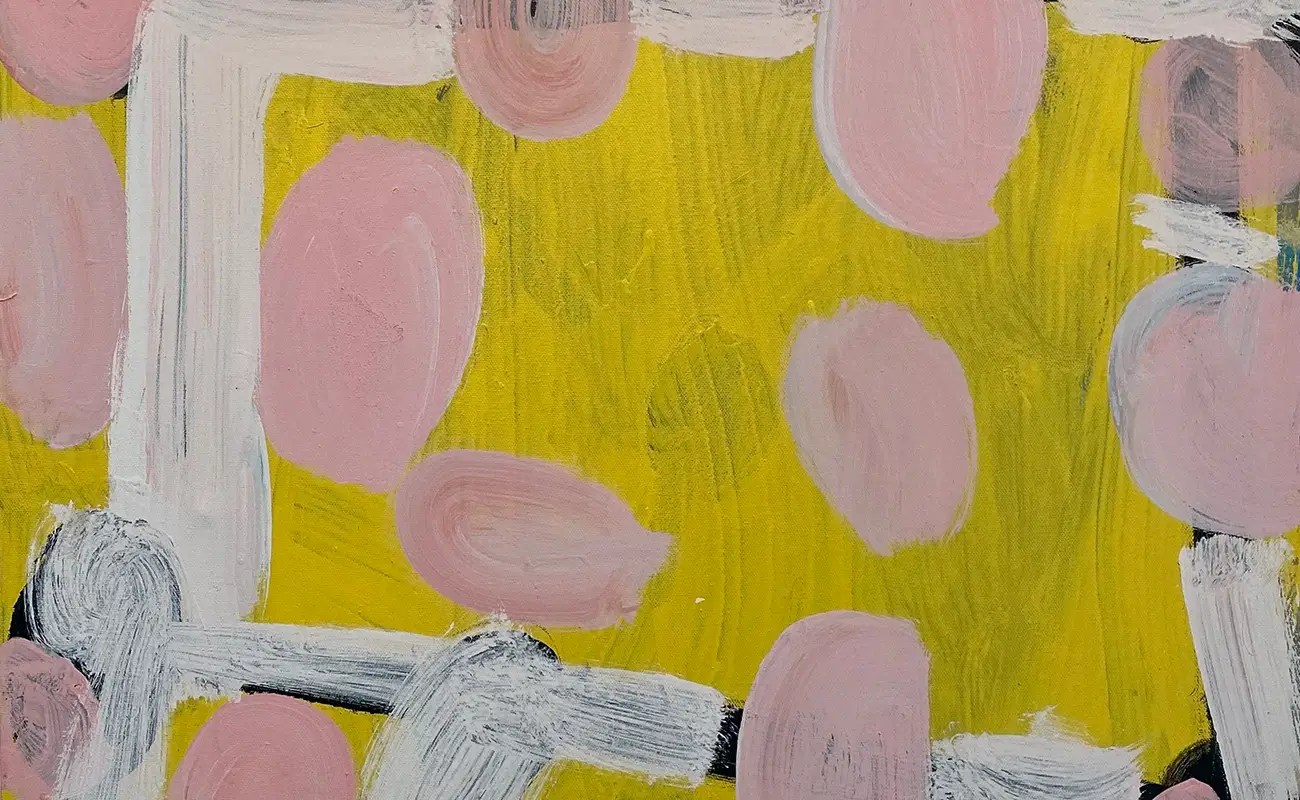
One of the defining features of Gary Komarin’s art is his preference for ordinary materials over precious ones. Instead of relying solely on traditional stretched canvas and conventional oil paint, he has often worked on industrial tarps, drop cloths, brown paper, and other humble supports. These choices are not gimmicks. They shape the mood and physical presence of the finished works. Such surfaces carry the marks of labor and use, bringing an earthy directness that polished materials might resist. Komarin has also employed latex house paint mixed with water and spackle, producing matte textures and colors that feel slightly skewed from standard fine art palettes. Those tones can appear familiar yet oddly displaced, a quality that mirrors the unstable identities of his forms. By embracing materials associated with construction rather than luxury, he aligns painting with work, improvisation, and daily life. The surface becomes less a sacred object and more an active site where invention can happen quickly and honestly.
The speed of these materials is crucial to his method. Fast drying paint does not permit endless hesitation, so decisions arrive with urgency. A line must stand, a stain must spread, a shape must be accepted or challenged in the moment. This tempo gives Komarin’s pictures their pulse. Viewers can sense a conversation between instinct and reflection, between swift action and later adjustment. Some passages appear almost accidental, while others reveal careful balance. That tension is central to the energy of the work. He often allows drips, rough edges, scraped zones, and unfinished transitions to remain visible, not as neglect but as evidence of process. Painting becomes a place where conscious intention meets forces that cannot be fully controlled. Such friction keeps the images alive. They never feel overmanaged. Instead, they carry the freshness of decisions made under pressure, tempered by the experience of an artist who knows when to intervene and when to let the surface continue speaking.
Komarin’s recurring imagery adds another layer to this material language. Cakes, vessels, awkward silhouettes, floating shapes, handwritten text, and emblematic forms appear throughout his paintings and monotypes. He once remarked on the remarkable variety he could draw from the cake format despite returning to it many times. That statement reveals his interest in repetition as transformation rather than sameness. The cake becomes comic, vulnerable, celebratory, architectural, or ghostlike depending on scale, color, and context. Vessel forms carry similar flexibility, suggesting containers, bodies, monuments, or memory. These images are never locked into one meaning. They function as triggers for association, allowing each viewer to bring personal responses. Because the symbols are simple yet unstable, they can hold surprising emotional weight. Komarin’s vocabulary therefore joins material roughness with psychological richness. The ordinary becomes poetic, and familiar shapes become vehicles for moods that language alone could never fully contain.

Across Museums, Cities, and Collections
Gary Komarin’s career has unfolded across an international network of exhibitions that confirms both the reach and relevance of his practice. He has shown extensively throughout the United States, the United Kingdom, Europe, and Asia, bringing his distinctive approach to audiences in multiple cultural settings. A notable chapter came with his solo museum exhibition at the Musée Kiyoharu in Japan. The related exhibition and catalog, Moon Flows like a Willow, were organized by the Yoshii Foundation in Tokyo and Paris, underscoring the global interest in his work. He was also invited to exhibit at the privately owned Musée d’Art Classique de Mougins in the south of France, where vessel works from Twenty Four Vessels at Kit Mandor were presented. These appearances matter because they place Komarin within conversations far beyond a single regional school. His paintings travel well precisely because they resist narrow explanation, offering viewers many entry points regardless of geography.
Important curated exhibitions have also connected Komarin to major figures in modern and contemporary art. In 1996, his work appeared in a pivotal show at 41 Greene Street alongside paintings by Jean-Michel Basquiat, Philip Guston, and Bill Traylor. Such company highlighted the seriousness of his contribution while revealing the broad range of artists with whom his work can productively converse. In 2009, he was invited to participate in a catalog exhibition in Dublin with Robert Motherwell and Sir Anthony Caro, and one painting from that event was later acquired by the Museo d’Arte Contemporanea di Roma. In 2016, he was included in a Denver exhibition with Joan Mitchell and Manuel Neri. These pairings are not merely prestigious names. They show that Komarin’s paintings can stand among artists associated with abstraction, figuration, sculpture, and expressive experimentation, reinforcing the versatility and depth of his visual language.
His art is also represented in many public, corporate, and private collections. Museums and institutions that hold his work include the Galleria Nazionale d’Arte Moderna in Rome, the Denver Art Museum, the Museum of Fine Arts Houston, the Museum of Contemporary Art San Diego, the Boise Art Museum, the Montclair Art Museum, the Newark Museum, the Zimmerli Museum, MAMBO in Bogotá, and the Musée Kiyoharu in Japan. Corporate collections have included Microsoft and other major companies, showing appeal beyond museum walls. Private collectors from New York, London, Zurich, Tokyo, Houston, Madrid, Los Angeles, and elsewhere have also acquired his paintings. This broad collecting base suggests a rare combination of critical respect and personal connection. Institutions value historical significance, while private collectors often respond to emotional immediacy. Komarin’s ability to engage both audiences demonstrates how his paintings can operate simultaneously as serious art objects and as intimate companions in lived spaces.

Gary Komarin: Legacy of the Open Image
Komarin has often been described as a painter’s painter, a phrase usually reserved for artists admired deeply by other artists for authenticity, intelligence, and sustained invention. In his case, the description points to a career grounded in commitment rather than fashion. He studied widely, including at institutions such as the New York Studio School, the School of Visual Arts, the Brooklyn Museum School, and Boston University, where he earned an MFA and worked with Philip Guston through a graduate teaching fellowship. Guston’s impact can be sensed in Komarin’s willingness to move between drawing and painting, humor and gravity, roughness and elegance. Yet influence never hardened into imitation. Komarin transformed inherited lessons into a language unmistakably his own. His pictures honor the freedom associated with the New York School while refusing nostalgia. They remain active, searching works made by an artist who understands history but is never trapped by it.
Recognition through awards and films has further marked the importance of his contribution. He has received honors including the Joan Mitchell Prize in Painting, a New York Foundation for the Arts Grant in Painting, the Edward Albee Foundation Fellowship in Painting, the Elizabeth Foundation Prize in Painting, and the Benjamin Altman Prize from the National Academy of Design Museum in New York. Documentary attention has also followed his career. Harry Moses, a producer connected with 60 Minutes, created the short film The Painter’s Path, offering insight into Komarin’s studio thinking and working life. He also participated in The Chalkboard Chronicles, narrated by Spalding Gray, and appeared in a documentary on Clyfford Still shown at the new Clyfford Still Museum in Denver, where Komarin’s work entered the permanent collection. Such projects indicate that his practice invites narrative because it combines visual achievement with a compelling philosophy of making.
Today, Gary Komarin lives and works in a house and studio in the wooded hills of Roxbury, Connecticut. That setting feels fitting for an artist whose paintings balance solitude with conversation. Removed from urban noise yet connected to an international audience, he continues to pursue images that resist final answers. The enduring strength of his art lies in this openness. He does not ask viewers to decode a fixed message. Instead, he offers spaces where memory, sensation, and interpretation can gather. A shape may resemble a cake, a vessel, a monument, or nothing named at all. A color may feel joyous and uneasy at once. Such ambiguity is not confusion but generosity. It leaves room for each encounter to become personal. In an era often driven by instant certainty, Komarin’s paintings insist on another value: the power of staying with what remains unresolved until it begins, quietly and unexpectedly, to speak.