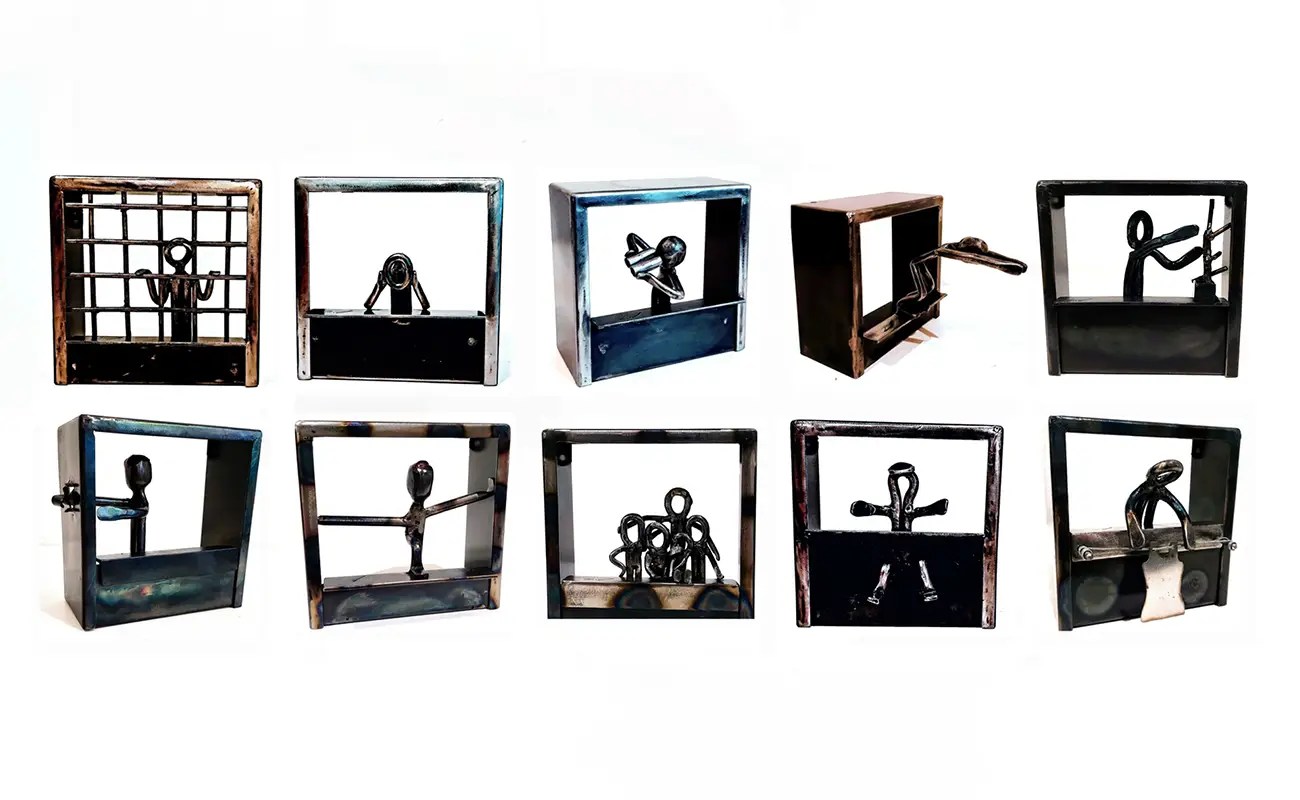
“Within a single frame, twenty three anonymous figures form a portrait of universal humanity that reflects experiences common to every human society.”
Shaping Meaning from a Resistant Material
Iron is rarely associated with tenderness or introspection, yet sculptor Ziv Ringer (Facebook page) transforms this demanding material into expressive narratives about the human condition. Working primarily with forged steel, he creates sculptures that range across abstract, figurative, decorative, and minimalist approaches while maintaining a strong conceptual foundation. Each piece reflects both physical discipline and thoughtful design, qualities essential when shaping metal through heat and force. Ringer employs classical blacksmithing methods that involve hammering hot iron on an anvil, but he also incorporates contemporary metalworking practices such as sawing, welding, grinding, and drilling. This combination of tradition and modern technique allows him to construct works that feel both grounded in craft and aligned with contemporary artistic language.
Behind this sculptural practice lies an unexpected professional history. Before dedicating himself fully to art, Ringer built a long career in the information and communications industry. After graduating in computer science in the early 1980s, he spent roughly three decades working in development, marketing, and senior management roles within the technology sector. Such environments require precision, strategic planning, and careful execution. These habits later proved highly valuable when applied to sculpture, particularly when dealing with iron, a material that offers little forgiveness for careless decisions. The discipline acquired in technology and business continues to influence how he conceptualizes and constructs his artworks today.
Family background also contributed significantly to the development of his sensibilities. Ringer’s father worked as a craftsman and taught technical subjects, introducing him early to the satisfaction of building objects with skill and accuracy. His mother fostered a deep appreciation for order and visual harmony, encouraging attentiveness to aesthetic balance. Together, these influences shaped a mindset in which technical skill and artistic awareness operate side by side. When Ringer approaches a sculpture, he brings both engineering logic and artistic intuition, enabling him to navigate the complex relationship between structural stability, surface refinement, and expressive intent.

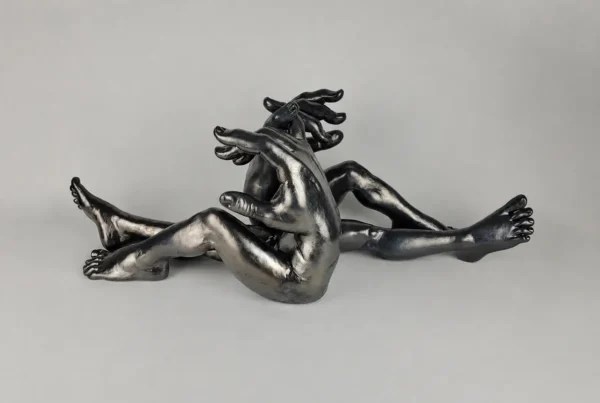
Woman lying down, homage to a sketch by Ahron Shoshani
Ziv Ringer: From Workshop Curiosity to Personal Studio
The transition from technology professional to sculptor did not occur through a sudden decision but through a gradual process rooted in curiosity and enjoyment. Ringer’s first encounter with ironwork came when he joined a group workshop that offered instruction in metalworking techniques. Initially, the experience functioned purely as a hobby. He experimented with forms, constructed small objects, and explored the possibilities of shaping iron through heat and hammer. The collaborative nature of the workshop proved particularly meaningful. Working alongside others fostered mutual encouragement, the exchange of ideas, and a sense of creative discovery that kept him returning to the forge.
Over time, this informal exploration developed into a more serious commitment. Roughly five years ago, Ringer established his own iron studio and began working independently. Creating in a personal workspace gave him freedom to refine techniques and pursue ideas at his own pace. Through sustained experimentation he developed working methods that gradually formed the basis of a recognizable personal style. Instead of strictly following conventional blacksmith traditions, he began integrating various processes to achieve surfaces and structures that matched his aesthetic goals. The studio became both laboratory and workshop, a place where craftsmanship and imagination interact continuously.
His stylistic approach centers on what he describes as a contextual aesthetic. Iron possesses inherent hardness and resistance, characteristics that make delicate detail difficult and sometimes unnecessary. Rather than attempting to mimic softness through excessive ornamentation, Ringer chooses to emphasize broader visual narratives. The sculptures focus on gesture, posture, and interaction, allowing the viewer to understand the story even when small details are simplified. At the same time, he invests significant effort in refining the surfaces of his pieces. Grinding, polishing, and smoothing remove visible joints and imperfections produced by forging and welding. Through techniques such as color fixing of heated iron and the insertion of brass inlays, he produces unexpectedly smooth textures that contrast strongly with the industrial character of the raw material.

Observing Humanity Through Iron Figures
Human figures occupy a central place in Ringer’s artistic vision. His sculptures frequently portray characters who embody emotional and psychological qualities that many people recognize in themselves. Determination, competitiveness, perseverance, and endurance appear regularly within his compositions, often balanced by quieter experiences such as loneliness, despair, or defeat. These themes allow the sculptures to function as reflections of human life rather than simple representations of bodies. Iron becomes a medium through which familiar struggles and aspirations take visible form, encouraging viewers to reflect on their own experiences.
Irony also plays an important role in the way these figures are presented. Ringer often places characters in unusual or unexpected situations that subtly question everyday behaviors. These arrangements may appear humorous at first glance, yet they frequently reveal deeper insights about ambition, vulnerability, or contradiction within human nature. The artist incorporates elements that may feel surreal, playful, or occasionally dark. Such contrasts help create emotional complexity within each work. A viewer might experience amusement while simultaneously sensing tension or unease, a dual reaction that invites longer contemplation.
Inspiration for these ideas arises from multiple sources. Fellow artists and the creative communities he encounters at exhibitions provide an ongoing stream of visual and conceptual stimulation. Exposure to diverse artistic approaches encourages him to reconsider familiar techniques and refine his own methods. However, the strongest influence remains everyday life. Conversations, encounters, and observations gradually evolve into sculptural concepts. Small moments witnessed in ordinary environments often ignite the first spark of an idea. Through reflection and experimentation in the studio, those impressions transform into finished sculptures that attempt to capture the complexity of human behavior.

Ziv Ringer: The Story Within “Living Together”
Among Ringer’s many sculptures, one piece holds particular personal significance. The work, titled “Living Together,” presents a dynamic composition that captures multiple aspects of human existence within a single frame. Constructed entirely from steel, the installation gathers twenty three anonymous figures in one carefully structured scene. None of these figures possesses identifiable gender, age, or cultural background. That anonymity is intentional. By removing individual markers, Ringer created a representation of humanity as a whole rather than a portrait of specific individuals or communities.

Within the composition, each figure performs a distinct action or occupies a different emotional state. Some characters appear engaged in moments of joy or celebration, while others confront struggle, uncertainty, or isolation. Scenes of cooperation exist alongside tension and conflict. Optimism and faith share space with drifting or loss. Through these contrasts, the sculpture reflects the diversity of human experience. Each figure can be understood as a snapshot of a particular moment, yet together they form a larger narrative that explores how people coexist, support one another, and sometimes collide within shared social spaces.
The physical scale of “Living Together” reinforces its narrative ambition. The installation measures seventy eight centimeters in height and one hundred eighteen centimeters in width, dimensions that encourage viewers to approach closely and examine each component figure. From a distance the composition appears as a unified arrangement, yet closer inspection reveals a multitude of small interactions. Ringer regards the sculpture as an expression of the experiences that connect people across cultures and generations. Victories, struggles, relationships, and losses exist beneath the surface of daily life. By presenting these elements side by side within a single work, he offers a visual meditation on what it means for individuals to exist together within the same human story.