
“C6_4827 encapsulates many defining aspects of my visual language: a commitment to abstraction, process-driven experimentation, and a dialogue between landscape and narrative.”
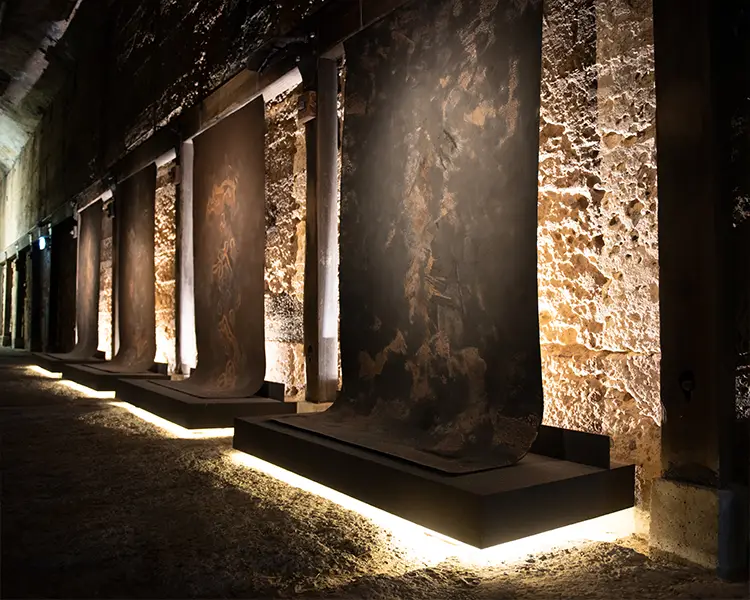
C6_4827, 2019
Installation Drawing and Mixed Media
Material Presence and the Poetics of Space
Chris Bowman (Instagram) has built a practice defined by abstraction, physical engagement, and a sustained investigation into rhythm, structure and narrative. Working across drawing, photography, installation, sculpture, and time-based media, he constructs environments where image and structure become inseparable. His approach resists static interpretation, instead inviting viewers into places where surfaces shift, oxidise, and respond to their surroundings. Years of experimentation with large scale drawing and image making have refined a visual language that balances reduction with expressive intensity. Through this language, Bowman examines how gesture can become both trace and event, and how space can function not merely as a backdrop but as an active participant in meaning. The result is a body of work that situates abstraction within lived experience, connecting landscape, architecture, and narrative through carefully considered processes that foreground material transformation.
Central to Bowman’s’ development is a deep commitment to process driven exploration. His drawings often emerge through sustained physical movement, where the act of mark making becomes performative and immersive. Paper, graphite, pigment, and industrial compounds are not passive supports but active agents that respond to pressure, gravity, and time. Oxidising substances introduce unpredictability, allowing chemical reactions to continue long after the initial gesture has been made. This emphasis on transformation reflects his ongoing interest in the tension between stability and disruption. Surfaces appear restrained and near monochromatic at first glance, yet closer inspection reveals layered complexities shaped by duration and environmental conditions. In Bowman’s hands, abstraction becomes a philosophical inquiry into order and chaos, inviting viewers to consider how material change mirrors broader cycles of growth, decay, and renewal.
Landscape also operates as an anchor throughout his practice. Rather than depicting scenery in a descriptive manner, Bowman approaches landscape as a shifting condition shaped by perception and memory. Working across Australia, New Zealand, United Kingdom, Europe, India, Japan, Chile and Thailand, he moves between observation and abstraction, often employing extreme shallow depth of field to obscure literal reference. Colour, structure, and compositional rhythm come to the fore, transforming geographical sites into fields of sensation. This approach aligns with his broader interest in how environments can be reframed through light, refraction, surface, and spatial intervention. By reducing visual information and amplifying material presence, Bowman encourages a heightened awareness of place that transcends straightforward representation, positioning landscape as both physical terrain and psychological construct.
“In Notation 5 (The Pool of Lethe) sequence plays a pivotal role in framing a dialogue between the three photographic panels – it gave me the structure to create a metaphorical tension between light and darkness, memory and presence”

Notation 5 (The Pool of Lethe), 2025
Photography
Chris Bowman: C6_4827 and the Alchemy of Oxidation
C6_4827, created in 2019 for the North Sydney Art Prize, stands as one defining work within Bowman’s extensive oeuvre. Composed of paper (Fabriano Artistico 640 gsm), light, timber, graphite, pigment, and rust compounds, the project synthesised years of research into large scale drawing and expanded image making. Awarded for its innovation and impact, the piece investigates gesture, the physicality of mark making, and the agency of a specific architectural site, the North Sydney Coal Loader. Bowman employed oxidising compounds to generate near monochromatic abstract surfaces that appear at once restrained and volatile. These surfaces continue to change over time, as the oxidation process remains active, ensuring that the drawings resist finality. In this way, C6_4827 embodies duration, impermanence, and material evolution, reinforcing Bowman’s conviction that artworks can function as living entities rather than fixed objects.
“Individually, each panel in C6_4827 creates an intimate space that draws the viewer deeper into the work – it is an invitation to immerse themselves in the rich drawn surfaces and spectral forms figures that emerge and disappear as the viewer traverses the work.”
The creation of C6_4827 demanded full bodied engagement. Bowman’s movements across the paper emphasise the act of drawing as a performance. The resulting forms seem to rise from within the surface, suggesting spectral presences. Gesture becomes both image and residue, recording the energy of its making while inviting contemplation. Installed within one of the historic tunnels of the Coal Loader, the four large scale works were suspended in procession, scaled precisely to the architectural apertures to create a cohesive spatial intervention. Viewers moved through a sequence of illuminated planes that responded to the sandstone and timber structure, creating a dialogue between contemporary abstraction and industrial heritage.
Light played a crucial role in extending the drawings beyond their physical boundaries. Bowman deployed architectural lighting to illuminate the textures and oxidised foundations, causing subtle shifts in tone and depth as viewers progressed through the tunnel. In this context, light functioned simultaneously as material and structural element, shaping perception and reinforcing the immersive quality of the installation. The surfaces echoed the surrounding architecture, yet they also disrupted it, introducing an atmosphere that felt contemplative and charged. C6_4827 encapsulates many defining aspects of Bowman’s visual language, including his commitment to abstraction, process-based experimentation, and the interplay between landscape, mythology, and philosophy. The work’s dynamic balance between order and chaos continues to inform subsequent projects, including large scale works such as The Awakening which extends his exploration of scale, sequence, and immersive abstract photography.
“In The Awakening (2020), I blend drawing and photography to reinterpret the Orpheus myth, creating a triptych of shifting topographies that portray the Gates of Aornum as a delicate threshold for the human condition. The title refers to the pivotal moment in the Greek myth Orpheus when doubt emerges, framing these gates as a fragile boundary for this momentous event”

The Awakening, 2020
Drawing and photography
Systems of Influence and Expanding Abstraction
Bowman’s artistic formation began in a creative household where experimentation with materials formed part of everyday life. Both of his parents sustained active art practices, fostering an environment where visual inquiry was encouraged and supported. A pivotal moment occurred at nineteen when his grandfather gifted him a camera, igniting a lifelong engagement with photography understood as painting with light. The camera introduced new ways of constructing images and perceiving that which is hidden within, laying the groundwork for his multidisciplinary direction. Undergraduate studies at Liverpool Art School broadened his exploration across drawing, painting, printmaking, photography, mixed media, experimental film and animation, establishing a foundation that would later expand through postgraduate study at the Royal College of Art in London.
At the Royal College of Art, Bowman concentrated on experimental film and temporal media, deepening his understanding of rhythm, duration, and structural progression. Influences from Structuralism, Minimalism, Constructivism, Postminimalism, Process Art, and Land Art shaped both his conceptual framework and aesthetic decisions. Artists such as Richard Serra’s investigations into weight and balance reinforced the importance of physical encounter. Paul Klee’s diagrammatic systems, Richard Long’s engagement with landscape and duration, and László Moholy-Nagy’s integration of light and technology in his Light-Space Modulators further expanded his thinking and art practice. The mid century collective Group Zero and early filmmakers Walter Ruttmann and Viking Eggeling contributed to his understanding of sequence, a language of abstraction and narrative progression, elements that remain visible and reframed in his tiled configurations and serial installations.
Photography continues to serve as both document and transformation within Bowman’s practice. Sculptures inspired by Moholy-Nagy and Group Zero, constructed from steel and perspex, are often illuminated by animation and dynamic light projection, generating motion and refraction that he later reframes and records photographically through still images. The camera freezes fleeting configurations, revealing spectral forms and abstract essences embedded within surfaces and mechanical structures. Contemporary figures such as Wolfgang Tillmans and Hiroshi Sugimoto resonate in his expansion of photography into spatial experience, while Julie Mehretu’s layered systems parallel his own ongoing investigations into abstraction. Conceptually, the Orpheus myth, with its universal human themes of love, descent, loss, return, art and death underpin many of Bowman’s works. This Greek myth is a tragedy, rich in metaphor and allegory around the human condition and its frailty that is relevant today and resonates through Bowman’s practice as illustrated in his triptych The Awakening.
This compliments Bowman’s engagement with Zen Buddhist teachings—particularly the concept of Śūnyatā, or emptiness—deeply informs his understanding of interdependence and impermanence. This philosophical grounding shapes his approach to form, space, and time, and is often evident in his abstract photographs and drawings. In these works, emptiness is expressed both as a material reality and a state of mind, evoking the essence of Sunyata while foregrounding process and transience.
“For me photography is ‘drawing with light’, a transformative act that reshapes both documentation and form. I use my sculptures and light mechanisms as a lens, through which I explore concepts of form and emptiness that often result in capturing spectral forms and ethereal traces of light”

apparat_Licht .04, 2020
Photography
Chris Bowman: Thresholds, Rhythm, and Future Trajectories
Daily practice for Bowman moves between studio, digital workspace, and fieldwork. Analogue and digital processes inform one another in a continuous feedback loop, where rapid prototyping and image interrogation refine compositional decisions. Instagram operates as an evolving archive in which the grid becomes both stabilising framework and disruptive device, allowing Bowman to consider visual sequences that are deconstructed and reconstructed in real time. The physical studio supports drawing, material experimentation, and mixed media installation development, while the digital studio functions as a site for editing, sequencing, and structural analysis. Fieldwork anchors these explorations in direct experience, grounding abstraction in encounters with specific geo landscapes, urbanscapes, and architecture.
“I am mainly concerned with topography. Photographs like “Liminal Space .01,” transform the elements of structure, and surface into rhythmic abstractions that capture the emotional essence of a place and reveal its topological patterns stretching their meaning beyond representation based on geographical precision.”

Liminal Space .01, 2024
Photography
Multiple projects often unfold simultaneously, linked by shared conceptual concerns yet expressed through varied formats. Large scale works on paper and board, fine art photography , light sculptures, installations, film, and animation coexist within a broader investigation into rhythm and structure explored through Bowman’s refined visual language of abstraction. Sequencing plays a central role, reflecting his background in experimental film and animation where progression shapes meaning and exploring that which is hidden and revealed within this highly experimental process. Russian Constructivism, particularly Malevich’s redefinition of spatial perception, informs his approach to building visual cadence across surfaces and images. Through repetition and variation, Bowman constructs nonlinear narratives that encourage viewers to navigate works as experiential journeys rather than static compositions. This method allows ideas to migrate across a range of media
His forthcoming project, Thresholds at the Edge of Time, extends this trajectory by approaching landscape as an evolving topology tracing hidden rhythms where form emerges not as fixed structure but through continuous variation within a field of forces shaped by differential relations and temporal flux. Working across a variety of mixed media Bowman seeks to explore notions of terrain and topology as both material presence and an aesthetic proposition. The project investigates how structure and temporality intersect, proposing that boundaries between them are continually defined and unsettled. By emphasising transformation and duration, he foregrounds the instability inherent in all forms. This direction builds upon the principles embodied in C6_4827 and The Awakening, and other works such as Liminal Space 01 and Notation_03 – Thresholds at The Edge of Time, reaffirming his deep commitment to abstraction as a means of examining existence and the shifting relationship between order and chaos. Within this framework, entropy operates as a conceptual lens, expressing how each composition navigates the tension between structure and unpredictability, where increasing visual complexity reflects a movement from order toward controlled chaos.
“In “Notation_03 – Thresholds at the Edge of Time,” 2026, I combine digital drawing and photography to explore hidden terrain and topology. The works in this series engage in a dialogue between landscape and narrative where past, present, and future intersect, creating boundaries and thresholds of transition.”