“Art is a vibrant conversation—a synthesis of cultures, experiences, and reflections.”
Origins of a Cross Cultural Vision
The trajectory of May Yeung’s artistic life unfolds across continents, histories, and disciplines, forming a practice shaped by movement and layered identity. Born in Australia, raised in Hong Kong, and later transformed by a decade in the United States, she carries within her a convergence of cultural perspectives that informs every sculpture she creates. Her academic years at the University of Chicago, where political science met visual arts, sharpened her awareness of how environments influence perception. For Yeung, art is never isolated from context. It emerges from the in between spaces where geography, memory, and personal history intersect. This sensitivity to place allows her sculptures to function as vessels of lived experience rather than static objects. Each work becomes a reflection of migration, adaptation, and the search for coherence within multiplicity, positioning her as an artist whose language transcends borders while remaining deeply personal.
From early childhood, creativity offered Yeung a steady undercurrent of expression. She began engaging with art at the age of three, long before she possessed the vocabulary to articulate why it mattered. Over time, exposure to aesthetic movements such as Pop Art and Impressionism expanded her visual lexicon. The bold chromatic intensity associated with Pop Art introduced her to the emotional potential of color, while Impressionism encouraged sensitivity to atmosphere and fleeting sensation. These influences did not remain confined to painting but migrated into her sculptural vocabulary. Color in her work is never incidental. It functions as an emotional register, a way to suggest vitality, fragility, or reflection. Through this interplay of vibrancy and restraint, Yeung constructs forms that appear both grounded and ethereal, inviting viewers to consider how memory and sensation coexist within physical matter.
Her artistic direction gained further clarity through profound personal encounters with illness and trauma, particularly experiences related to cancer. Rather than rendering these events in overtly dramatic imagery, Yeung channels them into distilled symbols that contemplate life and death as interconnected forces. The late Henri Matisse serves as a guiding presence in this evolution. His approach to cutouts, in which form and color emerge simultaneously, resonates with her own sculptural process. She embraces the idea of reducing a subject to its essential sign, carving and shaping material until only the core gesture remains. Through this disciplined simplification, Yeung achieves emotional resonance without excess. The result is a body of work that communicates vulnerability and resilience through contour, hue, and carefully considered space.

May Yeung: Form Filtered to Its Essence
Central to Yeung’s sculptural language is a commitment to clarity. She gravitates toward undulating silhouettes and calligraphic curves that evoke movement without literal representation. This affinity aligns her with Matisse’s philosophy of cutting directly into color, allowing shape to carry meaning without heavy modeling. In Yeung’s practice, contour becomes destiny. Saturated blues and vibrant greens define many of her compositions, echoing both aquatic serenity and botanical vitality. These forms hover between abstraction and symbolism, functioning as visual emblems rather than descriptive replicas. Viewers are encouraged to sense rather than decode, to experience emotion before analysis. Through disciplined reduction, she avoids visual clutter and instead foregrounds the power of a single gesture. Such restraint amplifies the psychological weight of her sculptures, proving that simplicity can hold remarkable expressive depth when guided by intention and reflection.
Material choices further reinforce her exploration of contrast and harmony. Painted wooden bases provide structural stability, anchoring the more delicate elements that rise from them. Cold porcelain flowers introduce a sense of fragility, their pale surfaces suggesting impermanence and tenderness. Polyfibre and glass occasionally extend this dialogue, creating subtle tensions between transparency and opacity. These combinations generate a quiet conversation between endurance and transience. Wood conveys durability and craft, while porcelain hints at vulnerability. By uniting these materials within cohesive compositions, Yeung transforms physical contrast into metaphor. Her sculptures embody the coexistence of strength and delicacy, echoing the dualities that define her thematic concerns. This thoughtful interplay underscores her belief that meaning resides not only in form but also in the tactile relationships between surfaces.
The work titled Hear Monet stands as a poignant example of her synthesis of influence and introspection. Inspired by a transformative visit to the Maison et Jardins de Claude Monet, Yeung sought to translate the sensation of light shimmering across water into three dimensional form. Crafted from cold porcelain and resting upon a carefully constructed wooden base, the sculpture evokes a water lily suspended in contemplative stillness. Its palette, dominated by French ultramarine and cobalt blue, captures both depth and luminosity. Subtle references to Japonisme echo Monet’s own fascination with Japanese aesthetics, while the sculpture’s clarity of outline reflects Yeung’s commitment to distilled form. Scheduled for presentation at Collect Hong Kong in March 2026, Hear Monet embodies her meditation on beauty’s fleeting nature and the enduring imprint of experience.

Bridges Between Nature and Memory
Research and observation shape Yeung’s daily practice as much as hands on fabrication. Sketches, photographs, and studies of historical artworks form the conceptual groundwork for each new piece. Inspired by Japanese woodblock masters Hiroshige and Hokusai, May will present her work “Izumi” at Art Central this year, reflecting her keen appreciation for compositional clarity and sensitivity to negative space. The iconic Japanese Bridge at Monet’s garden also continues to inform her thinking, symbolizing connection and passage. These references are not quoted directly but absorbed into her sculptural grammar. Through careful planning and carpentry, she transforms preliminary ideas into tangible objects that maintain a sense of spontaneity. The process becomes a rhythm of reflection and construction, allowing intuition and structure to coexist productively.
Her current project, Blue Bridge, extends this fascination with connection. Conceived with a palette of viridian and emerald green, the piece seeks to capture harmony within natural landscapes while acknowledging their fragility. The bridge motif suggests transition, inviting viewers to contemplate movement between states of being. Scheduled for exhibition at the National Art Centre, Tokyo, in June 2026, Blue Bridge reflects Yeung’s ongoing dialogue with Japanese visual traditions and her commitment to cultural exchange. The sculpture does not merely depict a structure; it embodies the psychological act of crossing from one perspective to another. Through curvature and chromatic nuance, she constructs an atmosphere of contemplation that feels both intimate and expansive.
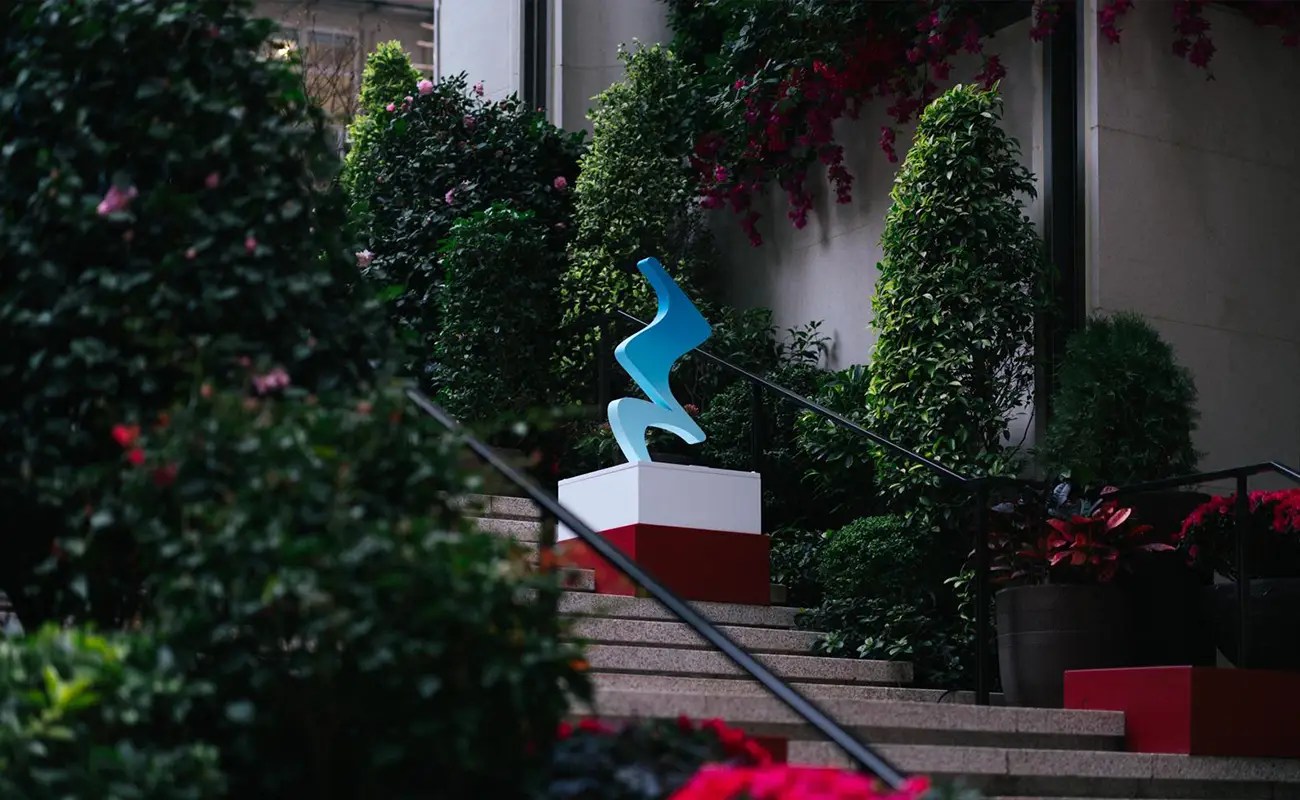
Nature functions in Yeung’s oeuvre not as background but as collaborator. Outdoor installations such as Hear the Flowers Sing demonstrate her sensitivity to environmental context, positioning sculptural forms in conversation with foliage and architectural lines. The surrounding landscape becomes an active participant, shifting the perception of color and shadow throughout the day. Earlier works like Musical Compass reveal her capacity to scale up without sacrificing lyricism, maintaining fluid gestures even within monumental dimensions. Citation, an installation created in 2012 within ecclesiastical architecture, introduced punctuation like forms that hinted at language and pause. This early exploration of communication beyond words foreshadowed her later emphasis on distilled symbolism. Across diverse settings, Yeung’s sculptures continue to affirm that space, memory, and material can merge into unified expression.
Following her collaboration with the French May Arts Festival, May Yeung presents Silence in Full Bloom at the Carrousel du Louvre. The work subtly merges Impressionist and musical influences: pastel blues and violets inspired by Claude Monet, a quarter rest carved from fir wood that echoes the ethereal rhythms of Claude Debussy, and a cold porcelain magnolia symbolizing dignity and perseverance. Conceived as an inclusive visual experience, the piece invites viewers to reflect on the shared space between silence and sound, stillness and movement.

May Yeung: A Conversation in Color and Silence
Duality remains the conceptual anchor of Yeung’s artistic vision. Life and death, silence and bloom, solidity and air coexist within her compositions without hierarchy. Personal encounters with vulnerability have sharpened her sensitivity to these contrasts, yet her works resist melodrama. Instead, serenity prevails. Color becomes a quiet declaration of presence, while negative space suggests absence without despair. This equilibrium allows viewers to approach complex themes through contemplation rather than confrontation. By transforming intimate experiences into universal symbols, Yeung extends an invitation to reflect on shared human fragility. Her sculptures do not prescribe meaning; they open space for interpretation, encouraging a personal dialogue between artwork and observer.
Cultural synthesis also defines her perspective. Experiences across Australia, Hong Kong, and the United States have cultivated an awareness of how identity shifts within different social contexts. Rather than treating these influences as separate strands, she integrates them into cohesive visual statements. References to Western modernism coexist with East Asian compositional principles, producing an aesthetic that feels both rooted and fluid. This integration is evident in her disciplined outlines, her reverence for color, and her sensitivity to environmental placement. Through sculpture, Yeung demonstrates that cultural exchange can generate clarity rather than confusion. Each piece becomes a testament to the possibility of unity within diversity, reinforcing her belief that art functions as a bridge across difference.
At the heart of her practice lies an enduring conviction that art is a living conversation. Every sculpture contributes to an evolving dialogue between past and present, artist and audience, memory and material. Hear Monet and Blue Bridge stand not only as individual achievements but as milestones within a continuing exploration of perception and impermanence. By shaping wood, porcelain, and pigment into distilled gestures, Yeung constructs spaces where viewers may pause and listen. Within these quiet forms, echoes of gardens, bridges, illness, and resilience intertwine. Her work affirms that when essence is revealed with clarity and care, it possesses the strength to resonate far beyond the boundaries of the studio.