Suspended Realities in Contemporary Chinese Painting
In an era saturated with rapid imagery and instant consumption, Zhiyong Jing stands apart through a practice grounded in stillness and introspection. Based in Beijing, he has cultivated a distinctive visual language that transforms quiet scenes into emotionally charged encounters. Rather than pursuing spectacle, he constructs environments where the boundary between lived experience and imagined space becomes porous. Educated at the Tianjin Academy of Fine Arts, where he completed his Bachelor of Fine Arts in oil painting in 2005 after graduating from its affiliated high school in 2001, Jing refined a disciplined technical foundation that now supports his poetic sensibility. His paintings invite viewers to slow their gaze and inhabit an atmosphere shaped less by narrative clarity than by emotional resonance. Within contemporary Chinese art, his voice feels measured and contemplative, offering an alternative to overt dramatization through images that whisper instead of proclaim.
This commitment to restraint shapes every aspect of his compositions. Human figures frequently appear diminished within expansive landscapes or architectural settings, suggesting vulnerability without overt tragedy. Roads stretch toward distant horizons, snow-bleached plains extend into silence, and anonymous storefronts glow under artificial light. In one striking image, a lone astronaut floats in an immense field of oceanic blue, a surreal presence rendered with calm precision. In another, a solitary man stands against a windswept ochre expanse, his posture conveying quiet displacement. These scenarios do not rely on theatrical gestures; instead, they cultivate existential distance through scale and emptiness. Jing positions his subjects at the periphery, encouraging contemplation of what lies between them and the surrounding void. The result is an art of suspension, where meaning arises gradually through atmosphere rather than explicit storytelling.
Architecture functions as more than a backdrop in these settings. Stark white buildings without windows, domed structures in barren terrain, and minimalist interiors illuminated by yellow light operate as psychological counterparts to the figures they accompany. These geometric forms suggest modernity’s promise of order and protection, yet they also convey detachment. Clean edges and simplified volumes project control, while the vast emptiness around them introduces uncertainty. In one composition, a man stands beneath a sign that reads “SELL THIS WORLD,” holding currency in his hand. The message hovers between satire and existential commentary, reinforced by the stark setting. Jing resists overt explanation, allowing ambiguity to linger. Through such carefully orchestrated contrasts between structure and isolation, he articulates a contemporary sensibility that recognizes both the stability and fragility of human experience.

Zhiyong Jing: Painting the Emotional Logic of Dreams
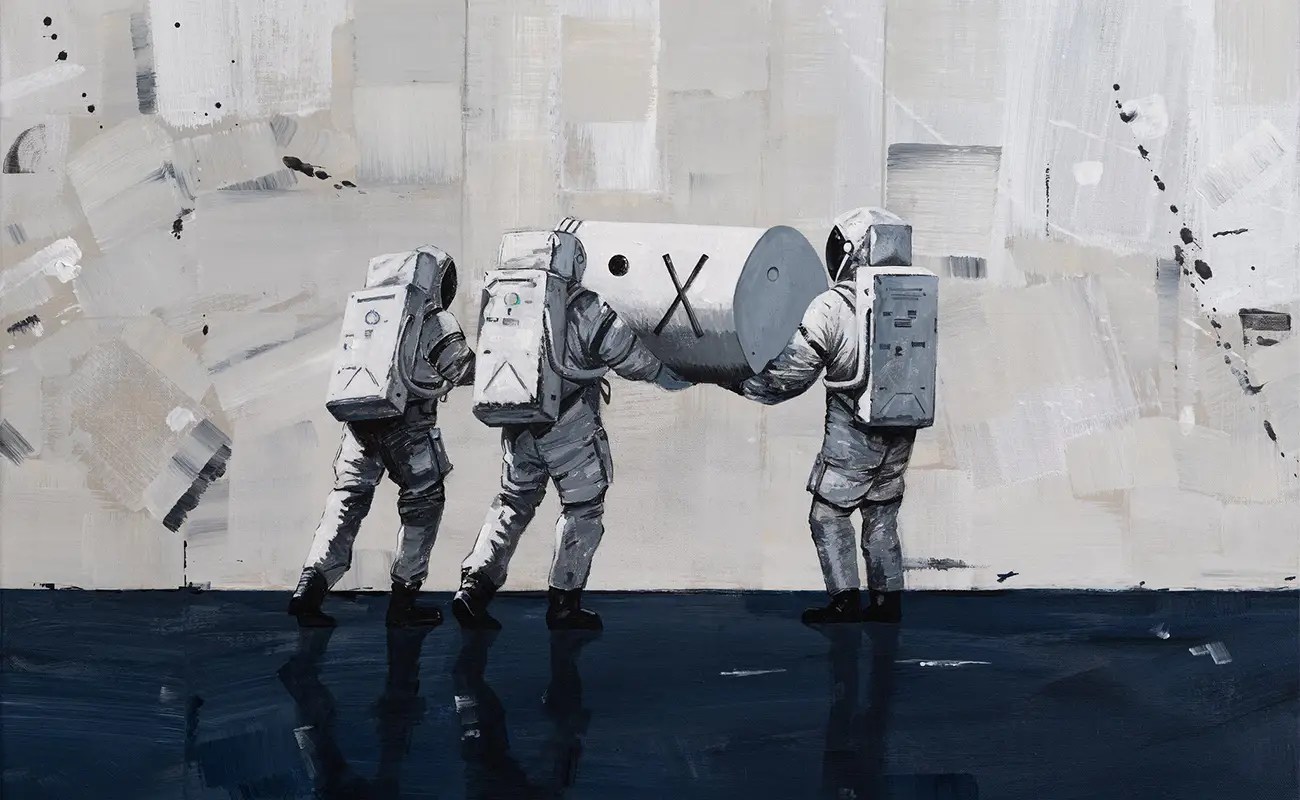
Dream imagery forms a central thread in Jing’s practice, guiding both his symbolism and compositional choices. He paints not only visible scenes but also the inner landscapes of hope, longing, and absurdity. Figures often avert their gaze, conceal their faces, or appear partially dissolved, as though recalled from memory rather than observed directly. This diffusion generates a sense of intimacy while preserving mystery. Instead of constructing linear narratives, he assembles images that follow emotional logic. Astronauts carrying an anonymous capsule marked with an “X” traverse quiet terrain, their mission undefined yet suggestive. A self-portrait mediated through a handheld mirror introduces questions of identity and self-perception. These motifs resist fixed interpretation, inviting viewers to engage with their own subconscious associations. Jing’s paintings resemble fragments of dreams that linger upon waking, coherent in feeling even when elusive in explanation.
Ambiguity in his work does not produce confusion; rather, it fosters psychological depth. Surreal elements integrate seamlessly into realistic environments, blurring distinctions between fact and imagination. A man spreading a vivid red swath across an otherwise neutral space transforms pigment into both gesture and metaphor. The red interrupts muted tones with decisive intensity, embodying emotion made visible. Elsewhere, subtle shadows and ghostlike forms appear less as threats than as traces of memory or attachment. These presences hint at vulnerability and introspection without resorting to melodrama. Jing’s approach aligns with an understanding of dreams as reflections of inner truth, where contradictions coexist naturally. Serenity and danger, absurdity and tenderness share the same canvas, mirroring the volatility of human thought. Through this synthesis, he turns surrealism into a personal language rooted in lived emotion.
Cinema further informs his approach to image construction. Scenes feel edited rather than staged, as though extracted from a larger, unseen sequence. Influences from directors known for atmospheric pacing and psychological nuance can be sensed in the stillness of his frames. A doorway, shoreline, or horizon line becomes a threshold charged with anticipation. Figures rarely act; they pause, suspended between decision and consequence. This sense of arrested time heightens the emotional weight of each gesture. Jing allows viewers to inhabit that interval, where reflection replaces action. The dreamlike quality of his compositions therefore functions not as escapism but as a mode of inquiry. By merging cinematic structure with painterly subtlety, he creates images that resonate long after they are seen, sustained by their quiet intensity and layered suggestion.

Color, Space, and the Poetics of Restraint
Color operates in Jing’s paintings with deliberate economy, reinforcing mood through limitation rather than excess. Expansive blues, desaturated earth tones, and chalky whites dominate his palettes, punctuated occasionally by a bold intrusion such as the striking red mentioned earlier. These restrained tonal choices heighten the emotional significance of each variation. Yellow interior light glowing against surrounding darkness recalls mid-century realist painting while maintaining a contemporary clarity. Surfaces appear smooth at first glance, yet subtle brush textures remain visible, grounding the images in physical process. This balance between refinement and material presence prevents the work from feeling sterile. Through careful modulation of hue and light, Jing cultivates stillness that feels inhabited rather than empty, encouraging sustained observation and emotional engagement.
Spatial isolation further amplifies the psychological dimension of his art. Figures placed at the edges of vast settings convey introspection without overt despair. Shorelines, intersections of road and sky, windows, and doorways recur as transitional motifs. These liminal sites suggest movement or transformation, yet the characters within them often remain motionless. The drama resides in suspension rather than event. A sense of quiet wonder accompanies this stillness, offsetting the solitude embedded in many scenes. By embedding his subjects within tranquil environments, Jing maintains a delicate equilibrium between melancholy and hope. The viewer perceives longing, yet also the possibility of renewal. This nuanced treatment of space transforms emptiness into a field of contemplation rather than absence.
The interplay between absurdity and lyricism distinguishes Jing’s visual vocabulary. An astronaut adrift in blue waters or a man confronting a vast ochre field might appear incongruous at first glance, yet these scenarios unfold with calm conviction. Absurdity becomes a mirror for contemporary dislocation, while beauty tempers its severity. Through this tension, he articulates emotional truths that feel widely relatable. His paintings do not insist upon a single interpretation; instead, they create conditions for reflection. The quiet surfaces conceal layers of introspection, inviting viewers to project personal memories onto the scenes. Such openness strengthens the work’s resonance, allowing it to function as both individual expression and shared experience. Color and space thus converge as vehicles for empathy and introspection.

Zhiyong Jing: Liminal Spaces and Contemporary Introspection
At the core of Jing’s artistic identity lies a fascination with thresholds, where clarity dissolves into ambiguity and imagination feels more persuasive than fact. This preoccupation with liminality shapes both subject matter and mood. Figures inhabit transitional zones that seem suspended between departure and arrival. The horizon line becomes a metaphor for uncertainty, while architectural facades suggest both refuge and isolation. His contemplative surreal realism synthesizes compositional clarity with symbolic openness, creating works that are accessible yet enigmatic. Rather than overwhelming the viewer with visual noise, he cultivates concentration. Silence in his paintings carries expressive weight, transforming absence into presence. Through this restrained intensity, Jing captures the contradictions of contemporary life, where connection and alienation coexist.
Themes of longing, isolation, hope, and quiet wonder recur throughout his oeuvre, yet they remain understated. Emotional states are embedded in gesture and atmosphere rather than declared outright. A figure holding currency beneath the provocative declaration “SELL THIS WORLD” prompts reflection on value and commodification without prescribing judgment. Astronauts bearing a capsule marked with an “X” evoke mission and mystery simultaneously. These images hover between satire and sincerity, resisting reduction to simple allegory. Jing trusts viewers to navigate uncertainty, allowing meaning to emerge through contemplation. His refusal to overstate emotion underscores a confidence in subtlety. The paintings reward prolonged engagement, revealing new associations over time.
Working and living in Beijing, Jing continues to refine a practice grounded in introspection and disciplined craft. His academic training in oil painting provides technical assurance, yet his vision remains rooted in personal inquiry. Dreams, memories, and fragments of observation intertwine within carefully balanced compositions. The absurd coexists with the poetic, and solitude is tempered by beauty. Through sustained attention to color, scale, and atmosphere, he constructs images that hum with quiet vitality. Zhiyong Jing’s art does not seek to escape reality; it reframes it through contemplation. Within the measured cadence of his paintings, viewers encounter not spectacle, but a profound invitation to pause and reflect.