The Ecology of the Inner Landscape
Contemporary art often addresses environmental crisis through images of pollution, decay, and climate anxiety, yet Dmitry Ligay approaches the subject from a more intimate and psychological perspective. Rather than focusing solely on visible ecological damage, he examines the condition of the human mind within a culture shaped by overconsumption and relentless stimulation. His work proposes that the environment does not exist only outside the body but also within it, influencing perception, emotion, and identity. By framing consciousness as a living system subject to contamination and renewal, Ligay positions himself within a thoughtful discourse on modern existence. His images invite viewers to reconsider their place in a society saturated with information and material desire, suggesting that mental clarity requires the same care as any physical habitat.
This emphasis on the “hygiene of the soul” defines much of his artistic inquiry. Ligay constructs visual narratives that question how individuals maintain integrity amid constant pressure from media, commerce, and ideology. The aggression of contemporary culture, along with its promises of utopian fulfillment, becomes a recurring undercurrent in his compositions. Figures appear suspended between attraction and resistance, shaped by invisible forces that press upon their bodies and thoughts. In this way, he addresses the tension between autonomy and external influence, portraying the self as both resilient and vulnerable. The surrounding world is not depicted simply as background scenery but as an active participant in shaping identity, sometimes nurturing and sometimes overwhelming.
Human consciousness and subconscious impulses form the core of Ligay’s imagery. He is particularly interested in how unseen mental processes respond to environmental stimuli, whether social, architectural, or technological. Through layered symbolism and carefully constructed compositions, he visualizes the metaphysical dimension of everyday life. The viewer is encouraged to read each work slowly, observing how objects, textures, and fragments of urban life intertwine with the human figure. This method transforms his illustrations into meditations on perception itself. Rather than presenting clear moral judgments, Ligay offers complex visual fields that mirror the intricate structure of thought. His art becomes a reflective surface where cultural noise and inner awareness meet, creating a dialogue that feels both urgent and contemplative.

Dmitry Ligay: From Architectural Foundations to Illustrative Vision
Dmitry Ligay was born and raised in Tashkent, in the Republic of Uzbekistan, where his early academic path shaped his disciplined approach to art. In 2007, he graduated from the Tashkent Architecture and Civil Engineering Institute, an education that grounded him in structural thinking and spatial awareness. Although architecture and engineering may seem distant from illustration, these studies instilled in him a sensitivity to form, proportion, and compositional balance. Shortly after completing his degree, he began focusing on illustration, gradually refining a personal style that merged classical draftsmanship with contemporary concerns. This transition marked the beginning of a professional journey that would connect him with international clients and establish his reputation as a versatile visual thinker.
Beginning in 2010, Ligay entered into collaboration with the Moscow based Bang! Bang! studio illustration agency, expanding his reach within the editorial and commercial art world. Over the years, he worked with prominent magazines, agencies, and companies across Russia and Asia, including GQ, Men’s Health, Rolling Stone, Snob, Yandex, Leo Burnett, and BBDO. His experience also extended to social projects and global campaigns, reflecting a capacity to adapt his conceptual language to diverse contexts. For fourteen years, he balanced assignments between cities such as Moscow and London, building a portfolio that demonstrated both technical mastery and conceptual depth. This period of commercial practice strengthened his understanding of audience engagement while allowing him to maintain a distinct artistic voice.
Since 2020, Ligay has dedicated himself primarily to original works, shifting his focus from commissioned projects to independent artistic exploration. This decision allowed him greater freedom to investigate themes of overstimulation and psychological saturation without the constraints of external briefs. His background in architecture continues to inform his compositions, which often display a clear structural logic beneath their visual complexity. At the same time, his long experience in illustration ensures that each piece communicates with clarity and precision. The synthesis of these influences has resulted in a body of work that feels both carefully constructed and emotionally charged, bridging the gap between design discipline and expressive imagination.

Collage, Consciousness, and Controlled Excess
Central to Ligay’s practice is his distinctive fusion of traditional drawing techniques with digital processes. He frequently begins with pencil sketches, watercolor washes, or acrylic paint, grounding his images in tangible materials. These elements are then refined and expanded through Photoshop, allowing him to layer textures, adjust tonal relationships, and introduce subtle visual interventions. The result is neither purely analog nor entirely digital but a cohesive hybrid that reflects contemporary modes of image making. In addition to painting and drawing, he creates collages that combine disparate fragments into unified compositions. Through this interplay of mediums, he demonstrates both technical flexibility and conceptual coherence, proving that innovation often arises from the thoughtful combination of established methods and modern tools.
The human figure occupies a central position in many of his works, serving as a site where environmental and psychological forces converge. Faces are rendered with striking emotional depth, capturing expressions that suggest introspection, tension, or quiet resilience. Around and within these figures, Ligay integrates meaningful objects and symbols that expand the narrative dimension of each piece. Architectural fragments, organic forms, and elements drawn from contemporary culture intertwine, producing layered visual stories. Despite the density of imagery, his compositions retain a sense of balance, reflecting his commitment to classical aesthetics interpreted through a modern lens. No two works appear identical, yet they share a recognizable visual language rooted in careful observation and imaginative transformation.
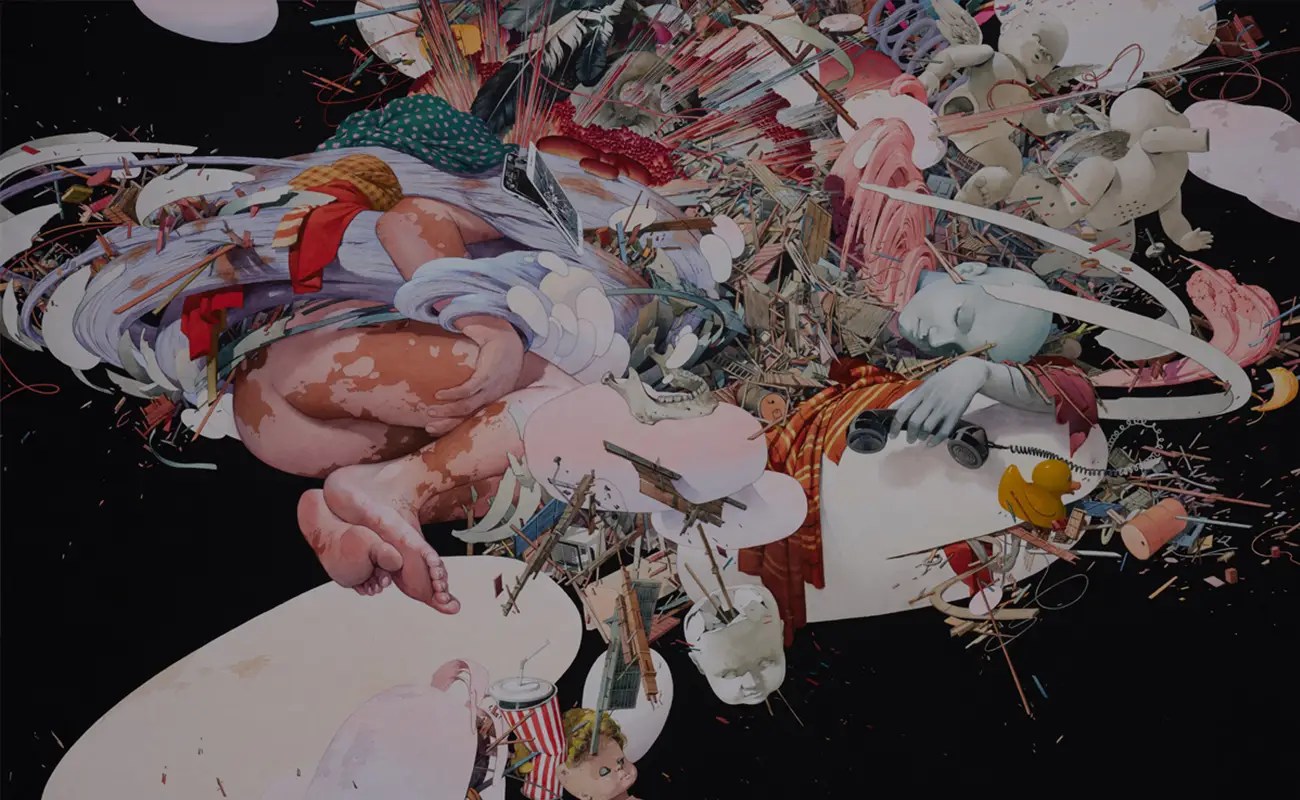
Accumulation plays a significant role in his visual strategy. Bodies sometimes seem to dissolve into cascades of objects, flora, fauna, and remnants of consumer culture. Domestic items, technological traces, and natural elements coexist within the same pictorial space, blurring distinctions between inner life and external surroundings. This abundance does not descend into chaos because it is guided by precise draftsmanship and spatial awareness. Textures are handled with sensitivity, distinguishing the softness of organic matter from the sharp edges of manufactured materials. Such contrasts heighten the thematic tension between nature and consumption. By orchestrating these dense arrangements, Ligay presents excess not merely as visual spectacle but as commentary on the layered pressures shaping contemporary consciousness.

Dmitry Ligay: Toward Visual Detox and Reflective Space
In his more recent works, Ligay has introduced expanses of white space that function almost like areas of pause within the composition. These open zones create a sense of calm that contrasts with the intricate clusters of imagery surrounding them. The effect resembles a visual breathing exercise, encouraging viewers to slow their gaze and reflect. Subtraction becomes a deliberate gesture, suggesting that restraint can carry as much meaning as abundance. Within these quieter passages, the eye finds relief from the intensity of detail, reinforcing the idea that mental clarity requires moments of stillness. Through this approach, Ligay subtly proposes that reducing noise, whether visual or informational, may serve as an act of personal and cultural resistance.
Color also contributes to this evolving sensibility. Vibrant reds and neon greens occasionally punctuate his compositions, echoing the urgency of contemporary life, yet they are balanced by muted greys, soft beiges, and earthy tones that temper the overall impact. Gold appears sparingly, often in fine linear accents that guide the viewer’s attention rather than dominate the scene. These chromatic decisions demonstrate his understanding of how palette influences emotional response. Instead of overwhelming the senses, he calibrates intensity with restraint, creating harmony within complexity. This careful orchestration underscores his commitment to thoughtful image making, where every tonal shift carries conceptual weight.
Encountering Ligay’s art requires patience and attentiveness. His works reward close inspection, revealing subtle details that might otherwise remain unnoticed. Small symbolic elements, delicate transitions of light, and hidden visual references contribute to a multilayered reading experience. Such intricacy reflects his belief that excess can be transformed into meaning through sustained observation. By inviting viewers to engage deeply rather than glance superficially, he challenges the rapid consumption habits that define much of modern culture. In this way, Dmitry Ligay’s artistic practice becomes both mirror and remedy, capturing the complexity of contemporary consciousness while offering a path toward introspection and renewed awareness.