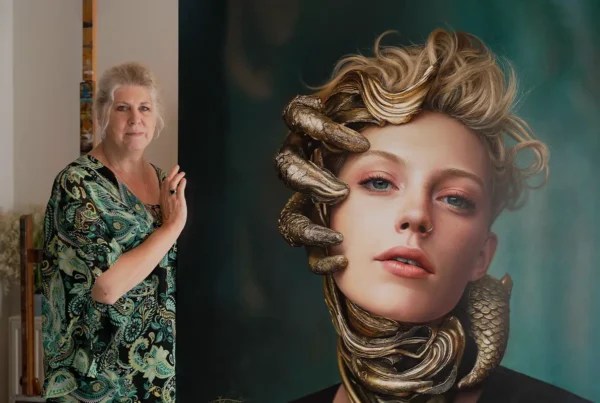
“I see my paintings like a doorway that invites you to step through with me—into a memory that keeps breathing, a space that keeps talking, and a story that keeps finding new endings in your gaze.”
The Silent Language of Spaces
In the evocative paintings of Irina Poloni, everyday interiors evolve into meditative spaces that bridge presence and memory. Working primarily with acrylic on canvas, she transforms objects, gestures, and rooms into living entities that breathe with introspection. Her art speaks a language of representation where observation merges with emotion, allowing light and shadow to communicate unspoken stories. Each scene feels like a suspended instant, poised between what has happened and what might unfold. This stillness, quiet yet charged, compels the viewer to pause and reflect.
The artist’s focus on human presence and domestic environments imbues her work with both intimacy and universality. People and objects coexist in subtle narratives that explore connection, isolation, and longing. These vignettes, defined by delicate lighting and precise composition, extend beyond the physical to evoke the inner landscapes of thought and memory. Her painterly technique—balancing disciplined structure with expressive looseness—reveals the harmony between control and spontaneity.
Poloni’s attention to material quality and archival integrity underscores her belief in painting as both craft and contemplation. The precision of her drawing, paired with the freedom of her brushwork, creates a rhythm of restraint and release. This balance mirrors the emotional cadence within her subjects: moments of introspection offset by flickers of revelation. For Poloni, painting is not merely an act of depiction but an ongoing meditation on perception itself.

Irina Poloni: The Art of Inner Vision
Irina Poloni’s journey began in Bucharest, a city whose textures, lights, and architectural contradictions became her first visual teacher. Trained at the Academy of Arts in Bucharest, she learned to translate observation into structure and emotion into form. Her early experiences among the city’s courtyards, boulevards, and markets shaped her sensitivity to place and time—qualities that continue to infuse her work. When she later moved to Switzerland, the shift in landscape invited introspection, compelling her to rediscover her own artistic rhythm.
Her practice reveals an artist deeply invested in the dialogue between exterior and interior worlds. The move from Romania to Switzerland became not just a relocation but a reorientation. It demanded she listen more closely to her instincts, reframe her questions, and rediscover how memory informs creation. The act of painting turned into an act of remembering—a process that fuses personal history with universal human experience.
Poloni’s paintings often explore the tension between familiarity and estrangement. Rooms appear both inhabited and vacant; figures are absorbed in private thought. Doors, windows, and thresholds act as recurring motifs, suggesting transition, hesitation, and possibility. Through these architectural metaphors, she examines how individuals navigate between the visible and the invisible, between reality and imagination.

Painting Time, Space, and Story
Across her oeuvre, Irina Poloni engages with cultural and emotional narratives that traverse literature, cinema, and music. Each painting unfolds like a stage where memory performs its quiet drama. Works such as “Johnny And Mary” (2023) reinterpret Robert Palmer’s song as a portrait of emotional disconnection in the digital age, where intimacy dissolves into parallel solitude. The juxtaposition of light, gesture, and symbolic imagery transforms the everyday into a meditation on longing and distance.
In “Entre Deux Portes” (2023), inspired by George Banu’s reflections on thresholds, Poloni explores duality—the meeting of inner retreat and outer exploration. Her composition holds two worlds in tension, yet united by a luminous coherence. Similarly, “Half-Open Doors” (2024) portrays a transitional moment, where light pierces darkness and ambiguity becomes a metaphor for choice and potential. These works invite the viewer to linger within their uncertainty, to inhabit the pause between movement and stillness.
Through paintings like “Kazuo Ohno” (2023) and “Lost In Venice” (2024), she honors the emotional gravity of performance and memory. Whether depicting a dancer’s spiritual discipline or puppets as symbolic witnesses, her images transform observation into empathy. Each composition holds fragments of cultural dialogue—gestures from theater, traces of literature, echoes of song—woven into the tactile immediacy of paint.

Irina Poloni: The Poetics of Reflection
Irina Poloni describes herself as a “slow painter,” one who approaches each work as a meditative conversation rather than a task. Her studio functions as both sanctuary and laboratory, where observation transforms into revelation. The interplay of light and shadow within her canvases is never decorative; it defines emotion, creating spaces that feel alive and resonant. Through restraint and nuance, she invites viewers to sense time not as linear but layered, as if memory itself had texture.
Her painting “Mistaken For A Hat” (2022), inspired by Oliver Sacks’s book, exemplifies this contemplative approach. The scene captures a character in quiet confrontation with perception, evoking the fragility of recognition and the poetry of human awareness. In another work, “Two Damn Fine Cups Of Coffee” (2025), a casual domestic scene becomes a hymn to the beauty of simplicity—coffee cups, sunlight, and fleeting calm elevated into timeless significance.
Poloni’s art envisions painting as a threshold between seeing and feeling. Her acrylic surfaces carry the residue of thought, gesture, and emotion, shaping a visual dialogue between artist and observer. Each image becomes an invitation to awareness, a pause in which light recalls the persistence of memory. Through her quiet yet powerful vision, Irina Poloni continues to explore how painting can hold both stillness and transformation within a single frame.