
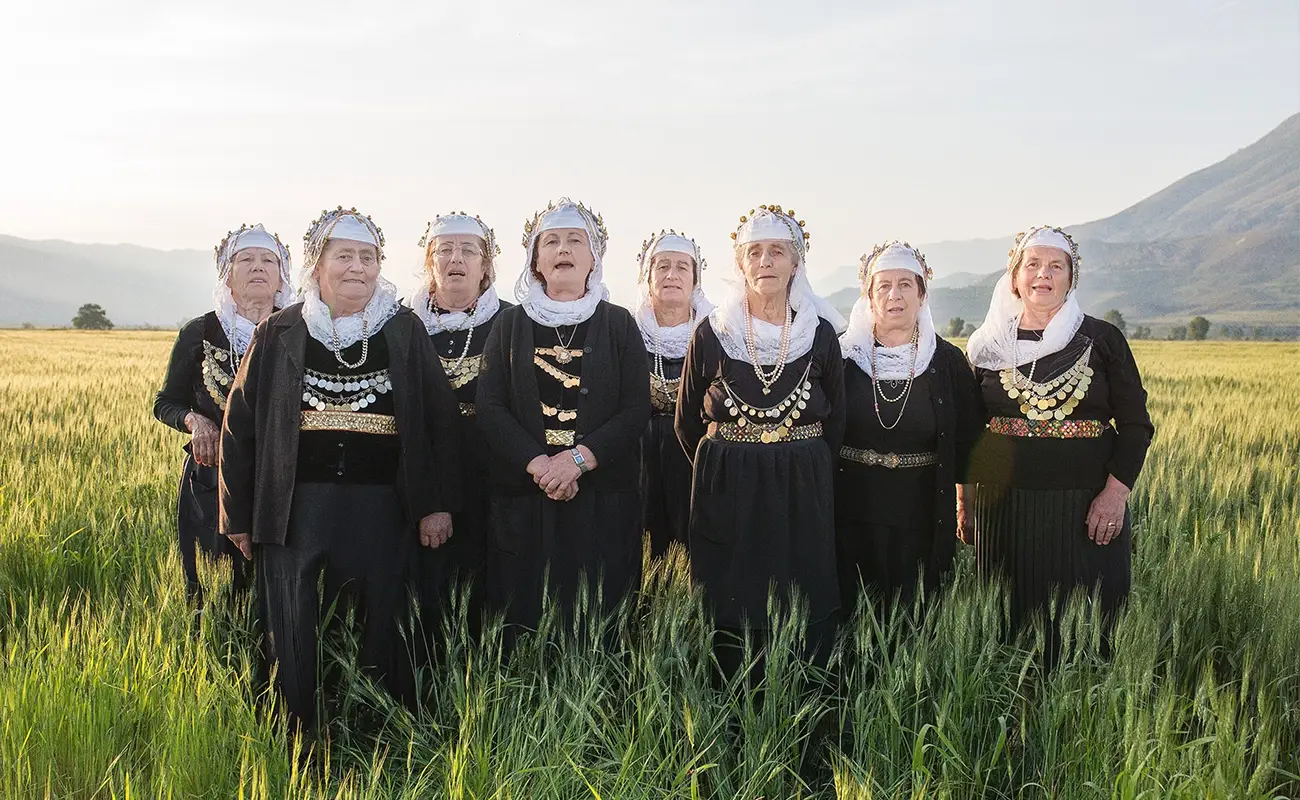
Header credit: Eliza Soroga, Roots, Athens and Epidaurus Festival 2018, photo by Aigli Drakou.
“I am interested in works that operate directly within reality, without theatricalisation, allowing tension, contradiction, and discomfort to remain visible.”
Attentive Bodies in Lived Environments
Eliza Soroga is a performance artist and documentary filmmaker whose practice unfolds between Athens and London, shaped by a sustained engagement with everyday life as both material and site. Working across performance art, video, observational documentary, installation, and public art, she approaches these forms not as separate disciplines but as interconnected methods for remaining close to situations that already exist. Visually, she often works with a “tableau vivant” or living-picture aesthetic, using stillness, duration, and minimal intervention as ways of remaining within the life of the site rather than standing apart from it. Her work is grounded in environments that are active and inhabited, spaces where routines, habits, and social behaviours quietly organise daily experience. Rather than transforming these conditions into spectacle, Soroga develops practices that approach them with restraint, allowing their internal logic to remain intact. This sensitivity to context has positioned her as an artist whose work operates from within reality rather than commenting on it from a distance, contributing to contemporary conversations around public space, performativity, and the ethics of artistic intervention.
Her background reflects a sustained commitment to both theory and embodied practice. She holds an MA in Performance Making from Goldsmiths, University of London, alongside an MA in Cultural Theory from the National and Kapodistrian University of Athens. Physical training has played an equally central role, particularly through Jacques Lecoq’s physical theatre technique and butoh dance, both of which continue to inform how she works with rhythm, stillness, and bodily presence. These influences support an approach that privileges duration and minimal action, often adopting a living picture aesthetic where movement is reduced and attention is heightened. Such choices allow the body to remain porous to its surroundings, reinforcing her interest in presence as something negotiated rather than imposed.
Recognition of her practice has emerged through international contexts. In 2024, she received a special prize from TASA, the Taiwan Art Space Alliance, and she has developed projects through artist residencies in Japan. These experiences have further reinforced her commitment to site-sensitive work, where each project begins with careful attention to how a place is used, who occupies it, and what remains unseen. By allowing locations to guide the work rather than treating them as neutral backdrops, Soroga constructs situations where art becomes inseparable from its environment, contributing to a broader effort to rethink how the public sphere might be experienced and reimagined through performance and sound.

Eliza Soroga, photo by Emma Luise Charalambous
Eliza Soroga: Origins of an Observational Practice
Soroga’s path toward becoming an artist was shaped less by a single decisive moment and more by a gradual alignment between her environment and her sensibilities. Growing up in Greece, she was surrounded by art without it being framed as exceptional or distant from everyday life. Her mother worked at Greek National Television, while her father taught television production at the University of Athens, having previously been involved in experimental cinema in Chicago with a strong interest in observational documentary. From an early age, she attended experimental galleries, film festivals, and screenings, encountering artists and filmmakers whose work treated daily existence as a field worthy of sustained attention. This exposure cultivated a way of looking that prioritised observation, patience, and an openness to the ordinary.
In her early twenties, Soroga interned at the Greek Film Archive, spending nearly a year watching experimental films on a daily basis. During the same period, she was also deeply engaged with the body through other disciplines. She had been a sprint runner during her school years and later performed as a singer in a small band, experiences that heightened her awareness of rhythm, repetition, exposure, and endurance. Although she did not yet articulate these experiences in artistic terms, they laid the groundwork for a practice attentive to bodily presence and temporal structure. An Erasmus year in Paris intensified this trajectory, immersing her in theatre, contemporary dance, and exhibitions, and confirming her desire to pursue a life in the arts.
Academic study initially offered a framework for this interest, particularly through Cultural Theory, yet it soon felt insufficient on its own. While working at the French Institute of Greece, Soroga often found herself leaving her office to watch performance rehearsals taking place in the same building. This experience marked a turning point, clarifying that she did not want to write about artistic work but to create it. Physical theatre workshops in Athens followed, revealing the lack of formal performance education there and prompting her move to London. At Goldsmiths, the MA in Performance Making provided not only a language aligned with her way of thinking but also a community that affirmed her concerns. Only later did she recognise how closely her own work resonated with her father’s early films, underscoring that her artistic direction emerged through continuity rather than rupture.

Eliza Soroga, Don’t Let the Darkness Catch You in Paleochora: A Kytherian Experience, 2025, photo by Kostas Koroneos.
Practices of Everyday Disruption
Soroga’s artistic style is defined by its movement across performance art, documentary filmmaking, public art, and multimedia installation, always grounded in everyday life as a primary material. Social behaviours, collective rituals, and habitual actions form the basis of her inquiries, particularly as they shape how public and shared spaces are inhabited. Her works operate directly within reality, resisting theatricalisation and allowing tension, contradiction, and discomfort to remain visible. Rather than resolving situations or offering clear explanations, she constructs conditions where meaning stays open, inviting viewers or participants to confront their own roles within the unfolding experience. Across her practice, Soroga is interested in how art can interrupt the normal flow of things—how it can enter public life, unsettle what feels familiar, and expose the performative structures that quietly organise how we move, consume, remember, and exist together. This approach reflects her broader interest in disruption that is subtle yet incisive, operating without overtly announcing itself as an interruption.
Through performance, mixed media, and sound, she works with interdisciplinary methods that operate within everyday environments, reaching for the poetics of places and injecting randomness into the city, foregrounding how space, bodies, and social roles are continuously produced through performativity. Her documentary work extends these strategies through sustained observation. TAIGA follows Taiga たいが in his daily life while collecting narrations of his night dreams over three months. Structured as a collage between everyday imagery and dream audio, the film allows the boundary between waking life and inner worlds to remain unresolved. More recently, Don’t Let the Darkness Catch You in Paleochora: A Kytherian Experience marked her first engagement with binaural sound. Presented in complete darkness, the immersive work draws from Kytherian legends and ghost stories, using three-dimensional soundscapes to evoke collective memory through voices, field recordings, and imagined presences. Across these projects, Soroga demonstrates a consistent commitment to ideas determining their own medium, allowing form to emerge from concept rather than habit.

Eliza Soroga, Women in Agony, Arte Laguna Prize Winner 2017, Oxford Circus, photo by Rocio Chacon.
Eliza Soroga: Intimacy, Influence, and Unstable Meaning
Among Soroga’s works, The Oppression of Intimacy holds particular significance for how it crystallised her thinking around audience, gaze, and unpredictability. This multimedia performance begins without explanation, with the audience unaware that they themselves are the subject. A live camera films them in real time, projecting their image onto a large screen as they watch. The initial realisation produces shock and awkwardness, intensified by the moving camera that borrows cinematic language through zooms and close framings. Hands, eyes, ears, and small involuntary gestures are brought into extreme proximity, creating a sense of forced closeness. Accompanied by a gentle piano piece by John Cage, played live or recorded, each iteration unfolds differently, sometimes ending in laughter, sometimes in unexpected emotion.
What makes the work enduring for Soroga is its capacity to escape control. In one performance on the outskirts of London, a mother and daughter were framed alone on screen, and when the daughter began to cry, the situation shifted into something unplanned and unresolved. Audience responses ranged from descriptions of cruelty to accounts of deep captivation, with one person remarking that unlike a mirror, the performance offered no exit. Others noted how the prolonged, unavoidable intimacy felt oppressive, pointing to the central tension between agency and passivity. Some spectators attempted to perform for the camera, while most remained still, unsure how to behave. For Soroga, these reactions reveal how looking is never neutral and how intimacy, when imposed rather than chosen, can become a form of pressure and control.
Her influences help clarify the foundations of this approach. Cinema has been central, particularly the work of Roy Andersson, whose use of stillness, repetition, and composed frames shaped her thinking around duration and collective behaviour. She also draws from Agnès Varda’s attentiveness to people and places, alongside the observational and surreal strategies of Éric Rohmer, Luis Buñuel, and Wim Wenders. In sound and composition, John Cage’s ideas around chance and listening have informed her understanding of structure beyond conventional narrative. Performance influences include butoh founder Kazuo Ohno and her long collaboration with Geraldine Pilgrim, which profoundly shaped her understanding of site-specific composition. Thinkers such as Guy Debord and Dadaist practices further contribute to a practice that values precision and risk, where form is carefully constructed while meaning remains deliberately unstable.