

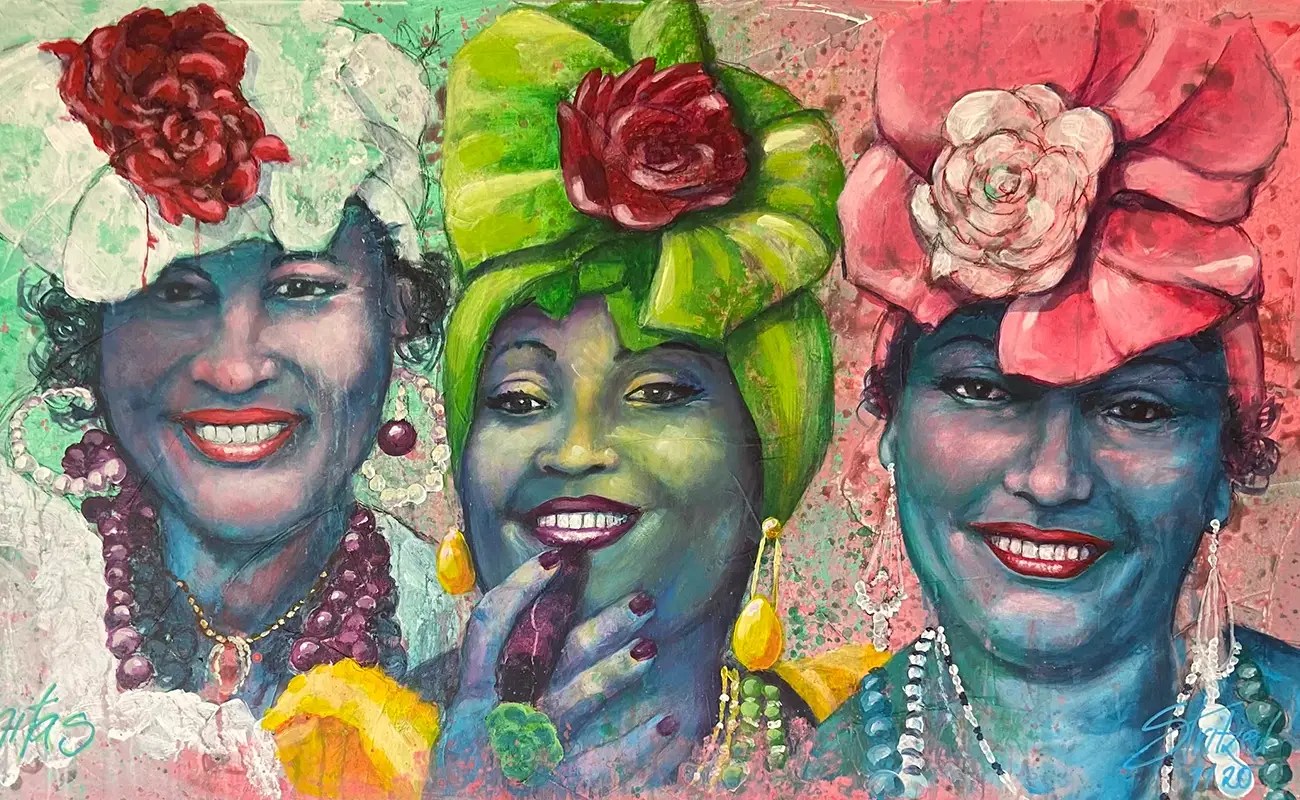
“I paint individuals whose presence often remains unheard in the global narrative—people whose dignity resonates not in loud declarations, but in subtle emotional frequencies.”
A Life Shaped by Observation, Travel, and Human Connection
Gerd Stritzel, born in 1961, has built an artistic practice grounded in curiosity, movement, and sustained attention to people often overlooked. His early education in art and graphic design in Stuttgart provided a structured visual foundation, yet his development did not remain confined to academic frameworks. Time spent in the United States proved formative, where he expanded his visual vocabulary while working across disciplines. Stage design projects for the San Francisco Opera and Ballet demanded an understanding of atmosphere, rhythm, and emotional pacing, while constructing dioramas for the California Academy of Sciences required precision, spatial awareness, and narrative clarity. These experiences sharpened his ability to merge visual impact with storytelling, qualities that later became essential to his portrait practice.
Travel gradually transformed Stritzel’s focus from environments to individuals. Moving through Nepal, Tanzania, China, New Zealand, and many other regions, he encountered people whose lives unfolded far from dominant global narratives. Farmers, monks, refugees, street vendors, and spiritual elders became central subjects, not as symbols but as distinct personalities. His portraits function as quiet thresholds into lived realities, inviting viewers to slow down and meet a gaze rather than consume an image. The artist’s interest is never rooted in spectacle. Instead, he emphasizes dignity expressed through posture, expression, and the subtle weight of experience carried in a face.
Across these journeys, Stritzel developed a visual language defined by contrast. Bold, celebratory color dominates the surface, yet beneath it exists a restrained emotional register that gives the work depth. Handwritten notes, fragments of maps, and symbolic objects appear within the compositions, serving as narrative anchors rather than decoration. Each painting becomes a dialogue between vitality and vulnerability, between outward brightness and inward reflection. This balance, cultivated through years of observation and cross cultural engagement, forms the backbone of his artistic identity.

Gerd Stritzel: Color as Language and Portraiture as Encounter
At the center of Gerd Stritzel’s practice lies a commitment to expressive portraiture that prioritizes presence over idealization. His subjects meet the viewer directly, often through frontal compositions that establish an immediate human exchange. Whether portraying a weathered elder or a smiling street vendor, he seeks to capture spirit rather than perfection. Facial expressions, gestures, and cultural details are rendered with sensitivity, allowing individuality to remain intact. The result is a body of work that feels personal without becoming insular, intimate without slipping into sentimentality.
Color plays a defining role in shaping this experience. Stritzel’s palette is fearless and joyful, liberated from strict naturalism and guided instead by emotional resonance. Saturated hues energize the surface, drawing viewers closer while reinforcing the cultural specificity of each work. Country specific colors and symbols emerge organically from his encounters, reflecting atmosphere, climate, and tradition. These chromatic decisions are not arbitrary. They function as emotional signals that amplify character and mood, making each portrait feel alive and immediate.
Narrative elements woven into the paintings further deepen engagement. Maps, handwritten texts, and symbolic objects appear as traces of movement and memory, encouraging viewers to imagine the unseen stories behind each face. These components transform the portraits into layered documents of experience rather than static representations. Influence also plays a role in shaping this approach. Stritzel has cited Anselm Kiefer as a significant artistic reference, particularly in the use of material presence and conceptual weight. Yet his own voice remains distinct, grounded in empathy and direct human connection rather than abstraction or distance.

Journeys Across Cultures and the Ethics of Representation
Travel remains the engine driving Gerd Stritzel’s ongoing exploration of humanity. Cambodia, Cuba, Doha, Sri Lanka, Bali, Costa Rica, Tanzania, China, and New Zealand have all contributed to cycles of work shaped by direct encounter. These journeys are not undertaken as brief visual surveys but as immersive experiences where conversations, shared moments, and observation inform the final image. Each painting emerges from time spent listening and watching, allowing authenticity to replace assumption. This approach ensures that cultural symbols and visual references are embedded with meaning rather than applied superficially.
A defining aspect of Stritzel’s work is his refusal to exoticize. Cultural richness appears through everyday details rather than dramatic gestures. Clothing, tools, and environments are presented with respect, reinforcing the individuality of each subject. His portraits operate as ethical encounters, insisting on equality between artist, subject, and viewer. Wrinkles, scars, and signs of labor are not softened or exaggerated. They are treated as records of lived experience, conveying resilience and history without judgment.
This ethical stance is reinforced through material choices and compositional restraint. The figures often command the frame, their gaze steady and unguarded. Background elements support rather than overwhelm, allowing attention to remain on the human presence. Through this consistency, Stritzel builds a visual archive of encounters that transcends geography. The works speak across borders, emphasizing shared humanity while honoring difference. His portraits ask viewers not to admire from a distance but to engage, recognize, and reflect on lives connected to their own through global systems of movement, labor, and exchange.

Gerd Stritzel: Kiatu, Social Responsibility, and Future Horizons
Among Stritzel’s many works, the painting titled Kiatu holds particular significance. The word means shoe in Swahili, a simple object that carries complex meaning in Tanzania, where footwear is not guaranteed. The piece emerged from an encounter with a young street vendor who sells used, recycled shoes. She balances shoes on her head, carries them across her body, and holds them in her hands, presenting herself with pride and a confident smile. The image offers insight into an economic reality shaped by global circulation, where shoes discarded in Europe begin a second life in Africa.
Kiatu extends beyond portraiture into social commentary without becoming instructional. It reflects on reuse, survival, and dignity within informal economies. The work resonates with broader discussions documented in the Ethnological Museum in Zurich’s publication Living from Old Shoes, which presents a nuanced view of the used shoe market in Tanzania. Stritzel’s engagement with this subject also translates into action. Through his support of the Shoes for Africa campaign, he hand paints and signs old shoes, directing proceeds to the Berlin based Shoeaid organization, which collects and distributes footwear across Africa. Art, in this context, becomes a bridge between awareness and tangible support.
Looking forward, Stritzel continues to pursue new encounters. A planned journey to Japan from January 30 to February 28, 2026, reflects his ongoing curiosity about the intersection of tradition and modernity. The trip is expected to result in approximately twelve paintings, shaped by both historical continuity and contemporary life. This forward momentum underscores a practice that remains open, responsive, and rooted in human connection. Each new destination offers not novelty, but another opportunity to listen, observe, and translate lived experience into color, form, and presence.


