“Becoming an artist is not an event, it’s a road.”
Art Shaped by Lineage and Legacy
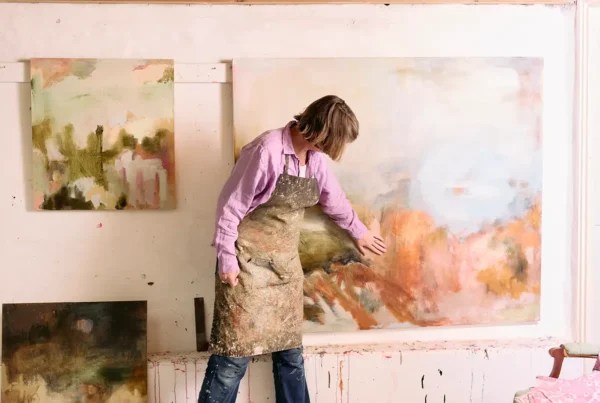
Maria Kazanskaya’s journey as an artist is profoundly rooted in her classical training in Russia, where rigorous practice in life drawing and painting formed the backbone of her artistic development. This intensive early foundation, built on hours spent sketching and painting live models, provided more than just technical skill; it cultivated an intuitive understanding of composition, a fluent command of the brush, and a fearless curiosity for experimentation. Equally formative was her immersion in the vast and varied collections of art museums across Moscow, St. Petersburg, and smaller regional cities. These institutions, often containing unexpected treasures of the Russian avant-garde, offered a living dialogue with the past, encouraging Kazanskaya to explore historical narratives while forging her own path.
Rather than seeing art as a fixed identity or a singular moment of arrival, Kazanskaya describes her creative life as an evolving process — one in which she is constantly shaping and reshaping herself through her work. Her understanding of being an artist goes beyond a professional label; it is, in her words, a continuous becoming. This dynamic outlook is reflected in her willingness to adapt, grow, and rethink her methods and materials over time, whether in response to her internal reflections or to the shifting conditions of the world around her. Her work resists the boundaries of trend or school, instead following a deeply personal logic.
Influences arrive in Kazanskaya’s studio not as blueprints but as starting points for departure. While she acknowledges the inspiration she has drawn from other artists at different stages of her life, she deliberately steers clear of imitation. Trends, too, are examined critically. From the exaggerated textural devices popularized by figures like Anselm Kiefer to the contemporary vogue of textile and embroidery arts, Kazanskaya observes artistic movements with both curiosity and skepticism. In her own practice, each technique must earn its place by serving the deeper meaning of the work. When she explores a theme, she invents the visual language necessary to carry it, allowing medium and message to grow organically together.

Maria Kazanskaya: People, Places, and the Emotional Landscape
The dual pillars of Kazanskaya’s practice are her depictions of nature and of people — each approached with a level of emotional investment that resists casual observation. Her portraits emerge not from commissions or neutral studies, but from relationships of care, curiosity, or intimate recognition. Self-portraiture offers her the freedom to distort, experiment, and reimagine without boundaries. This freedom gave rise to series like Self Studies (2010–2012), Hats (2013), and Masks (2013), where she investigated identity and transformation using her own image as a malleable instrument.
Her portraits of loved ones carry a different weight. In works like My Son (2002–2006), The Game of Life (2008), and FB Friends (2014), Kazanskaya renders those closest to her with a quiet, attentive intensity that suggests emotional proximity rather than mere likeness. A particularly striking example is her 2015 series Children of the Enemies of the People, comprising 23 small canvases. These portraits, inspired by photographs of children affected by Stalinist purges, became more than a historical project. The children, discovered by chance, embedded themselves so deeply in her consciousness that she felt compelled to “adopt” them through paint. The resulting images resonate with grief, tenderness, and a profound sense of moral engagement.
Even her portrayals of nature often function as emotional portraits. Kazanskaya’s series Dirty Flowers (2010–2012) presents individual blooms not as decorative objects but as complex characters, each with a distinct expression. Her expansive Pacific Ocean works similarly treat waves and water not as passive elements but as living presences. These pieces reveal her unique ability to anthropomorphize the non-human without resorting to sentimentality. Nature in Kazanskaya’s work is never mere backdrop — it breathes, remembers, and transforms, acting as both witness and participant in human histories.

Technique as Language, Texture as Memory
Kazanskaya’s material choices are never arbitrary; instead, each medium is selected to echo and intensify the conceptual core of her subject matter. Her ongoing series California Ghosts stands as a prime example of this union between technique and theme. In this body of work, she constructs haunting images of abandoned homes set within the stark landscapes of California. These are not static ruins but sites of layered narrative — evidence of both human presence and the forces of nature reclaiming what was built. To express this duality, Kazanskaya employs rough canvas and collaged surfaces enhanced with sand, acrylic paste, and glass beads, which she later paints over in oils. The resulting textures fracture the images, simulating the erosion of time and the quiet violence of desert winds.
Conversely, her Pacific Ocean series employs a radically different approach, favoring smooth mylar film and fluid oil techniques to convey the kinetic elegance of moving water. The transparency of the base, combined with the liquidity of the paint, allows the works to capture the play of light, shimmer, and motion that define the ocean’s surface. This shift in technique underscores her refusal to let one aesthetic dictate her entire practice. Instead, Kazanskaya allows the nature of each subject to determine its own visual treatment, creating works that are as materially diverse as they are emotionally consistent.
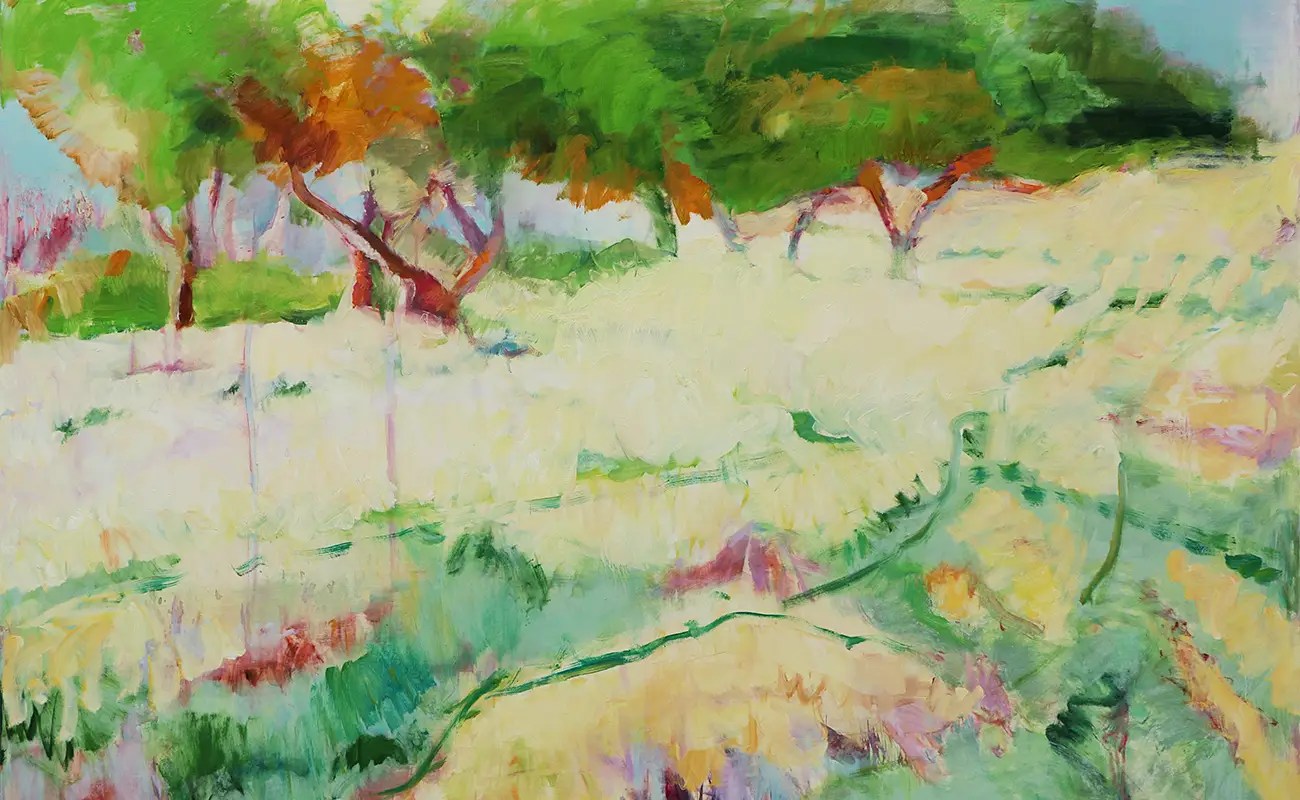
Her everyday working process reflects this balance between conceptual preparation and material immediacy. Although she often paints quickly, either in the studio or occasionally on site, the work always begins with prolonged contemplation, sketching, and the slow accumulation of ideas. Projects unfold not according to deadlines but through a rhythm of reflection and execution. Recently, she has continued California Ghosts, now turning her attention from the dry deserts of southern California to the more verdant, quiet regions of the north. The ocean, the changing flora, and the layered history of the land continue to draw her in, offering new material for an already rich series.

Maria Kazanskaya: Between Threshold and Transformation
One particularly resonant piece within California Ghosts encapsulates many of the themes and visual strategies that define Kazanskaya’s work. Known as #51, the painting introduces a ghostlike figure departing a crumbling house. Unlike other figures in the series who hover at the threshold or look inward, this one steps outward, its identity blurred and uncertain. The dress is nearly contemporary, yet its features appear incomplete, as if the figure were a fading photograph rather than a person. This deliberate ambiguity challenges viewers to question the direction of the figure’s journey — is she leaving the past, or emerging into it?
The architectural elements of #51 echo this uncertainty. The center of the house is rendered in fine detail, complete with ornate gratings and a clear entryway, but these material certainties give way to distortion as the structure rises. The roof and porch dissolve into abstraction, and the stairs vanish into an unseen void. Such spatial instability mirrors the emotional and historical dislocation that the work embodies. The color palette deepens this tension, combining unnatural blues with jarring flashes of yellow. These hues resist comfort, casting the house in a light that is both spectral and arresting.
Kazanskaya’s process for #51 reveals her sophisticated layering of media. She first prepared the linen with acrylic gel to simulate the tactile surface of aged wooden planks. Over this textured ground, she blocked out a basic color scheme using ink, then developed the final image with oil paint. This combination of techniques invites the viewer not only to see but to feel the fragmentation and erosion at the heart of the painting. The figure, the house, and the land itself all seem to occupy an unstable in-between space — a theme that Kazanskaya returns to repeatedly in her work. In #51, she achieves a powerful synthesis of subject, material, and meaning, offering a meditation on memory, abandonment, and the porous boundary between past and present.