“The fleeting and the eternal, presence and departure, seeing and being seen — these are the tensions that define my work.”
Suspended in Perception
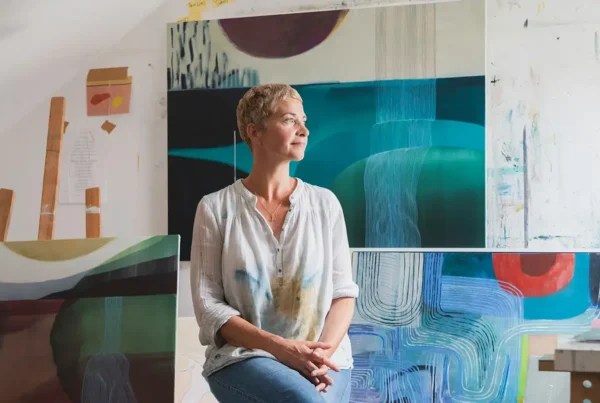
Amid the shifting light of Los Angeles and the coastal quiet of Xiamen, Zhen Wei creates work that captures something far less tangible than place — she gives form to the thresholds of human perception. In her paintings, photographs, and installations, moments that might otherwise vanish unnoticed are stretched and held still, offering viewers a quiet space to consider what slips between awareness and absence. Wei is not simply recording the visible world; she is responding to those psychological interludes when the body remains grounded in reality, while the mind begins to drift into memory, anticipation, or reverie. Her artistic inquiry hovers precisely where certainty blurs — in the pause between seeing and understanding, between presence and departure. This preoccupation with the ephemeral underpins her evolving body of work, which continues to receive attention in both the United States and abroad.
Working fluidly across disciplines, Wei explores the tension between what is fleeting and what endures. Oil and cold wax become her primary instruments, allowing for a nuanced layering process that mimics the gradual emergence and dissolution of thought. Her approach is rooted in sensitivity to atmosphere, and she navigates the visual and emotional contours of impermanence with a careful eye. Rather than depict overt narratives or defined subjects, she opens space for experiences to settle and shift within the viewer. Her compositions often resist immediate comprehension, inviting a slower kind of looking, where clarity arrives not through detail but through sensation. In this space, time behaves differently — stretched, slowed, and sometimes completely stilled.
Wei’s work has been exhibited across a range of venues, including the Sasse Museum of Art, Peggy Phelps & East Gallery, and Ginkgo Art Gallery in the United States, as well as A60 Contemporary Art Space and AMACI Contemporary Art Day in Italy. Recognition from institutions such as CGU’s President’s Art Award, the TERAVARNA Finalist Award, and her participation in STRATA III at Verum Ultimum Art Gallery affirms the resonance of her practice. But her artistic voice remains quiet and resolute, attuned less to accolade than to those fleeting moments when perception flickers and the inner world becomes momentarily legible. Her commitment lies in articulating that suspended state — the in-between — through a visual language that balances fragility with focus.

Zhen Wei: Charting the In-Between
Before turning fully to art, Zhen Wei trained in landscape and urban planning, a background that continues to shape the way she sees and understands spatial experience. Her sensitivity to environmental transitions — how one space flows into another, how atmosphere shifts around structure — now informs how she builds each piece. She identifies and amplifies perceptual moments that might otherwise pass unnoticed, allowing them to become the foundation of her practice. These are the pauses and hesitations in daily life that offer a break from narrative or logic, allowing emotion to surface. Within this liminal zone, Wei finds fertile ground for exploration. Her paintings do not resolve; instead, they hold space for instability, echoing the psychological experience of being half-present — both grounded in a place and slightly removed from it.
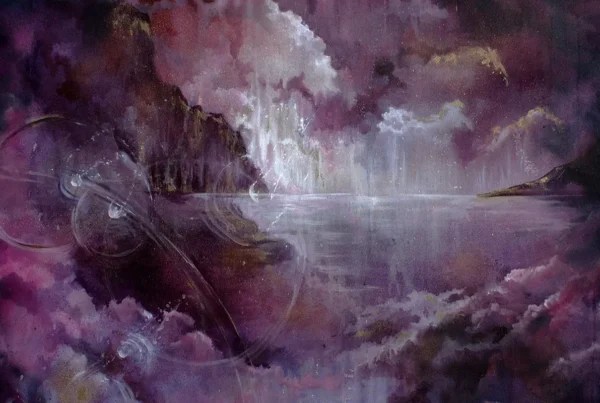
In her recent paintings, she focuses on the concept of thresholds — not only physical ones, but also emotional and perceptual boundaries. Using cold wax and oil, she manipulates texture, depth, and transparency to slow down the act of looking. Surfaces shift gently between figuration and abstraction, suggesting the presence of forms that never fully settle into recognition. These images seem to hover between memory and observation, capturing what lingers at the edge of consciousness. For Wei, this process is not about illustrating ideas but about preserving sensations — those fragile impressions that rise before language or after an experience has passed. She creates work that gives weight to these sensations, allowing them to exist as visual experiences that resonate quietly but powerfully.
Wei often likens her paintings to “fragile bubbles” — spaces that briefly contain an emotional state before dissolving. This idea is central to her approach and continues to inform how she engages with both material and subject matter. Her choice of wax contributes to this effect; it softens the boundaries within each composition, echoing the instability of memory and the delicacy of suspended thought. Through this process, she crafts environments that are emotionally charged yet visually subtle. She does not seek resolution or clarity but aims to articulate the unresolved. These suspended visual fields invite the viewer to linger, to pause, and perhaps to find their own drifting thoughts mirrored within.

A Reflection, Brief and Deep
Among Wei’s body of work, one piece holds particular significance. It captures a quiet moment during a rainy day — the reflection of a road sign in a shallow puddle while she waited at a bus stop. The image is simple, almost mundane, but within it she found an entire world temporarily held together in water and light. The painting ends just as the image reaches the edge of the paper, ready to disappear with the slightest movement. A passing car, the arrival of the bus, or even a shift in her posture could have shattered the puddle’s surface and erased the scene. This sense of delicate impermanence is what gives the work its power. It embodies the fragile space between anticipation and action, between being in a place and slipping away from it.
The painting is rendered in oil and cold wax on paper, a deliberate choice that reinforces the piece’s vulnerability. Paper, as Wei notes, is more fragile and less permanent than canvas or wood. Its delicacy mirrors the fleeting quality of the moment it captures. Cold wax enables her to create surface textures that suggest movement and stillness simultaneously. The painting’s blurs and soft edges evoke the instability of memory and perception, while its tactile quality draws the viewer in to examine its subtle layers. Through this medium, Wei translates a minor event into a contemplative image that invites extended looking. The puddle becomes more than a reflective surface; it is a portal into the psychological space of waiting, drifting, and observing without control.
What makes this work particularly compelling is how seamlessly it expresses Wei’s ongoing fascination with suspended experience. She captures not only the visible scene but also the emotional undercurrent of that specific moment in time. The act of waiting in the rain, the gentle pull of wandering thoughts, and the awareness of everything’s potential to vanish — all of this is preserved in the painting’s quiet presence. It is an image that asks for silence from the viewer, not in demand, but in resonance. The fleeting quality of the scene does not weaken its impact; rather, it sharpens it. Through this singular work, Wei articulates her core artistic concern: that some of the most powerful human experiences occur not during grand events, but in those barely noticeable pauses when the world briefly recedes.

Zhen Wei: Between Sky and Thought
Wei’s creative process begins long before the brush meets the surface. Her daily practice centers on observation — not of events, but of perceptual shifts that hint at something deeper. She collects fragments of experience, noting where atmosphere feels different or where attention gently slips. These moments are stored and revisited, considered not for their narrative value but for their emotional resonance. Some remain as quiet notes, while others evolve into full compositions. Her engagement with material is equally intentional. Preparing her own cold wax, adjusting its consistency, and mixing it with pigment becomes a ritualistic part of the work. This slow, physical engagement with medium allows her to enter a focused, contemplative state — one where repetition and resistance clear space for reflection.
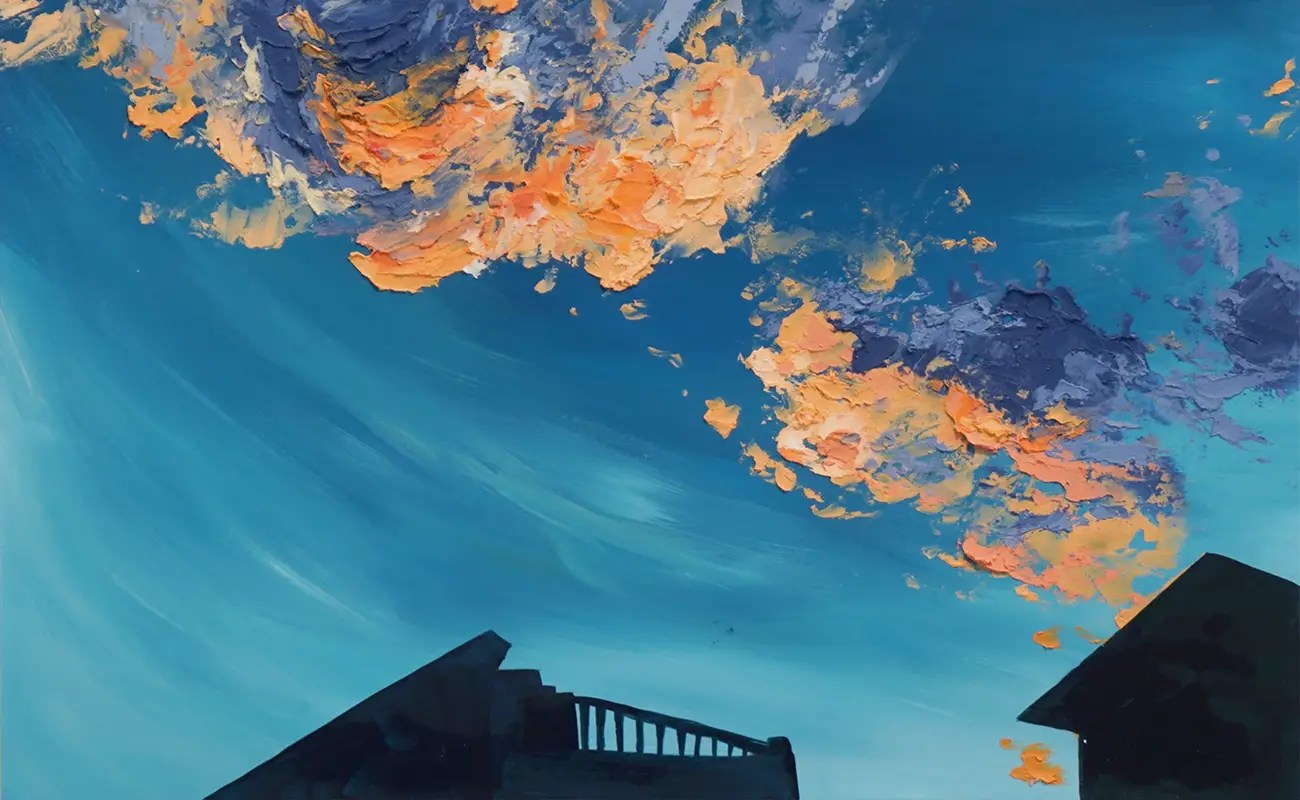
Currently, Wei is immersed in a series titled Daydream Bubble, which continues her exploration of transitory states, this time using the shifting sky as both subject and metaphor. Growing up in an urban environment and later studying urban design, she became attuned to looking upward — a habit born of seeking openness in confined spaces. The sky, ever-changing yet always present, becomes a mirror for inner states. In each work within the series, she captures a fleeting emotion held momentarily in cloud patterns, light shifts, or atmospheric conditions. These sky-scapes do not depict meteorological events; they record an interior weather, a mood held briefly before dissolving. Each painting becomes a membrane — translucent, suspended, and carrying the full weight of the moment it contains.
Wei describes the pieces in Daydream Bubble as psychological capsules — fragile and hovering, easily broken yet fully inhabited. They are records of time not as chronology, but as sensation. Like the puddle in her earlier work, the sky here becomes a reflective surface through which interior experience is made visible. Her compositions in this series do not demand interpretation. Instead, they offer space for feeling, asking viewers to slow down, to enter that same suspended state from which the work emerged. In doing so, Wei continues to refine her visual vocabulary, one that insists on the significance of the impermanent, the drifting, and the nearly invisible. Through her attentive practice, she builds not just images, but spaces for thought to unfold without conclusion.