The Language of Machines and Memory
Refik Anadol has emerged as one of the most visionary figures in media art, redefining the interface between human creativity and artificial intelligence. Born in Istanbul in 1985 and currently based in Los Angeles, Anadol has become internationally celebrated for his groundbreaking exploration of data as an artistic medium. At the intersection of machine intelligence and aesthetics, he transforms massive datasets into immersive visual experiences that challenge conventional boundaries of perception and design. Through his work, Anadol invites audiences into unseen worlds where memory, emotion, and technology merge into something deeply evocative yet entirely new.
Leading Refik Anadol Studio, a transdisciplinary team composed of creatives and researchers from around the world, he has cultivated a collaborative ecosystem fluent in both visual culture and algorithmic logic. From architectural projection mapping to generative AI installations, the studio works across disciplines to produce large-scale artworks grounded in equity, inclusivity, and scientific inquiry. Anadol also co-founded Dataland, the world’s first museum dedicated to AI arts, set to open at The Grand LA in 2025. This upcoming institution promises to push the boundaries of artistic interaction, enabling real-time dialogue between audiences and machine-generated environments.
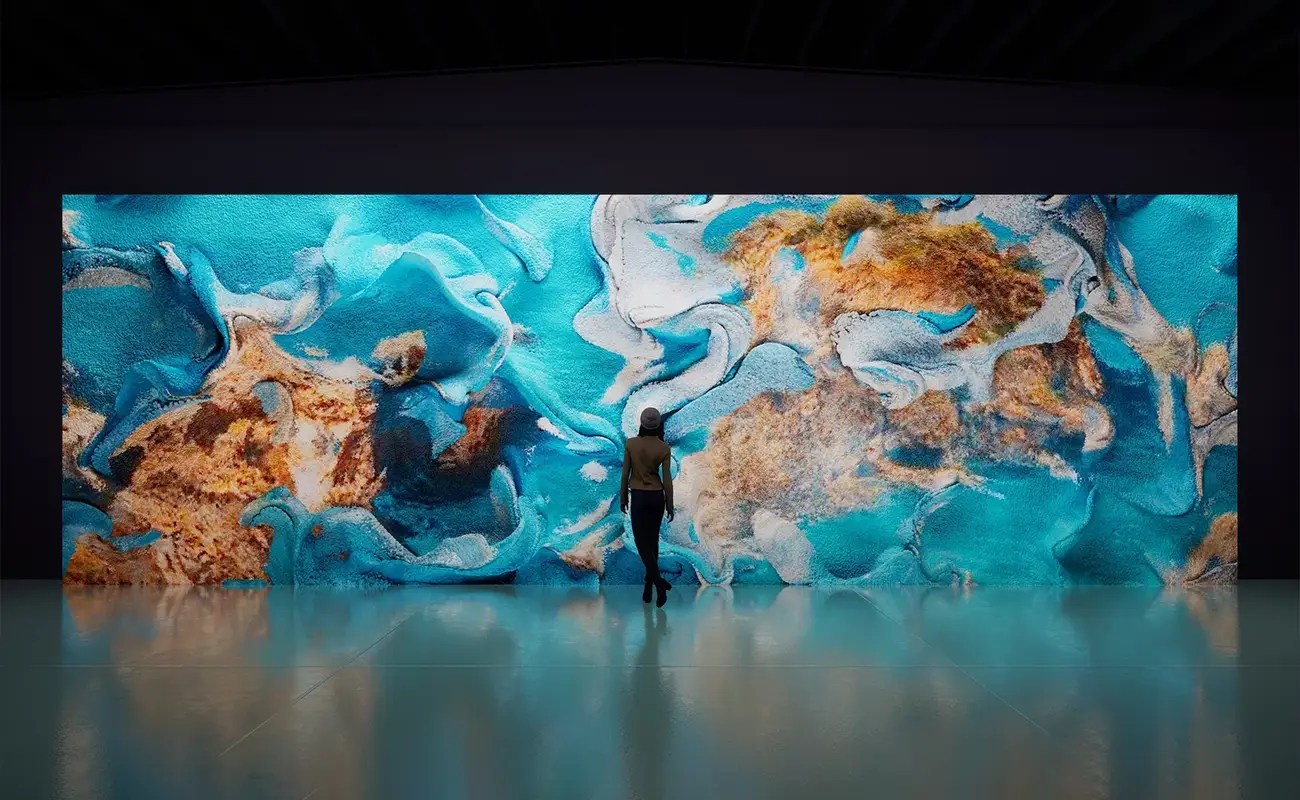
Central to Anadol’s work is the idea that data can be more than abstract numbers—it can hold memory, identity, and even emotional resonance. By utilizing machine learning as a creative partner, he invites viewers to rethink what it means to observe, remember, and imagine. His installations often give digital form to invisible structures, whether that be memory patterns from neural activity or meteorological and architectural archives. The results are breathtaking, with entire buildings enveloped in living visual compositions, immersive interiors that dissolve traditional boundaries, and AI-generated landscapes that reframe both urban and natural environments.

Refik Anadol: The Machine That Dreams
For Anadol, artificial intelligence is not just a tool but a collaborator capable of imagination. His work with AI began in earnest in 2016 during an artist residency at Google, where he created Archive Dreaming, one of the first artworks to use public data to generate real-time visual compositions. This piece set the tone for what would become a hallmark of his practice: inviting machines to “dream” with curated data, offering audiences a glimpse into the complex textures of information we usually take for granted. With the aid of proprietary software developed by his studio since 2014, Anadol’s projects use this methodology to reveal surprising narratives from vast, often overlooked data.
This philosophy reached new heights in Unsupervised, exhibited at the Museum of Modern Art in New York. For this project, Anadol processed metadata from MoMA’s collection to create a continuously evolving, AI-generated artwork. Unlike traditional curation, this piece allowed the machine to determine form, style, and composition based on thousands of artworks. The audience witnessed not just a reinterpretation of art history, but an autonomous visual logic unfolding live. In a similar vein, Quantum Memories at the National Gallery of Victoria in Melbourne harnessed 200 million images of Earth’s landscapes and atmospheres to present an alternate, algorithmically derived nature—one that exists beyond human cognition.
Whether he’s training AI to interpret the visual legacy of Frank Gehry, or mapping the neurological process of memory using EEG data in Melting Memories, Anadol continues to pose profound questions about perception and authorship. His installations are not static objects but living systems. Each work evolves with the machine’s processing capabilities and reflects both the limits and the potential of synthetic cognition. Through this, Anadol positions himself not just as an artist but as a thinker reshaping how society engages with the digital subconscious.

Rethinking Nature Through Artificial Perception
In recent years, Refik Anadol has increasingly turned his focus toward nature—not as it appears to the human eye, but as it might be perceived through the lens of artificial intelligence. Since 2020, his studio has developed the Large Nature Model, the first open-source generative AI system trained specifically on ecological data. Drawing from over half a billion images and sounds sourced from institutions such as the Smithsonian, National Geographic, and the Natural History Museum in London, this model allows Anadol to explore organic systems as dynamic, living archives of information. The result is an ongoing investigation into the fragility and majesty of the natural world, reimagined through computational eyes.
This endeavor culminated in Echoes of the Earth: Living Archive, his first major solo exhibition in the United Kingdom, held at Serpentine North in London. The show immersed visitors in expansive AI environments built from datasets of coral reefs and rainforests, producing works like Artificial Realities: Coral and Artificial Realities: Rainforest. Each piece reflects a complex interplay between natural history and synthetic interpretation, allowing visitors to experience ecosystems in states of transformation and abstraction. These immersive environments do not merely replicate nature—they question how technology might archive, reconstruct, and ultimately reimagine it.
Anadol’s relationship with the natural world also carries a deeply personal and ethical dimension. Introduced to Amazonian culture through his partner and studio co-founder Efsun, he collaborated with the Yawanawá people of Brazil to develop an open-source AI model designed to preserve their language and cultural memory. Using advanced AI tools, the project reconstructs extinct plant and animal species based on collective knowledge and ancestral stories. This initiative not only affirms Anadol’s commitment to cultural preservation but also exemplifies his belief that technology must serve humanity’s deeper narratives—those of origin, connection, and continuity.

Refik Anadol: The Ethics of Innovation
Beyond the aesthetic spectacle, Refik Anadol’s work is grounded in a deliberate and principled approach to the ethics of technology. At the heart of his practice lies a clear commitment to transparency, data responsibility, and knowledge sharing. Anadol’s studio refuses to work with personal data, relying exclusively on open-source or institutionally curated datasets. This decision is not merely procedural but philosophical, reflecting his view that ethical boundaries must evolve alongside technological capabilities. Through collaborative partnerships with institutions like NASA’s Jet Propulsion Lab, MIT, and Stanford University, Anadol ensures his work is both scientifically rigorous and ethically aligned.
His studio operates like a research lab, composed of a fifteen-member team that spans disciplines such as architecture, music, neuroscience, AI engineering, and philosophy. Each project begins with intensive data collection and model training, but Anadol remains intimately involved in defining the conceptual vision and emotional tone of every piece. This hands-on approach ensures a delicate balance between computational complexity and artistic clarity. The goal is not just to generate striking visuals but to create meaningful experiences that resonate across cultures, disciplines, and generations.
Anadol’s influence has also extended into blockchain-based art, where his projects have reshaped digital ownership and social impact. Since releasing his first NFT in 2021, he has launched over a dozen data-driven collections. Among them, Machine Hallucinations – Space: Metaverse, presented with Sotheby’s, introduced immersive NFT art to global audiences. His NFT Living Architecture: Casa Batlló was auctioned by Christie’s and included in their 21st Century Evening Sale, standing alongside works by Banksy and Jeff Koons. Beyond commercial success, these projects have raised over $10 million for organizations like UNICEF and the Alzheimer’s Foundation. The Winds of Yawanawá NFT collection alone generated $3 million to support Amazonian cultural preservation, demonstrating that in Anadol’s world, digital innovation and social responsibility are deeply intertwined.