Storms of Light, Shadows of Memory
Born in 1982 in Valjevo, Serbia, Ana Pušica Krämer emerged from a landscape scarred by political upheaval and social unrest. Now based in Munich, Germany, her work bridges geographic and emotional terrains, shaped by early years spent navigating the instability of a post-conflict society. For her, painting is not simply a profession, but a sanctuary — a kinetic and visceral response to a world often split by contradiction. The canvas becomes her safe space, where vivid energy transforms internal disarray into something resonant and alive. Within the layers of her work, one finds not protest or political commentary, but a relentless pursuit of emotional alchemy.
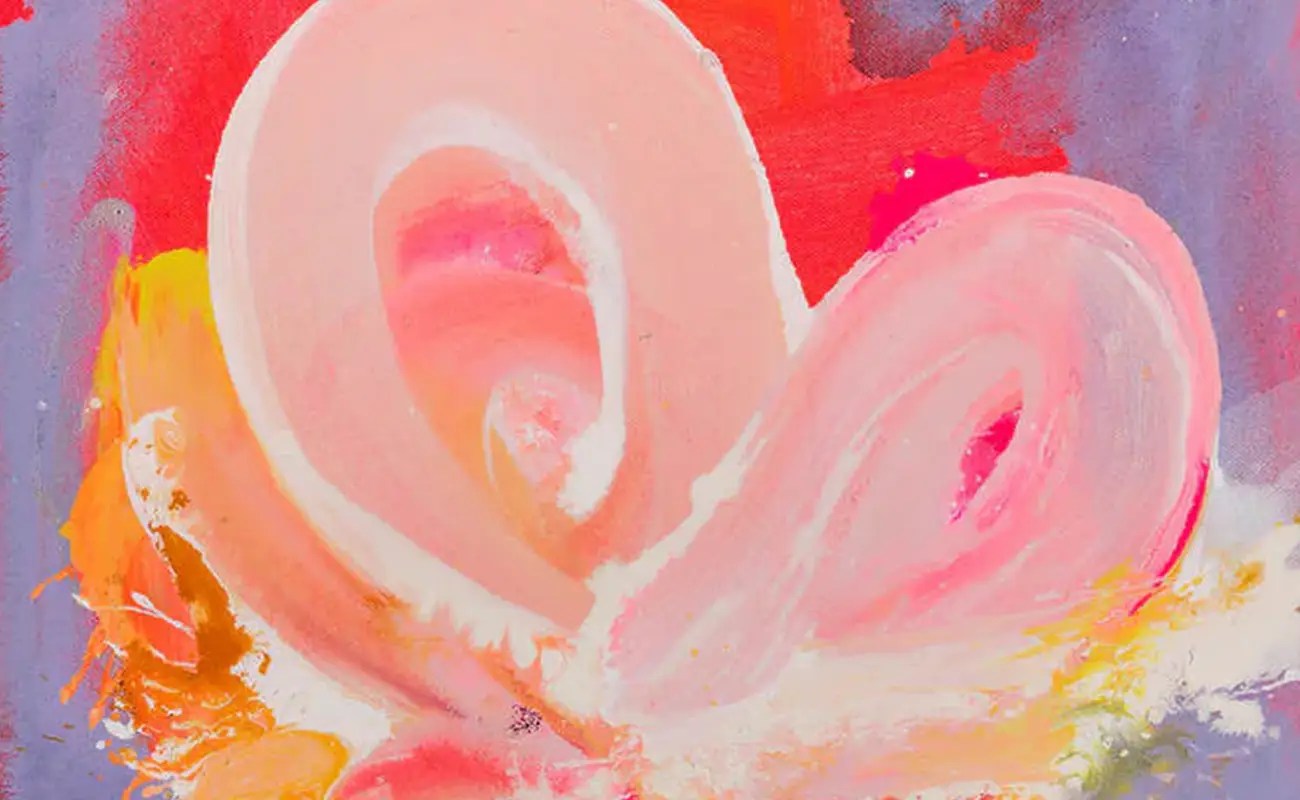
Her style resists stillness. Instead, it embraces velocity — what she affectionately compares to a “beautiful fluorescent thunderstorm.” This metaphor reflects her signature approach: charged, unpredictable, and luminous. Within her practice, vibrant colours and intuitive gestures collide in an urgent dance, defying conventional structure. Working across vast surfaces, she paints not with distance, but with physical intimacy, her entire body involved in each mark. The result is not merely an image, but a living imprint of motion, emotion, and instinct. Her art channels the rhythm of existence, shaped by both childhood solitude and the demands of the present.
Pušica Krämer’s career has stretched across continents, with exhibitions in cities as varied as Munich, New York, Riyadh, Xiamen, Melbourne, and the Maldives. Regardless of location, however, her foundation remains unchanged: painting as experience, as necessity. Trained at the Academy of Fine Arts in Munich under Professor Anke Doberauer, and previously at the Art High School Bogdan Šuput in Novi Sad, she carries forward a tradition of rigorous study, yet never abandons the raw spontaneity that defines her work. Whether in her Munich studio or a remote island residency, her creative pulse beats to the rhythm of colour, movement, and urgency.

Ana Pušica Krämer: Dancing on the Edge of Control
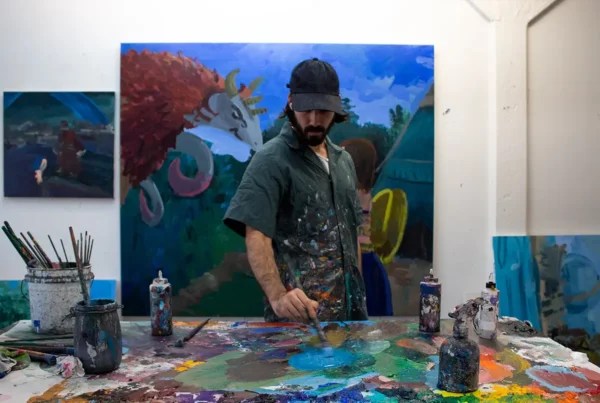
For Pušica Krämer, the act of painting unfolds like a ritual, one grounded not in perfection but in vulnerability and immediacy. Her studio is never a silent space of still contemplation; it’s a site of immersion where she walks, splashes, and moves across the floor, surrounded by multiple canvases at once. Often using her hands, feet, brushes, and even toilet paper, she works with acrylics that dry quickly — a choice that supports her desire to capture energy in a single breath. This methodology allows the work to retain its original force, refusing to be overthought or overworked. Her paintings are a negotiation between two polarities: intention and chance.
She frequently begins a piece with a sketch or a photograph, but what emerges is never rigidly planned. The process is guided more by sensation than precision. Figures drift through her compositions — not in full form, but in fragments. A hand, a shoulder, an ear. These glimpses hint at presence without declaring it. They invite viewers to wonder: are these bodies dancing, dissolving, or dreaming? She embraces the ambiguity. The presence of the human figure, even in abstraction, connects her to the canvas like an echo of her own solitude from childhood. It is less about representation and more about emotional continuity.
This balance between chaos and control defines her creative philosophy. For Pušica Krämer, control is not security; it is a limitation. Letting go — embracing what she cannot foresee — is what makes her work truthful. She never fully knows what a painting will become until it is dry and lifted from the floor. That unpredictability is not a flaw, but the engine of her expression. Through this approach, each artwork becomes a mirror of her internal state, shaped by both her discipline and her willingness to surrender. The dance between those opposing forces sustains her, both as an artist and as a human being.

Where Colour Breathes and Silence Speaks
At the core of Pušica Krämer’s artistic language lies an enduring love affair with colour. It is her most intimate companion, her clearest form of communication. Opening a jar of pigment triggers a surge of clarity for her — a moment when everything snaps into focus. Shades like Magic Blue, Space Turquoise, and Cosmic Latte are not just aesthetic choices; they are emotional tools, each capable of constructing entire worlds. With colour, she doesn’t just paint scenes, she builds atmospheres, places where thought and sensation are inseparable.
The influence of environment on her palette became especially pronounced during her recent residency at Patina Maldives. There, surrounded by lush greens and shimmering waters, her visual language underwent a profound shift. Traditionally a “pink girl,” Pušica Krämer found herself unexpectedly drawn to green — a hue she had previously rejected or adored with no middle ground. The natural beauty of the island coaxed her into a new relationship with this colour, softening her resistance and expanding her range. That change not only altered her colour palette, but also infused her compositions with a lighter, freer energy.
This residency also challenged her working rhythm. In contrast to the controlled routines of her Munich studio, the island brought constant interaction and unpredictability. Visitors wandered through her workspace, conversations sparked spontaneously, and the creative process became more social, more porous. The result was a series of works that leaned toward figuration, influenced by the movement and presence of people around her. One unexpected figure kept reappearing in her sketches: the resort manager, a tall Frenchman who naturally fit into the aesthetic vocabulary she had developed over years. This shift toward incorporating more identifiable forms marked a new chapter, yet remained rooted in her signature blend of gesture and emotion.

Ana Pušica Krämer: Painting Where the Pulse Lives
Pušica Krämer’s studio is never confined to a single location. Whether she’s standing barefoot on the floor of her Munich workspace or surrounded by salt air on an island in the Indian Ocean, her true studio exists wherever the act of creation begins. The physical place matters less than the emotional state it enables. For her, art-making is a way to return to instinct, to shed overthinking, and to move with honesty. She feels most alive not in stability, but in the middle of that energetic storm — where colour splashes, feet press into canvas, and chaos becomes clarity.
A powerful moment during her Maldives residency came when a young girl visited her studio. Asked to draw something she wanted to share with the world, the child sketched a simple image of her mother and said, “That’s my mom.” The purity of that response resonated deeply with Pušica Krämer. In contrast to adults who often overanalyze and self-censor, children create without fear, without filters. This encounter reminded her of her own goal: to paint not with guarded precision, but with fearless sincerity. That child’s drawing, as unassuming as it was, embodied the kind of authenticity she strives for in every painting.
Ultimately, her creative identity is intertwined with movement — not just the physical gestures of painting, but the emotional and geographical shifts that shape her perspective. Whether immersed in her structured routines in Germany or thrust into spontaneous environments abroad, she adapts without losing the pulse of her work. Her identity as an artist is not fixed, but in constant flux, shaped by interaction, change, and sensation. She doesn’t chase perfection. Instead, she seeks those unpredictable moments when colour, instinct, and vulnerability align. That is where she feels most grounded — not in stillness, but in motion, alive in the centre of the storm she has chosen to embrace.