Echoes Across Time: The Artist as Archivist of Experience
Emerging from the granite-lined streets of Aberdeen on Scotland’s northeast coast, Barry McGlashan has carved out a distinctive space in contemporary painting where memory, curiosity, and historical fascination collide. Born in 1974, McGlashan’s artistic journey has been one of continual investigation—into the past, into personal recollection, and into the mysterious spaces between fiction and truth. His visual language is layered with subtlety, shaped by a deep sensitivity to both the fragility of memory and the enduring power of image-making. Rather than merely recording what he sees, McGlashan reconfigures his inspirations through the lens of imagination, producing works that are rich in symbolism, wit, and narrative complexity.
From a young age, McGlashan was drawn to art as a means of exploring the world beyond the bounds of his coastal hometown. This ambition led him to Gray’s School of Art in Aberdeen, where he studied drawing and painting and graduated with first-class honours in 1996. Just two years later, he returned to the institution as a lecturer, teaching in the department until 2005. During this formative period, McGlashan refined his visual vocabulary, developing a method rooted in observation but always attuned to reinterpretation. His time as both student and educator at Gray’s shaped a foundational commitment to painting not just as a craft, but as a means of intellectual and emotional inquiry.
Over the years, McGlashan’s work has garnered national and international recognition, with his paintings held in esteemed collections such as Aberdeen Art Gallery, the Royal Scottish Academy, and The Scottish Society in New York. His reputation as a thoughtful and inventive painter earned him the 2001 Alastair Salvesen Scholarship from the Royal Scottish Academy, enabling him to spend three months travelling through the United States. That journey ignited a lasting engagement with American landscapes and culture, which continues to inform his practice. In 2024, this longstanding contribution to Scottish art was acknowledged when he was elected an Academician of the Royal Scottish Academy.

Barry McGlashan: Reimagining History Through the Artist’s Studio
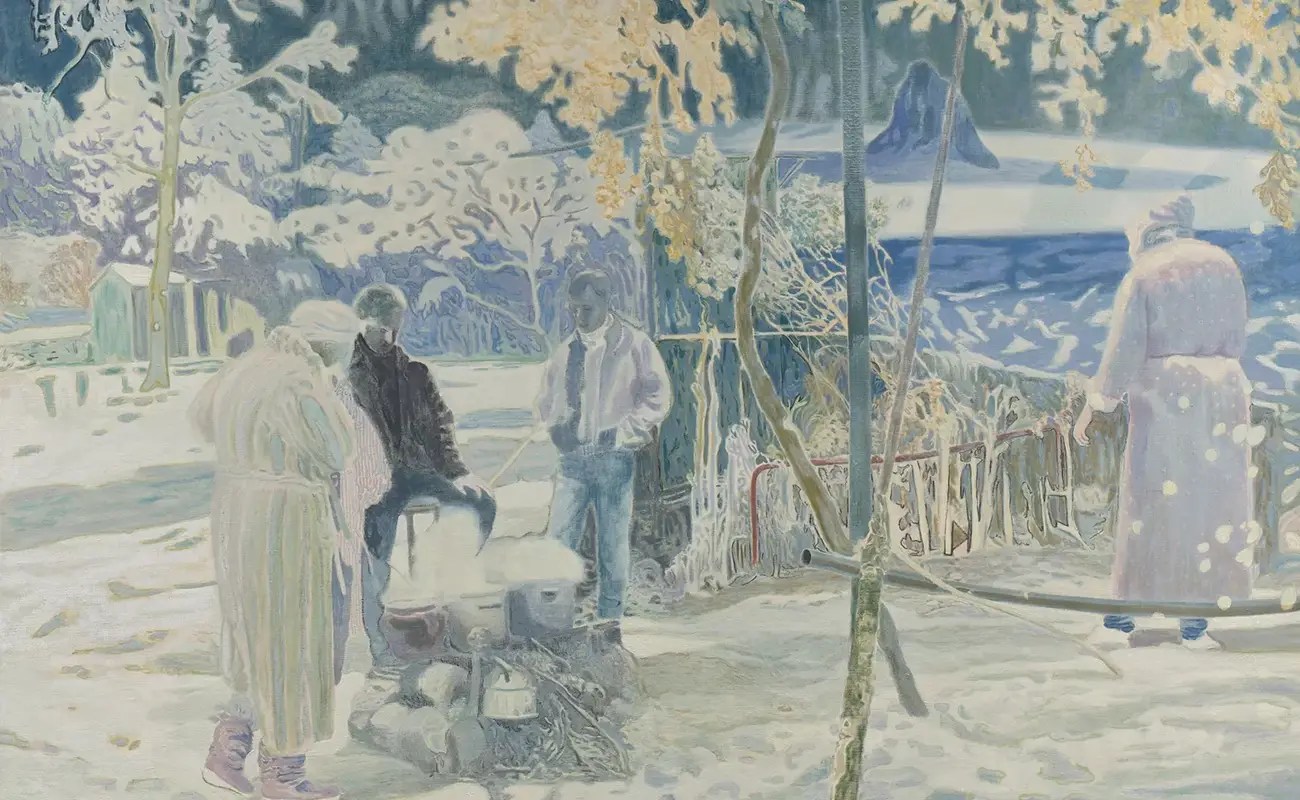
Central to McGlashan’s recent body of work is his fascination with the private spaces of artists past and present—particularly their studios, where the alchemy of creation unfolds. His paintings do not seek to mimic historical narratives; instead, they use them as jumping-off points for invention, humour, and a spirited dialogue across time. One particularly notable example of this exploration is his painting exhibited in 2019 at the Rubenshuis Museum in Antwerp. Displayed in the very studio of Peter Paul Rubens, the work marked a symbolic encounter between two artists separated by centuries but united in their dedication to the act of painting as both craft and inquiry.
In McGlashan’s view, every brushstroke holds the residue of time—his own and that of the subjects he portrays. The studio becomes more than a site of creation; it transforms into a stage where ideas from literature, cinema, travel, and art history are conjured and reshaped. Whether referencing pioneering explorers or interpreting remembered film scenes, his canvases reflect a nuanced understanding of how memory is altered by repetition, distortion, and reflection. He once described this process as a “painterly distortion,” where the original source material evolves over time spent in the studio, revealing new meanings through the act of transformation.
This interplay between fact and invention also points to McGlashan’s enduring interest in storytelling. His works often contain layers of allusion and visual references that reward prolonged engagement. Through a combination of research and intuition, he constructs scenes that feel both familiar and strangely displaced. The result is a body of work that invites viewers into an ambiguous narrative space—one where recollection, history, and creative mischief coexist. The decision to evoke rather than declare allows his paintings to operate on multiple levels, encouraging dialogue between the seen and the suggested.

The Painter as Timekeeper: Surface, Memory, and Mark-Making
McGlashan’s paintings are as much about the physical act of making as they are about their subject matter. He speaks of his work as an accumulation of time, each mark on the canvas a testament to the hours spent thinking, researching, and responding. This sensitivity to surface and materiality reflects an approach to painting that privileges process as much as outcome. The surfaces of his works often appear dense yet intimate, composed of layers that suggest both erosion and preservation, much like the layered nature of memory itself.
Much of McGlashan’s subject matter is drawn from places he has visited, books he has read, photographs he has studied, and films he remembers. But these sources are never reproduced verbatim. Instead, they are fragmented and reassembled, passing through the filter of memory and imagination. He finds particular beauty in what he describes as the “fragility of recollection,” where the original moment becomes transformed, blurred, and ultimately more poetic in its imperfections. This mutability becomes both subject and technique, with every element contributing to a larger meditation on how time changes what we remember and how we remember it.
In this way, McGlashan’s paintings operate as visual diaries—intensely personal but widely accessible, grounded in specificity but always open-ended. By treating each image as a composite of time, he blurs the lines between the remembered and the invented, the real and the imagined. It’s this tension that animates his work, creating a dynamic interplay between what is shown and what is suggested. The results are works that do not simply ask to be viewed but to be considered, questioned, and remembered in turn.

Barry McGlashan: The Art of Shared Wonder
At the core of McGlashan’s artistic philosophy is a compelling desire to connect—through image, history, and emotional resonance. He has articulated a guiding aim: to explore and evoke shared experience. This is not about documenting the world as it is but about navigating the intricate ways in which personal and collective histories intersect. In doing so, he challenges viewers to reflect not only on what they see but also on what they bring to the act of seeing. His paintings, often infused with a subtle playfulness, invite a type of curiosity that is both intellectual and emotional.
This balance between scholarship and spontaneity is perhaps one of McGlashan’s most distinctive qualities. There is a deliberate erudition in the way he researches his subjects, whether drawing on the lives of historical figures or analysing the architecture of a forgotten studio. Yet there is also a joyfulness that runs through his work—a sense of imaginative freedom that resists rigid categorization. One critic aptly described his approach as possessing “boundless curiosity” and a “naughtiness” that breathes vitality into his art. It is this unpredictable blend that makes his work feel alive, resonant, and wholly his own.
Now living and working in Edinburgh, McGlashan continues to produce paintings that reflect his commitment to exploration—not only of the world but of the ideas and memories that shape our understanding of it. His work resists the pull of finality, instead offering viewers moments of reflection suspended in paint. By embracing the fluidity of memory and the possibilities of fiction, Barry McGlashan transforms his canvases into portals through which we glimpse the complexity of human experience. In doing so, he reminds us that art need not offer answers; it can instead pose richer, more enduring questions.