Urban Pulse to Spatial Symphony
Jan Kaláb’s journey from the graffiti-covered walls of Prague to the halls of international art museums speaks to an unrelenting spirit of transformation and experimentation. Emerging in the late 1990s from the newly democratized Czech Republic, Kaláb first made his mark in the raw energy of street art. Known under the pseudonym “Cakes,” he became a vital force in shaping Prague’s underground graffiti scene. Alongside his crew, The DSK, he helped to redefine urban expression in post-communist Eastern Europe, their creations punctuating train yards and cityscapes with vibrant, defiant visual language. What began as rebellious inscriptions soon grew into a foundational practice, seeding the roots of his future explorations.
While his early work was grounded in the streets, Kaláb’s ambitions could not be confined by traditional graffiti alone. By the early 2000s, he was pushing into three-dimensional interventions, shifting from 2D tags to sculptural forms placed against public walls. Rebranding himself as “Point,” he sculpted oversized letters that acted more like visual architecture than simple signage. This was not merely aesthetic evolution—it marked a profound transition in his conceptual approach. Geometry, space, and materiality began to replace signature and territory. Graffiti morphed into sculpture; color and form became tools of abstraction. His growing interest in Neoplasticism and formal reduction signaled a deepening relationship with modernism and conceptual art.
That shift led Kaláb to the Academy of Fine Arts in Prague, where he earned his master’s degree in 2006. The academic environment encouraged an introspective turn, allowing him to develop a formal vocabulary that was increasingly meditative, geometric, and fluid. Just two years after graduation, he held his debut solo exhibition at Trafo Gallery, one of Prague’s most respected contemporary art venues. The gallery’s selective exhibition calendar highlighted Kaláb’s rapid ascent in the fine art world, acknowledging his capacity to transcend his graffiti roots while honoring the kinetic energy they provided. The show marked the beginning of a practice that would soon occupy walls, canvases, and digital spaces around the globe.

Jan Kaláb: The Architecture of Color and Form
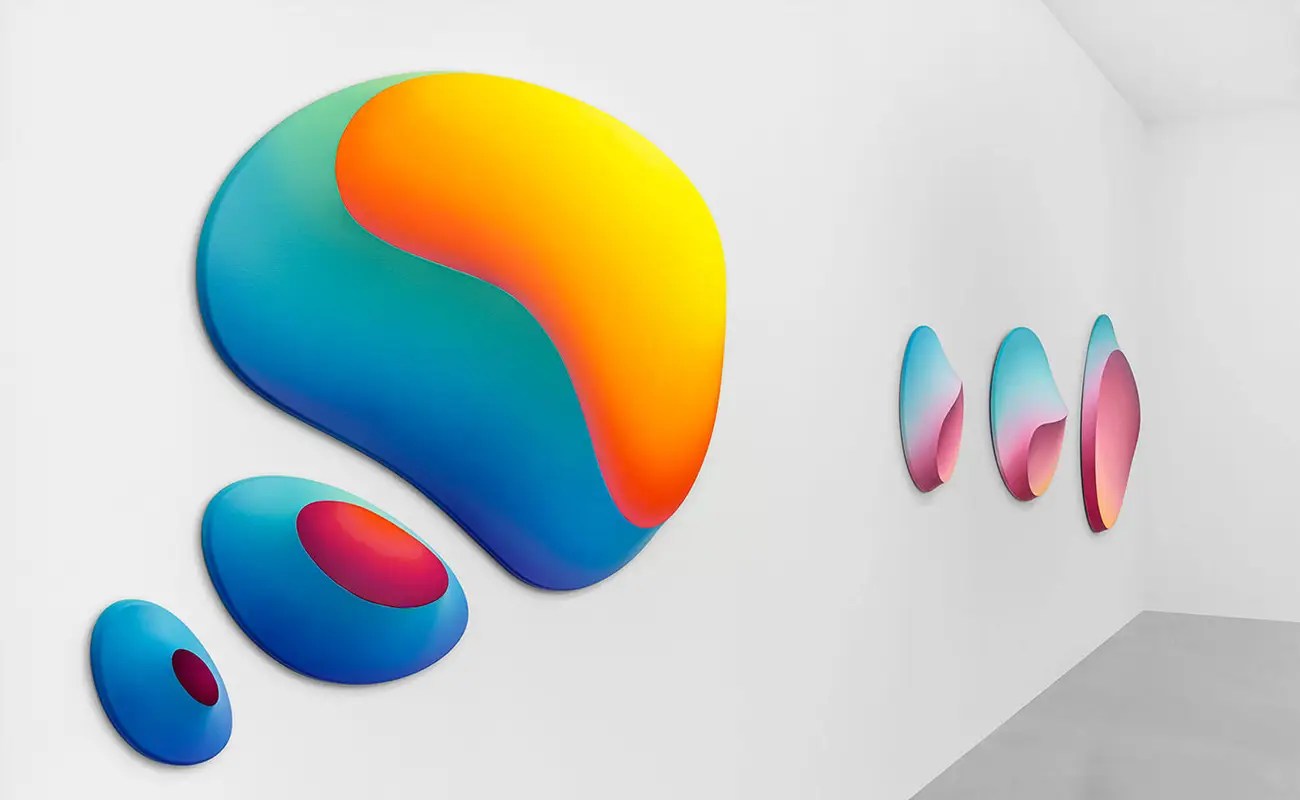
Kaláb’s work has come to inhabit a unique space between sculpture and painting, where neither discipline dominates but instead enters into a kind of visual dialogue. His painted works often possess sculptural qualities, with stretched canvases bulging from the wall in organic protrusions, while his three-dimensional pieces are rarely left unpainted. Shape and color are his true mediums, interchangeable and inseparable. He favors the circle not simply as a motif but as a conceptual anchor—a container for tension, motion, and energy. The interplay of convex and concave surfaces, layered gradients, and vibrant hues creates a dynamic in which the work seems to oscillate before the viewer’s eyes, alive with movement even in stillness.
At the heart of Kaláb’s approach lies a desire to create something entirely unfamiliar—visual experiences that don’t mimic or reference existing objects or symbols. Instead, he seeks to articulate beauty through a kind of spatial intuition. His forms often evoke biological or cosmic imagery, but always abstractly, without literal representation. He states that his goal is not to replicate the tangible world, but to manifest a vision of something as yet unseen. In this way, his art becomes an exercise in perceptual expansion, challenging the viewer to consider the fluid boundaries between memory, emotion, and dimension. His pieces often evoke sensations akin to déjà vu, as if unlocking dormant associations or long-forgotten moments.
Color in Kaláb’s work is not decorative—it’s emotional and structural. Each hue carries a vibrational energy that contributes to the overall composition’s spatial effect. The transitions between shades are often so gradual that they create illusions of depth and motion, encouraging the viewer to move around the work, changing their angle to unlock new perspectives. In some cases, the entire canvas is unframed, further dissolving the border between artwork and environment. This spatial ambiguity allows his pieces to function both as meditative focal points and active participants in the architectural context in which they’re placed. By blurring categorical boundaries, Kaláb reinvents the relationship between object and observer.

A Global Voice Rooted in Prague
While Kaláb’s artistic language is universal in its abstraction, his origins in Prague remain an integral part of his identity. Growing up during a time of profound cultural transformation, he was part of a generation navigating the new openness of post-communist Europe. His earliest interventions in public space were acts of reclaiming and reimagining urban environments previously subdued by political ideology. That sense of freedom and urgency still permeates his work, even as it now inhabits the pristine spaces of galleries and museums. The city of Prague continues to serve as both a literal and symbolic backdrop to his evolution, with its streets bearing traces of his past and present.
The scope of his exhibitions reflects both his global appeal and the growing interest in hybrid forms of contemporary abstraction. Since his first solo show in 2008, Kaláb has exhibited widely, from Bogotá to Berlin, Paris to Taipei. Prestigious venues such as the MAXXI National Museum of 21st-Century Arts in Rome, and the Albin Polasek Museum in the United States, have hosted his work, while major art publications and platforms, including Creative Boom and Lidové noviny, have recognized his contributions. He has also participated in collective exhibitions spanning five continents, further cementing his position as one of the most internationally visible artists of Czech origin today.
Beyond gallery walls, Kaláb’s large-scale murals extend his vision into the urban fabric. Cities like Bogotá, London, and Prague feature his vibrant geometries in public space, where they activate architecture with color and motion. These murals demonstrate his commitment to accessibility and his belief in art’s power to reshape public consciousness. His foray into NFTs also illustrates his responsiveness to new mediums and technologies. Whether working with pixels or paint, on a street corner or in a museum, Kaláb remains consistent in his pursuit of beauty through abstraction, always seeking to open new visual and emotional territories for his audience.

Jan Kaláb: Painting the Unseen Dimension
For Kaláb, the act of creation is akin to a metaphysical journey—a search for dimensions that do not yet exist. He often likens his artistic process to discovering unknown terrain, moving through spaces that are intangible until shaped by intuition and labor. He describes moments of euphoric clarity, when the final stroke or form not only completes a piece but signals a breakthrough in his practice. These moments of transcendence are rare but unforgettable, marking a psychological and technical leap that leaves lasting impressions on both artist and audience. They are the milestones that define his evolving body of work.
One of the most compelling aspects of Kaláb’s philosophy is his conviction that inspiration has no end. He imagines each completed piece not as a conclusion but as an opening—an invitation into further inquiry. This recursive vision guides his approach to series-based work, where shapes and patterns evolve incrementally across multiple pieces. Rather than repeating motifs for stylistic cohesion, he allows each form to suggest the next, creating a continuum of development. The circle, often central to his work, becomes not just a shape but a metaphor for this cyclical, self-renewing creative process. Its purity and paradox offer endless variables through which he investigates the tension between internal and external forces.
Kaláb’s vision is not about providing answers but about expanding the field of visual possibility. Whether evoking the cellular structures of the microcosm or the vastness of galactic systems, his works strive to embody a sense of universal connectedness. The spaces he creates—be they canvases, sculptures, or digital environments—invite a kind of contemplative engagement, urging viewers to pause and immerse themselves in sensation and perception. For Kaláb, the highest aspiration is not to represent what we already know, but to awaken in us a recognition of something we’ve never fully seen. In this search for the unseen, he continues to redefine the contours of contemporary abstraction.