
Carved Origins and the Choice to Break Away
The sculptural path of Willy Verginer unfolds from a landscape where woodcarving is not merely a craft but a shared cultural language. Born in 1957 in Bressanone, in the province of Bolzano, and trained at the Art Institute of Ortisei with a focus on painting, he entered an environment shaped by centuries of figurative tradition. Early professional experiences in the wood sculpture studios of Val Gardena immersed him in technical rigor and inherited forms, grounding his understanding of material, proportion, and manual discipline. This formative context provided more than technical skill; it offered a historical framework that he would later challenge, revise, and reshape into a personal sculptural vocabulary. The decision to engage with tradition while simultaneously questioning its limits became a defining dynamic of his artistic identity.
During the 1980s, Verginer consciously sought distance from established conventions rooted in his valley. Through self-directed study and experimentation, he began to test alternatives to ornamental virtuosity, favoring a language that emphasized conceptual tension over decorative refinement. His teaching role at the Professional School of Sculpture of Selva between 1984 and 1989 reinforced this process, placing him in dialogue with younger generations while clarifying his own position as an artist. A significant early milestone arrived with one of his first solo exhibitions at Galleria Spatia in Bolzano, curated by Danilo Eccher, where he presented abstract wooden works combined with natural materials. These pieces signaled an early resistance to narrative figuration and pointed toward a broader sculptural inquiry that extended beyond regional expectations.
The 1990s marked a period of intense exhibition activity and collective exchange, notably through the founding of the Artistic Group Trisma alongside Walter Moroder and Bruno Walpoth. This phase encouraged confrontation and mutual influence, yet it was followed by a prolonged interval of uncertainty and reduced creative output. Rather than halting his development, this pause functioned as an internal recalibration. The accumulation of doubt, research, and reflection during these years laid the groundwork for a decisive transformation. By the early 2000s, the need to redefine form, subject, and intention had matured into a clear artistic shift, setting the stage for the radical changes that would soon reframe his sculptural practice.

Willy Verginer: From Crisis to a New Figurative Language
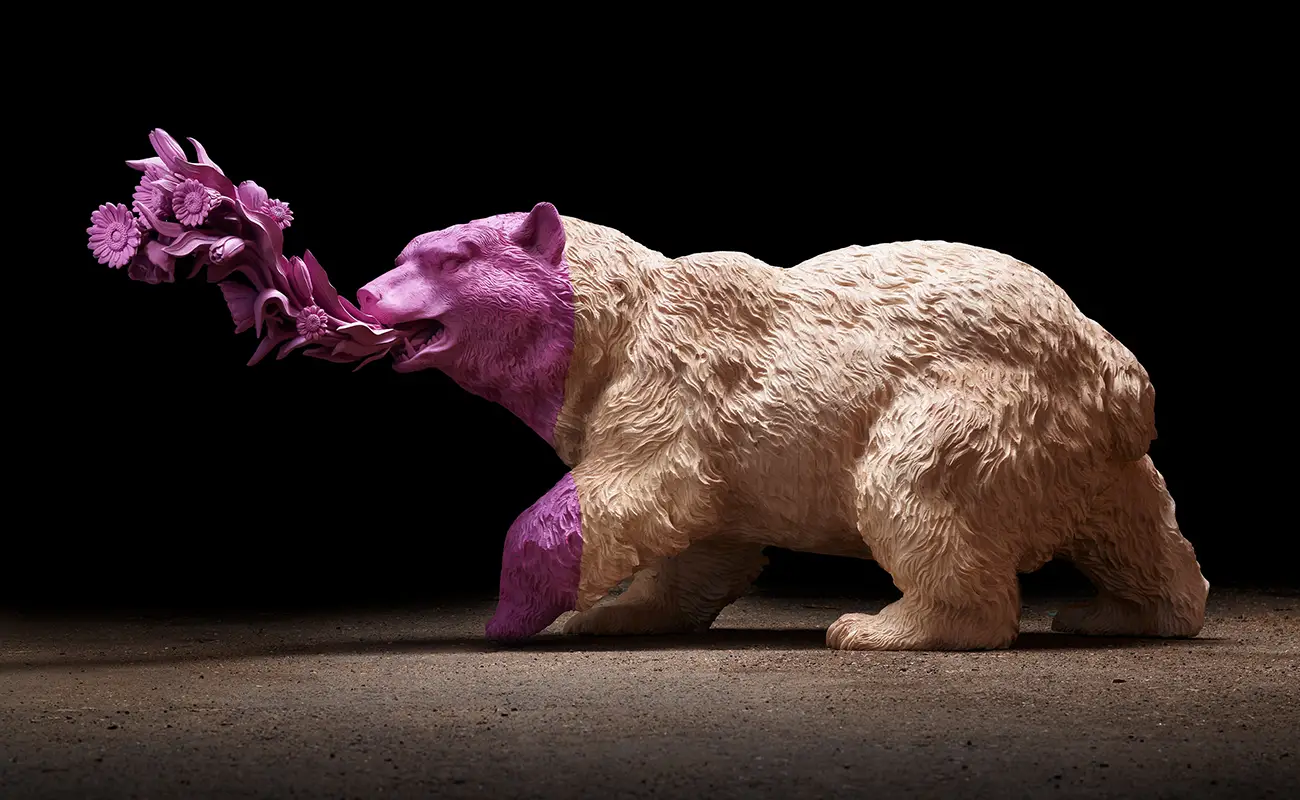
A turning point arrived in 2005 with a solo exhibition at Galleria Castello in Trento, where Verginer presented a body of work that departed sharply from his previous explorations. Figurative sculpture returned to the center of his practice, yet it appeared transformed. Human and animal forms emerged with controlled realism, carved in wood with visible traces of the hand, while acrylic paint in artificial, non-natural hues interrupted the surface. These colors did not enhance realism but actively challenged it, asserting themselves as conceptual elements rather than descriptive ones. The encounter between carved form and synthetic pigment established a visual dissonance that became immediately recognizable and set the foundation for his mature style.
This renewed direction quickly gained critical attention, leading to solo exhibitions curated by Alberto Zanchetta, Luca Beatrice, and Ivan Quaroni in cities including Vicenza, Milan, Bergamo, and Trento. The sculptures from this period often depict figures caught in moments of suspension or imbalance, their gestures restrained and expressions neutral. Boxes, tables, crates, and other ordinary objects frequently appear, situating bodies within constructed environments that suggest containment or control. Through these scenarios, Verginer introduced a quiet sense of unease, where familiarity is subtly disrupted rather than overtly dramatized. The tension between the credibility of the carved anatomy and the interruption caused by color generates a persistent ambiguity that resists simple interpretation.
International visibility followed, notably with exhibitions at the Coda Museum in Apeldoorn in 2010 and in Antwerp in 2012, where sustained exhibition activity continues to the present. His invitation to represent Trentino Alto Adige at the 54th International Art Exhibition of La Biennale di Venezia in 2011 further confirmed the relevance of his sculptural language within a global context. Participation in events such as the Biennale Italia China in Monza and the Annual Collectors Contemporary Collaboration in Hong Kong expanded this dialogue beyond Europe. Throughout these experiences, Verginer maintained a consistent focus on the relationship between form, color, and conceptual restraint, refining a language that communicates through precision rather than excess.

Cycles, Symbols, and the Expansion of Meaning
Between 2013 and 2014, Verginer initiated a significant new cycle titled Baumhaus, first presented at the Museum of Contemporary Art in Lissone and later at the Biennale Gherdëina with a monumental work bearing the same title. In this series, the figure becomes inseparable from architectural or arboreal structures, suggesting themes of shelter, vulnerability, and imposed order. The Baumhaus sculptures extend his investigation into human intervention within natural contexts, using scale and spatial presence to heighten psychological impact. The monumental installation at Biennale Gherdëina emphasized this shift, confronting viewers with a physical experience that mirrored the conceptual weight of the work.
The years that followed brought a dense sequence of exhibitions and institutional recognition. A solo show at the Ianchelevic Museum in La Louvière in 2015 coincided with participation in Open Art in Örebro and the group exhibition Nature at the Galleria Civica of Trento. His involvement in Wood Holz Lën in 2017, curated by Gabriele Lorenzoni, marked the first Italian exhibition dedicated to contemporary wood sculpture, situating his practice within a broader material discourse. That same year, a large-scale installation at Wasserman Projects in Detroit became a pivotal statement in his research on environmental themes, demonstrating a mature synthesis of form, color, and ethical reflection.
This conceptual trajectory continued with participation in Nature in Art at MOCAK in Krakow in 2019 and the launch of the Rayuela series, first shown at Zemack Gallery in Tel Aviv and later explored in a solo exhibition at Studio Arte Raffaelli in 2020. The following years saw his inclusion in the traveling exhibition Gazing of Tranquility across major museums in China, alongside the development of Il giardino perduto, presented in the church of San Barnaba in Bondo Trentino and later installed at Aky Gallery in Taipei. Recent collective exhibitions such as Net Zero in Dhahran and Future Garden in Guangdong further underline the consistency of his engagement with environmental concerns, approached through suggestion and symbolism rather than explicit narrative.

Willy Verginer: Living Wood, Artificial Color, and Contemporary Responsibility
At the core of Verginer’s sculptural language lies a deliberate friction between material authenticity and visual intervention. Wood remains central, not as a nostalgic reference but as a living substance shaped by human intention. The carved surfaces retain subtle irregularities that affirm the act of making, countering any illusion of mechanical perfection. Against this tactile presence, flat fields of artificial color assert themselves with striking clarity. These chromatic zones function as interruptions, signaling alteration, intrusion, or imbalance. Their synthetic nature stands in contrast to the organic material, reinforcing a dialogue about humanity’s impact on natural systems without resorting to overt moralizing.
Figures within his sculptures often appear calm yet constrained, their stillness charged with latent tension. Animals are presented with anthropomorphic hints or structural modifications, while human bodies may be fragmented or partially obscured by geometric supports. Such choices suggest a world shaped by control and adaptation, where coexistence between human activity and natural life is fraught with compromise. Rather than presenting dramatic scenarios, Verginer relies on restraint, allowing viewers to sense unease through proportion, placement, and color. This subtlety encourages prolonged observation, during which the emotional and conceptual layers gradually emerge.
Living and working in Ortisei, Verginer continues to develop a practice that balances continuity with renewal. His sculptures resist spectacle, instead offering carefully constructed encounters that reward attention and reflection. Through decades of experimentation, crisis, and reinvention, he has shaped a body of work that speaks quietly yet persistently about transformation, responsibility, and the fragile boundary between what is natural and what is imposed. The enduring strength of his art lies in its ability to hold beauty and disturbance in the same form, inviting viewers to confront familiar materials and figures that have been subtly, and irrevocably, altered.