
“Through my artwork I envision and create the world as I would like it to be – a place where harmony exists between animal, nature, and human.”
A Visual Language of Intuition and Connection
Sudie Rakusin has created an artistic path that defies categorization, threading together lived experience, symbolic imagery, and emotional depth. From an early age, art was not something Rakusin pursued—it was something she embodied. Gifted her first easel as a child, she found solace and joy in making art from the moment she returned home from school. This devotion never waned. Rakusin’s lifelong commitment to her practice is less a career choice and more a natural state of being. Today, her work is a vivid expression of her identity as a feminist and animal advocate, drawing deeply from her beliefs and values. Through her paintings and drawings, she imagines a more harmonious world, one in which women, animals, and nature coexist in mutual respect and beauty.
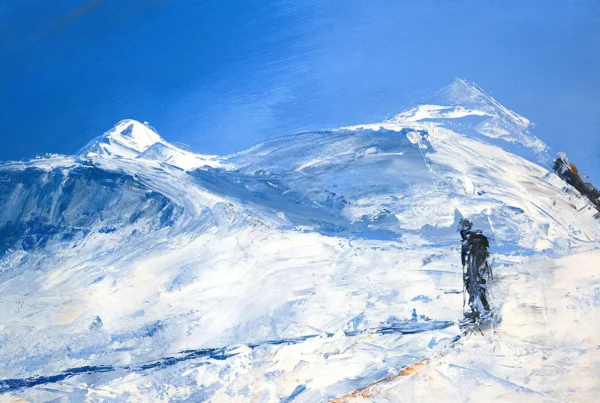
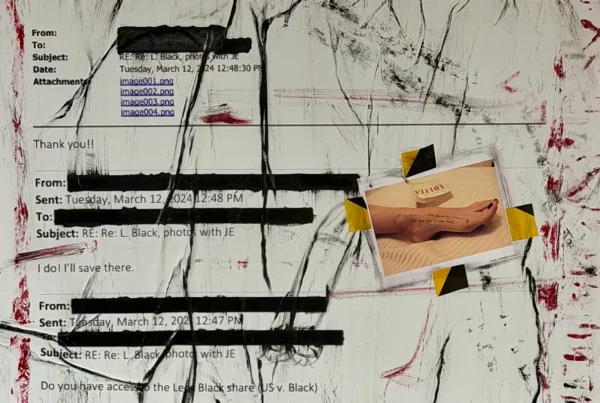
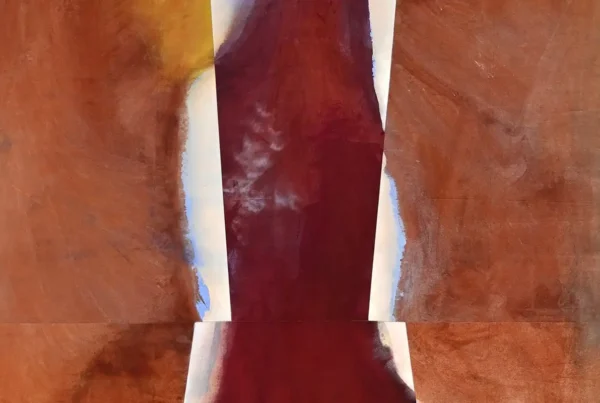
Her artistic style cannot be confined to a single label. Rakusin allows her creative direction to be guided by emotion, environment, and imagination. She explores both abstraction and figuration, often merging the two into compositions that echo both ancient symbolism and modern sensitivity. Color, light, and pattern are not merely aesthetic tools for her—they are integral elements that help communicate a deeper emotional and spiritual resonance. Women and animals are recurring figures in her work, presented not simply as subjects but as embodiments of strength, wisdom, and interconnectedness. By blending these elements, Rakusin’s pieces move beyond the canvas to propose an idealized vision of the world, grounded in reverence and empathy.
Rakusin’s approach to artmaking is inherently curious and expansive. She refuses to place constraints on her style, instead choosing to follow the flow of inspiration wherever it leads. That openness to form and meaning is reflected in the broad spectrum of visual influences and thematic undertones present in her body of work. From the delicate tracery of Renaissance painting to the spontaneous mark-making of contemporary abstraction, her compositions stand as evidence of an artist who listens closely to both the outer world and her inner voice. Each piece becomes an act of communication, not only with viewers but with the deeper forces she seeks to understand and honor.
In addition to painting and drawing, Rakusin also sculpts animals using papier mâché, further extending her creative expression into three dimensions. These sculptural works echo the same themes of reverence and vitality found throughout her two-dimensional pieces, reinforcing her deep connection with the animal world.
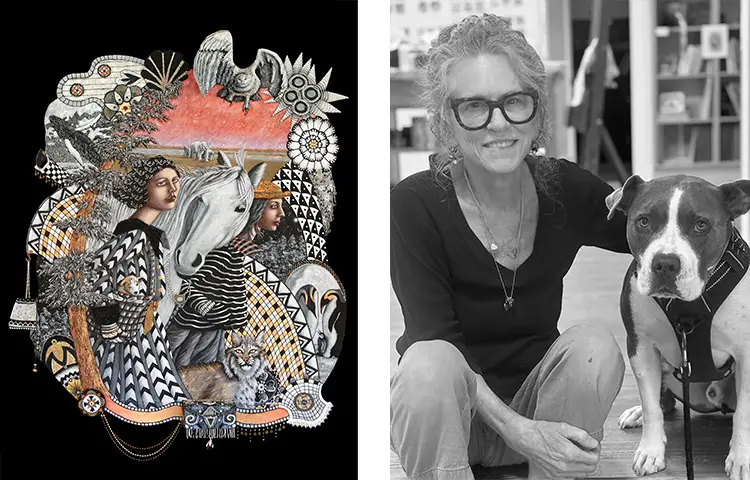
Sudie Rakusin: Translating Vision Through Symbol and Detail
Sudie Rakusin draws influence from a wide array of sources, many of which are rooted in daily experiences and fleeting moments of beauty. A walk through the woods, the glint of sunlight on a cheekbone, or the joyful sprint of her dogs across a meadow all become catalysts for artistic creation. For Rakusin, inspiration is a sensory process; colors mix in her mind before they reach the palette, and movements are studied before being rendered. She is equally impacted by literature, finding rich visual stimuli in poetry, mythology, and evocative prose. Words that spark images become seeds for new work, encouraging a translation of language into line, texture, and color. These influences reveal an artist who is deeply engaged with her environment and alert to its many nuances.
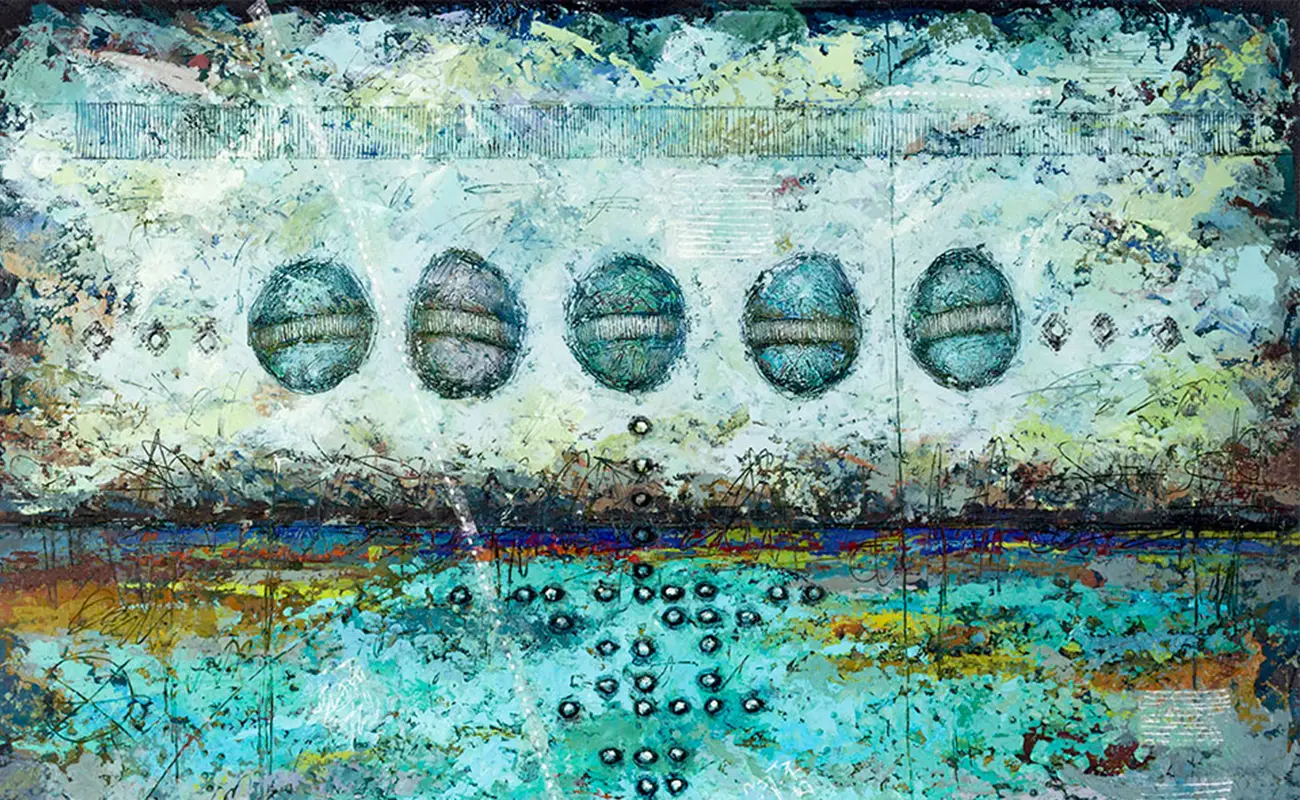
Historically, Rakusin is drawn to the Northern Renaissance, a period that resonates with her for its intricate craftsmanship and symbolic density. The era’s precise line work, ornamental patterning, and layered meanings align closely with her own sensibilities. She admires how objects in those paintings carried more than visual weight; they held stories, beliefs, and coded messages. Rakusin channels this same impulse in her own art, embedding symbolic motifs throughout her compositions. Grids, orbs, and ladders frequently appear in her abstract pieces, hinting at metaphysical concepts like ascension, containment, and cosmic order. These symbols enrich her work with layers of significance, inviting viewers to pause and interpret rather than simply observe.
While her abstract works display textured surfaces that suggest ancient maps or sacred manuscripts, her figurative pieces occupy a different, though equally symbolic, terrain. Women and animals populate richly patterned landscapes, their gestures and expressions conveying a profound serenity and inner power. In these works, the boundary between the real and the fantastical is fluid, allowing for a dreamlike ambiance that evokes illuminated texts or visionary storytelling. Her female figures are not passive muses but central, empowered presences. Animals—often symbolic and deeply expressive—enhance the emotive charge of these scenes. Rakusin constructs these compositions not as frozen moments but as visual myths, capable of communicating across time and language.

Art as Sanctuary and Inner Compass
Art, for Sudie Rakusin, is far more than a creative endeavor; it is a form of healing, a sanctuary, and an ongoing act of self-discovery. Each piece she creates holds a personal resonance, infused with the emotions experienced during its making. Rakusin doesn’t separate her inner world from her artistic process, as the two are intrinsically bound. This connection becomes especially profound during moments of grief or physical recovery. After losing her beloved dog, Marmalade Moon, and during the challenging period following open-heart surgery, Rakusin turned to her art not just as an outlet, but as a way to reestablish balance and meaning. In her studio, surrounded by the tools of her practice, she finds comfort and continuity. The act of drawing or painting makes the world feel more coherent and beautiful, especially when personal circumstances feel fragile.
Rakusin maintains a structured approach to her daily work, guided by a sense of purpose that she attributes to her father’s influence. Regardless of inspiration, she arrives at her studio each day, believing firmly that consistency invites creativity. Her discipline is not rigid but intentional; she shows up to signal her availability to the Muse. This daily ritual of presence fosters an environment in which new ideas can emerge organically. The studio becomes a space of quiet anticipation, where even the blank canvas carries the potential for revelation. Her creative tools are always prepared, reinforcing the belief that artistic insight often comes not from waiting, but from working.
One of her most recent projects was a series of eleven paintings inspired by numerology. Though she hasn’t yet determined what direction her next body of work will take, Rakusin embraces that uncertainty with openness. She trusts that when the next idea is ready, it will arrive—often unannounced, yet unmistakable. This fluid, receptive approach mirrors the themes present in her artwork: cycles, transformation, and intuitive knowledge.
For Rakusin, abstract work in particular presents a unique challenge. While she finds ease and clarity in painting women, animals, and natural forms—where a clear beginning, middle, and end often reveal themselves—abstraction requires a different kind of listening. She recalls a quote by Carol Shields: “How does a poet know when a poem is ended? Because it lies flat and taut, nothing can be added or subtracted.” This insight has become a guiding principle in her process. While working on an abstract piece, Rakusin will sometimes hear an inner voice quietly affirm, “I think you’re done.” When she steps back and truly looks, she often finds that to be true. Over time, she has learned to embrace this ambiguity and be at peace with the not-knowing. For her, it is yet another form of trust—an invitation to respond with intuition rather than certainty.

Sudie Rakusin: A Feminist Mythmaker in Paint and Pattern
Sudie Rakusin’s work stands apart for its bold synthesis of personal belief, artistic exploration, and feminist vision. Her paintings speak of a world that centers the wisdom of women, the sanctity of animals, and the spiritual depth of natural forms. In her figurative compositions, the female body is not objectified but revered. These women, often adorned in intricately patterned clothing and surrounded by vivid natural motifs, radiate both sensuality and stillness. They appear as priestesses or guardians, connected to cycles older than language. Animals are not side figures but partners in these scenes—often owls, horses, or leopards—projecting a sense of watchfulness and intuition. These creatures carry symbolic weight, suggesting themes of transformation, protection, and wild intelligence.
Her use of pattern is especially significant. Patterns flow through her works like a second language, appearing in garments, landscapes, and sky forms. These decorative elements are not ornamental in the trivial sense; they are layered with cultural memory and artistic inheritance. Rakusin draws from textile traditions, sacred geometry, and historical decoration, weaving these references into her visual storytelling. The result is a visual surface that invites extended viewing and multiple interpretations. Whether exploring grief, empowerment, or connection, her art provides a sensory and psychological experience that encourages contemplation rather than consumption.
Rakusin’s abstract works expand her mythmaking into more conceptual territory. Without direct narrative, these pieces use color, shape, and texture to suggest hidden systems or spiritual maps. They often feel ancient yet modern, meditative yet vibrant. Symbols such as ladders or grids appear frequently, acting as thresholds or frameworks for meaning. Even in the absence of figures, there is a quiet vitality in these compositions—a sense that they are alive with intention and message. This dual ability to work in both figurative and abstract modes allows Rakusin to speak to different facets of the human experience. She is not confined to a single voice but moves fluidly between languages of representation and suggestion, always grounded by her unwavering commitment to art as truth.
How to reach Sudie Rakusin:
Website: sudierakusin.com
Email: [email protected]
Instagram: @sudie.rakusin