
“I paint movement. I paint becoming. I paint aliveness — the kind that only reveals itself when everything unnecessary has been stripped away.”
A Life That Became Its Own Training Ground
Priscilla Visser, known professionally as P. Alive, occupies a distinct position within contemporary abstract art, one shaped less by formal instruction and more by lived transformation. Her creative practice emerges from a life marked by illness, rupture, awakening, and renewal, experiences that demanded a relentless stripping away of false structures and inherited narratives. Long before she named herself an artist, her personal history compelled her to confront emptiness and rebuild from a place of internal honesty. This process forged a profound relationship with consciousness itself, which continues to guide her work. Rather than treating art as a separate discipline, Visser understands creation as an extension of survival, awareness, and integration, where making becomes a form of listening rather than assertion.
This foundation deeply informs the way her work exists in the world. Visser does not approach painting as a means of illustration or commentary, but as an embodied practice rooted in presence. Her background shaped an instinctive sensitivity to energy, movement, and internal states, allowing her to bypass conventional compositional strategies. What emerges instead is an approach where truth precedes image, and motion precedes form. Each piece is born from an internal alignment, a conscious return to a deeper source that directs the work from within rather than from external expectation or aesthetic trend.
Within the broader art landscape, this orientation grants her practice a quiet authority. Her paintings feel lived rather than designed, carrying the weight of accumulated experience without relying on narrative explanation. The significance of her work lies not in stylistic novelty, but in its commitment to authenticity. By allowing her life to function as her earliest training, Visser established a practice that remains responsive, grounded, and uncompromisingly sincere, offering viewers an encounter with art that reflects internal transformation rather than surface intention.

Priscilla Visser: Inner Architecture and the Language of Becoming
Visser often explains that she did not become an artist so much as recognize what had always been present. From her perspective, creativity existed as an internal language long before it manifested visually. Movement, energy, and awareness formed her first vocabulary, later translated into physical materials. This understanding defines her current style, which resists fixed identity in favor of ongoing becoming. Her paintings operate through layered phases that echo psychological and spiritual evolution, capturing moments of collapse, recalibration, and renewal without attempting to resolve them into a final statement.
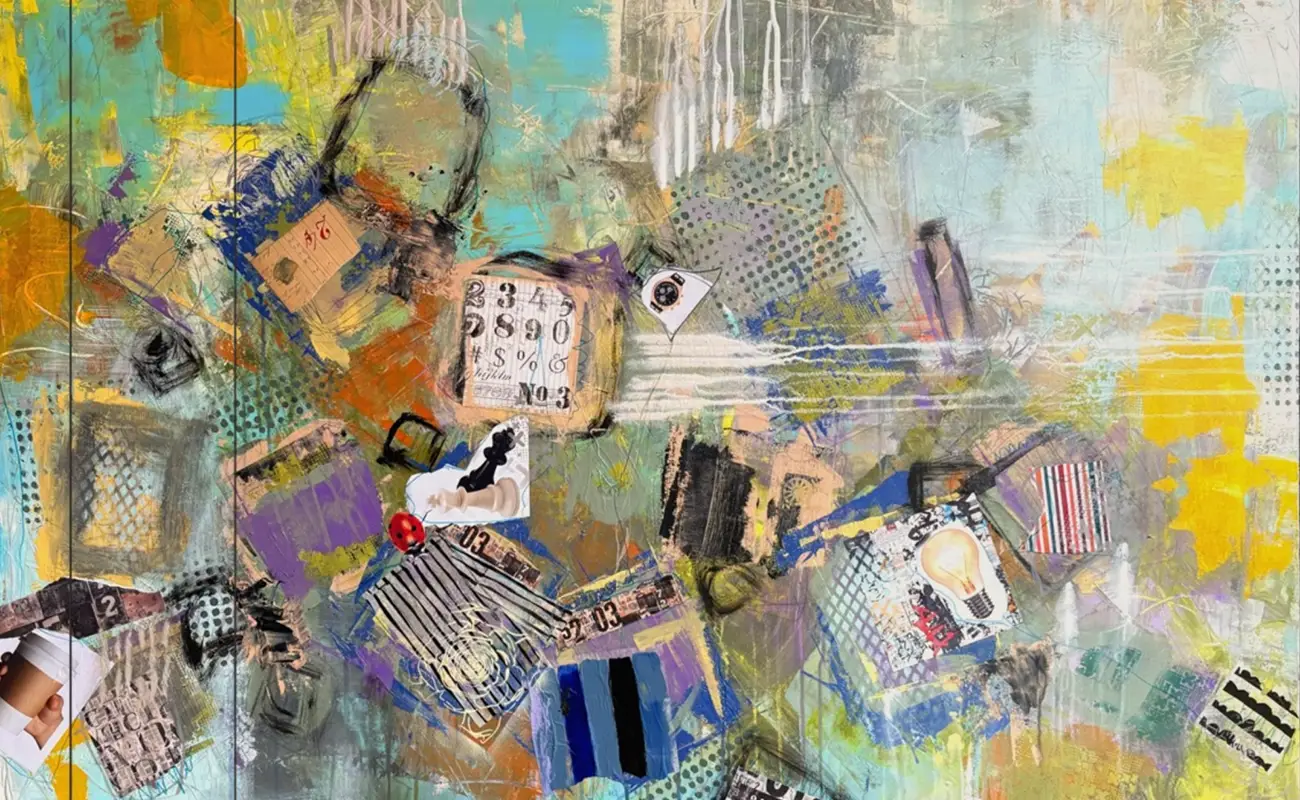
Central to this approach is the concept of inner architecture. Beneath the visible gestures and surfaces lies a framework built from repetition, structure, and interruption. Collage elements, grids, numerals, paper fragments, and textured grounds establish a hidden scaffolding that is repeatedly concealed and uncovered. This process reflects the tension Visser explores between control and release. Order is constructed, challenged, softened, and partially revealed again, mirroring the internal processes through which individuals confront fear, dissolve resistance, and reorganize themselves through awareness.
Her core themes consistently return to the truth of becoming, a state that acknowledges what exists beneath distraction and noise. Rather than presenting identity as fixed or resolved, her work emphasizes return, the act of remembering what has always been present but obscured. This philosophy allows her paintings to remain open and alive, never concluding their own narrative. Through this lens, abstraction becomes not an escape from meaning, but a direct engagement with it, offering a visual language capable of holding complexity without forcing closure.

Accumulation, Disruption, and the Energetic Archive
Formally, Visser’s paintings align with contemporary abstract expression and intuitive collage, yet they remain distinguished by a strong autobiographical and metaphysical urgency. Her surfaces are accumulated rather than composed, functioning as energetic archives where material records states of consciousness instead of visual stories. Each layer carries residue, memory, and intention, creating what might be understood as a lived record rather than a designed composition. This accumulation allows the work to feel dense with experience, even when individual elements remain partially obscured.
Her process follows a cyclical rhythm that defines both method and meaning. History is built through collage and mark-making, then disrupted through scraping, washing, and assertive gestures. Softening follows, allowing new relationships to emerge, before selective revealing brings fragments back into visibility. Radiator-brush strokes, dripping veils of acrylic, graphite marks, and ink lines coexist with underlying structures that suggest containment and memory. This oscillation between the visceral and the structured generates a productive friction, where immediacy is held within a sense of internal order.
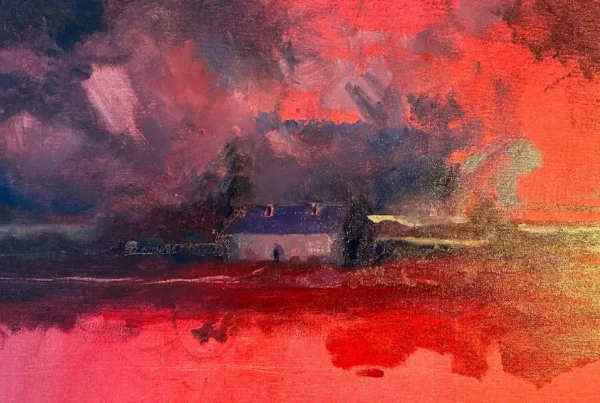
Color within her work behaves as energy rather than decoration. Acidic pinks, earthen reds, muted greens, pale blues, and chalked whites appear bruised, luminous, or partially erased, reinforcing the sense that these paintings arise from lived intensity. One early and meaningful piece marked a pivotal shift in her practice, when she stopped painting images and began painting truth. At its center formed a dense collage core, surrounded by acrylic, ink, graphite, and accidental histories. That work revealed itself as energetic biography rather than composition, establishing a relationship where the painting led and Visser followed.

Priscilla Visser: Presence, Process, and Spaces of Restoration
Visser’s daily practice begins long before paint meets surface. Each working day starts with alignment, a conscious return to presence that prepares her to engage material from a grounded state. Movement precedes gesture, allowing the body to guide the first marks rather than conceptual planning. The initial contact often arrives through a radiator brush, setting the tone for a process that unfolds in distinct phases. History-building, disruption, softening, and revealing occur not as rigid steps, but as responsive actions guided by what the work requires in each moment.
This attentiveness ensures that her paintings remain collaborative rather than controlled. She listens to the surface, allowing it to dictate pacing, pressure, and direction. The resulting works feel both raw and held, reflecting a balance between surrender and structure. Embedded materials, ghosted marks, and partial symbols suggest memory without nostalgia and identity without portraiture. Viewers encounter spaces that invite feeling rather than interpretation, emphasizing sensation and resonance over intellectual decoding.
Looking forward, Visser envisions expanding this sensibility beyond the canvas. Her aspiration is to create an immersive installation that integrates light, sound, sculpture, and painting into a unified environment. The goal is not spectacle, but resonance, offering a space where people feel safe, whole, and gently restored. This vision aligns seamlessly with her existing practice, extending her commitment to presence and inner return into shared physical space. Through this evolution, her work continues to position abstraction as a direct encounter with truth, grounded in awareness and human experience.