
“I realized that the images carried something more than documentation. They held memory, emotion, and a quiet sense of place.”
Rooted Vision and the Quiet Authority of Place
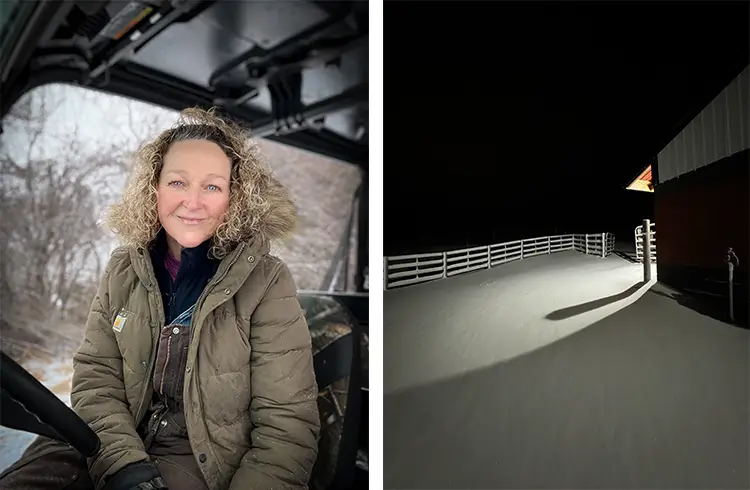
Life on a small farm in rural Wisconsin forms the foundation of Michaela Foreman’s photographic practice, shaping not only what she sees but how she understands seeing itself. Her days unfold according to seasonal cycles, animal care, and the steady labor required to grow food, and this lived structure gives her work a sense of gravity that resists haste. Photography emerges from within this environment rather than being imposed upon it. The land, weather patterns, and gradual shifts of light create a framework in which observation becomes a daily discipline. Foreman’s images carry the imprint of this pace, offering viewers an encounter with moments that feel earned through attention rather than extracted through urgency. The significance of her work within the contemporary photography landscape lies in this commitment to ordinary experience, framed with respect and restraint, allowing subtlety to take center stage.
Before settling into rural life, Foreman spent many years in cities, building a professional identity far removed from the art world. Her earlier career included work as a computer programmer, project manager, and entrepreneur, roles that demanded efficiency, planning, and abstraction. The transition from those environments to farming introduced a profound shift in perception. Rural living required her to slow down and notice incremental change, whether in soil conditions, animal behavior, or the quality of morning light. That recalibration of attention became the backbone of her photographic language. Instead of dramatic gestures or constructed scenes, her images reflect accumulated awareness, shaped by repetition and care. The camera became a tool for honoring the knowledge gained through living closely with the land rather than a device for spectacle.
This background grants Foreman’s photography a distinct emotional register. Her work does not separate labor from beauty or routine from meaning. The same patience required to tend animals or prepare fields is present in how she waits for a moment to unfold before lifting the camera. Through this approach, her photographs speak quietly but with confidence, inviting viewers to reconsider what constitutes significance. By grounding her practice in daily life rather than artistic convention, Foreman contributes a body of work that feels both deeply personal and broadly resonant, anchored in the shared human experience of paying attention to where one stands.
Michaela Foreman: An Unconventional Path Toward Recognition
Foreman’s entry into photography did not follow an academic or institutional route, and this distance from traditional art training continues to inform her outlook. Photography began as a private act of documentation, a way to record the realities of farm life for herself rather than for an audience. Over time, the images revealed emotional weight and narrative depth that extended beyond simple record keeping. Memory, feeling, and place became embedded in the photographs, and Foreman recognized that the act of photographing was helping her understand her surroundings more fully. This realization marked a turning point, transforming a personal habit into a committed artistic practice grounded in lived experience.
Early encouragement played a meaningful role in this evolution. Sharing images on Instagram allowed her work to reach viewers organically, where it began to attract attention and affirmation. Support from her husband, who gifted her a Fuji camera, provided both practical means and emotional confidence to pursue photography with greater intention. Guidance from her brother in law, an established artist and professor, offered reassurance that her perspective held value. Foreman has spoken about feeling supported by circumstances aligning in her favor, referencing publications, exhibitions, and her own solo show as moments that affirmed her direction. These milestones arrived without abandoning the humility that defines her approach, reinforcing her belief that authenticity carries its own momentum.
Recognition continued to grow through awards and exhibitions, including repeated honors from the Julia Margaret Cameron Awards, acknowledgments from the Pollux Award, and selections for international platforms such as FotoNostrum in Barcelona and the London International Creative Competition. Publications in Black and White Magazine and inclusion in the World of Photography Book expanded her reach, while exhibitions at the SEC Center of Photography and a solo presentation at Levee Contemporary Gallery in Wisconsin grounded her presence locally. These achievements reflect not a strategic climb but a steady accumulation of trust from the photographic community, earned through consistency and sincerity rather than trend alignment.

Living with Light, Labor, and Influence
The defining qualities of Foreman’s visual style rest on simplicity and honesty. She gravitates toward natural light, unguarded moments, and scenes where imperfection is not corrected but welcomed. Her photographs often center on the intersection of land and labor, capturing how work shapes both environment and identity. Solitude appears frequently, not as isolation but as space for reflection, while the passage of time reveals itself through weathered surfaces, seasonal change, and quiet repetition. These themes form a cohesive language that invites viewers to slow their own pace and meet the images on their terms, engaging with what is present rather than what is embellished.
Influence in Foreman’s work arises primarily from life experience rather than from specific artistic figures. The land itself functions as her most consistent collaborator, dictating rhythm, mood, and possibility. Light shifts, storms, animal movement, and seasonal extremes shape not only the visual content of her photographs but also their emotional tone. Her experience immigrating from the United Kingdom to the United States introduced questions of belonging and adaptation that continue to inform her sensitivity to place. Building a life through entrepreneurship, forming a family with her husband, raising stepchildren, and becoming a grandmother have all deepened her awareness of continuity and care. These layers of experience quietly guide how she frames each image.
Foreman’s respect for other photographers also reflects this orientation toward gratitude and presence. She speaks about valuing images not only for their visual strength but for the fact that someone was there to witness a moment fully, emotionally and attentively. This appreciation reinforces her own commitment to showing up consistently in her environment, camera in hand, without expectation of outcome. Rather than following theory or fashion, her work grows out of attentiveness, shaped by what daily life offers when observed with patience. This grounding allows her photographs to communicate across contexts, connecting personal history with shared human feeling.

Michaela Foreman: Presence, Process, and the Meaning of Morning Light
One photograph holds particular significance within Foreman’s body of work, taken early in the morning on her farm just after first light. The image presents a familiar scene composed of earth, shadow, and emerging brightness, yet its power lies in the stillness it conveys. Nothing dramatic occurs within the frame, and that restraint is precisely why the photograph matters to her. It captures the moment before the day asserts itself, when labor has not yet begun and the world feels briefly suspended. For Foreman, this image encapsulates her understanding of photography as an act of presence rather than display, reminding her that attention alone can reveal meaning.
The medium for this work, as with all her photography, is digital, though her approach resists speed or excess. She works slowly and intentionally, often returning to images in reflection rather than chasing constant production. This particular photograph serves as a touchstone within her practice, a reminder that complexity is not required to communicate depth. By revisiting it, she reconnects with the values that guide her work, patience, humility, and trust in what unfolds naturally. The image reinforces her belief that photographs can hold emotional weight without explanation, allowing viewers to bring their own experiences into the encounter.
Daily life continues to shape how Foreman works and what she hopes to build next. Her days are divided between farm responsibilities and photography, though the boundary between them remains fluid. She photographs when instinct and light align, often during early mornings or at day’s end, allowing scenes to develop without interference. Looking forward, she aims to continue developing a long term body of work centered on rural life and place, seeking a cohesive series that communicates not only how the land appears but how it feels to inhabit it. Through this ongoing commitment, Foreman’s work aspires to speak quietly across cultures, where specific places become reflections of shared humanity.