
“Any cocoon can become a coffin if you stay in it too long.”
Formed by Museums, Motion, and Early Knowing
Judi Lightfield’s artistic sensibility was shaped long before she ever considered a career in the arts, formed through constant exposure rather than formal declaration. Growing up just outside New York City, she regularly visited the Metropolitan Museum of Art and the Museum of Modern Art, where civilizations and movements unfolded before her as part of daily life. Ancient Egyptian sculpture, classical Greek and Roman works, Renaissance painting, Impressionism, and Abstract Expressionism were not distant historical markers but familiar presences. Art existed as a lived experience, something absorbed through repetition and proximity rather than instruction. This immersion created a visual fluency that later became foundational to her work, allowing her to move intuitively between representation and abstraction without feeling bound to a single tradition or lineage.
That early awareness developed alongside personal instability. At thirteen, Lightfield ran away from home and lived briefly on the Lower East Side of Manhattan, an experience that exposed her to both freedom and vulnerability at an early age. Her childhood was marked by difficulty, yet it also reinforced a sense of independence and resilience. Even then, art remained a constant thread. She had already begun drawing obsessively as a child, fascinated by how pressure and touch could alter color and meaning. By her teenage years, oil painting entered her life, followed by a temporary departure due to a physical reaction to solvents. These early experiments across materials reinforced her sensitivity to process and physical response, lessons that would later resurface in her mature practice.
Education eventually provided structure without dulling her instincts. Lightfield initially studied Environmental Design at the University of Massachusetts before transferring to the University of Oregon, where she completed a Bachelor of Science in Fine Art. This academic journey strengthened her understanding of spatial relationships and visual systems while allowing experimentation to remain central. Moving to Colorado after graduation introduced her to dramatically shifting weather, vast landscapes, and atmospheric conditions that would later influence her approach to space, edges, and form. From the beginning, her work reflected a balance between observation and emotion, between what is seen and what is felt but not easily defined.

Judi Lightfield: Career Momentum, Loss, and Reinvention
Relocating to Denver in 1977 marked the beginning of Lightfield’s professional emergence. Her first gallery exhibition in 1984 resulted in five sold paintings, though only two were paid for before the gallery collapsed financially. This early experience became a recurring metaphor for her career, steady advancement paired with unexpected setbacks. Despite such challenges, her work gained traction throughout her thirties and forties, leading to representation in galleries across the United States. Cities such as San Francisco, Chicago, Atlanta, Houston, Palm Springs, Scottsdale, and Jackson, Wyoming became part of an expanding professional map, reflecting both commercial success and sustained creative output.
Alongside her studio practice, Lightfield worked for twelve years at the Denver Art Museum as an exhibition designer. This role sharpened her understanding of how viewers move through space and encounter objects over time. Designing wall arrangements, lighting schemes, and interpretive elements required clarity, restraint, and an ability to honor cultural context. Exposure to Native American, Mesoamerican, Asian, Western, European, and contemporary departments deepened her awareness of how meaning is shaped by presentation. This sensitivity later translated into her paintings, which guide the eye deliberately while allowing space for contemplation rather than instruction.
In February 2005, her life shifted irrevocably with the sudden death of her daughter, Sarah, caused by an allergic reaction to prescribed medication. The loss fractured Lightfield’s sense of stability and purpose, bringing her flourishing career to a halt. One year later, she transformed grief into action by selling her remaining paintings through two fundraising events, raising thirty eight thousand dollars to establish the Sarah McConnell Fund at the Denver Foundation. The years that followed were defined by rebuilding, both personally and artistically. Reinvention came slowly, requiring patience and a willingness to reexamine not only how she worked, but why she worked at all.

Process, Color, and the Discipline of Letting Go
Lightfield’s painting process mirrors lived experience, marked by anticipation, conflict, and resolution. Entering the studio always presents possibility. The beginning of a painting feels expansive and hopeful, with color drifting freely and forms suggesting land and sky without resistance. As work progresses, tension arises. Shapes compete, colors clash, and nothing seems willing to settle. This stage demands persistence rather than certainty. Finishing a painting becomes an intense act of focus, where minor adjustments in value, line, or hue can shift the entire composition. Completion is less about perfection than recognition, knowing when balance has been reached and when further effort would diminish what has emerged.
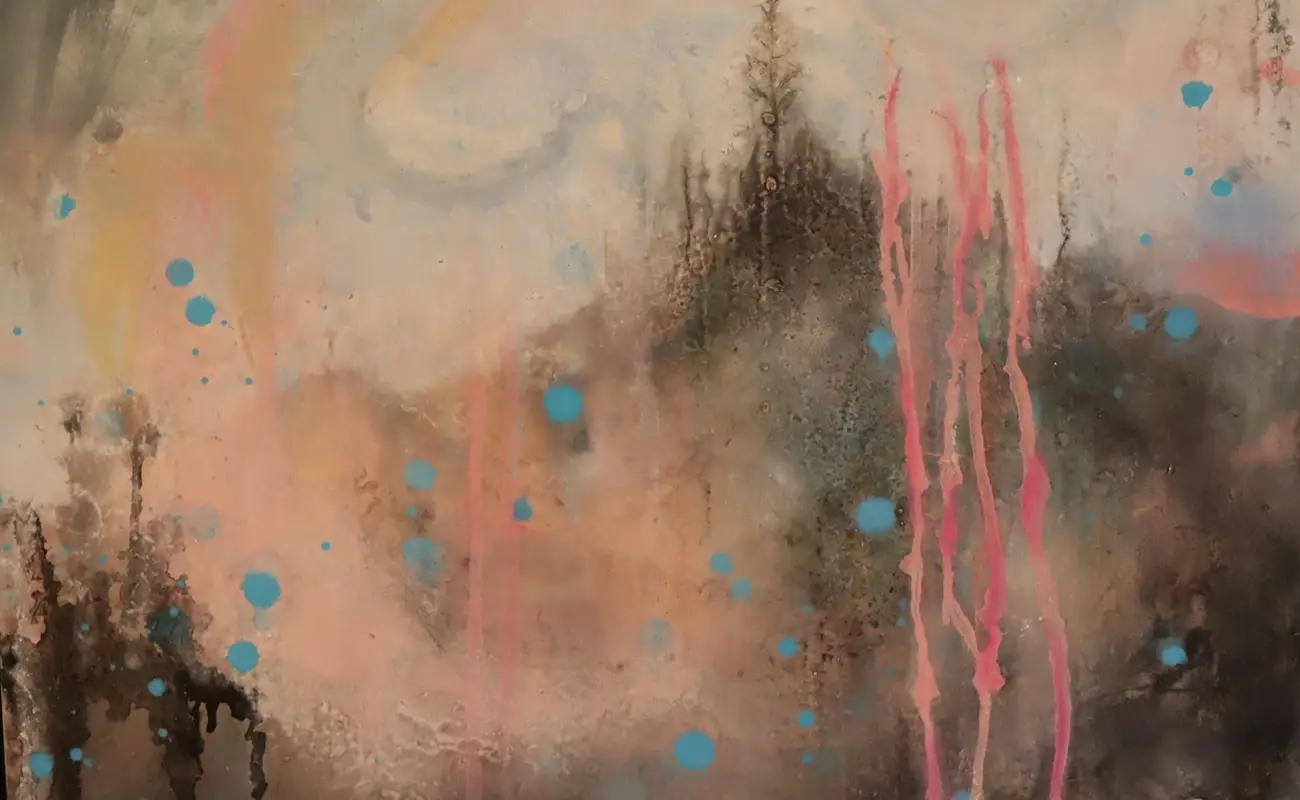
Color remains her most trusted guide. Lightfield possesses an acute sensitivity to chromatic relationships, aware that perception changes based on proximity and contrast. A blue can read as luminous or dull depending on its neighbors, while a subtle shift can revive or flatten a surface. Muddy passages often require starting again, reinforcing her acceptance of risk and repetition. She frequently paints over older works, allowing previous textures and decisions to inform the present surface. Roughness is embraced rather than concealed, adding physical history to each piece. Edges are softened or sharpened deliberately, creating spatial movement without rigid boundaries.
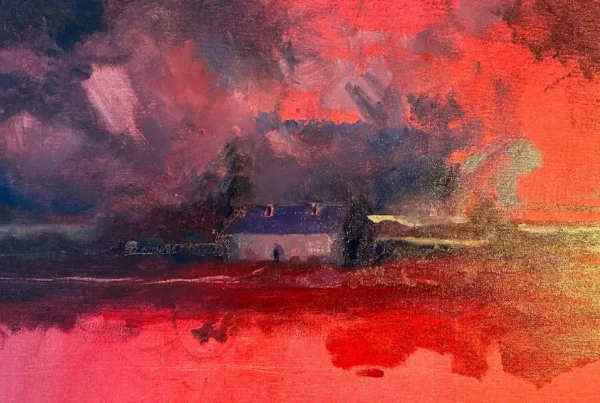
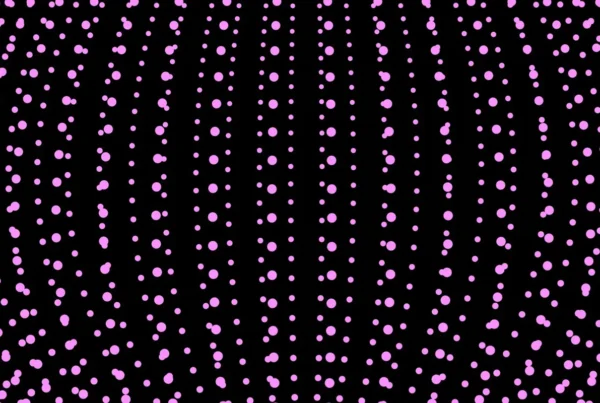
Her approach to landscape reflects an attraction to transition rather than definition. Colorado’s rapidly changing weather and mountain environments taught her to observe impermanence firsthand. Clouds without fixed outlines, shifting light, and the experience of multiple seasons in a single day shaped her preference for ambiguity. The ephemeral became central to her vision. In earlier series, abstracted landscapes served as emotional stand ins for relationships with family and friends. Later, bubble forms emerged as metaphors for personal realities, questioning whether protection limits freedom. Her current body of work, Some Thoughts about Orbs, extends this inquiry. On first seeing the paintings, the orbs stand out. With time, the landscape reveals itself. Staying longer, the orbs begin to occupy the space between land and sky, making the invisible visible. Edgar Degas once noted that art concerns what one allows others to see, a sentiment that resonates deeply within this work.

Judi Lightfield: Teaching, Orbs, and the Search for the Improbable
Teaching became another vital extension of Lightfield’s practice. Completing a Master of Arts in Education at Regis University allowed her to combine studio knowledge with language, helping others articulate visual ideas. Over twenty one years, she taught drawing, painting, two dimensional and three dimensional design, color theory, art history, and art appreciation. Her students ranged from early childhood to advanced age, reinforcing the belief that creativity remains accessible throughout life. Verbalizing visual concepts strengthened her own clarity, sharpening her awareness of structure, intention, and communication within her artwork.
Each body of work informed the next. From explorations of relational landscapes to bubble installations that reimagined the opening of Genesis, Lightfield continuously challenged her assumptions. In the bubble series, she learned to suggest both earthly and outer space environments, pushing paint to imply depth without literal depiction. These investigations laid the groundwork for her current focus on orbs. Using oil paint thinned with mineral spirits and guided by gravity and air, she initiates each painting through controlled unpredictability. Color choices reflect emotional states, while time and patience determine when intervention is necessary. The process involves extended waiting, allowing surfaces to record movement, restraint, and duration.
The orbs themselves carry layered meaning. They suggest particles, energy, and unseen presences that coexist with the visible world. Figures have reentered her work as well, evolving from rigid forms into lighter, more fluid presences that float or press against invisible boundaries. Negative space functions as landscape, organized by horizon and tension. Titles often reference color, grounding abstraction in material decisions. Fully invested in this body of work, Lightfield searches for the improbable, pointing toward a quiet spiritual balance within uncertainty. Her paintings do not dictate interpretation. They offer space, inviting viewers to recognize connections between intention and chance, and between the tangible world and what quietly surrounds it.