
“Art can transform grief into beauty and return forgotten stories to the light.”
At the Edge of Feeling and Form
The artistic practice of Yos Joseph Tany unfolds in a charged space where perception, intuition, and structure meet. His paintings emerge from sustained attention to boundaries rather than fixed categories, engaging zones where landscape dissolves into abstraction and emotion organizes itself into visual rhythm. This orientation has allowed his work to grow outside the confines of a single style, encouraging continuous evolution across decades. Rather than aiming for stylistic resolution, Tany treats painting as an active process of inquiry, one that reflects inner states while remaining responsive to the external world. His art consistently seeks connection, restoration, and an intensified awareness of presence, positioning each canvas as an encounter rather than an object.
This approach was shaped by a life grounded in reverence toward people, nature, and unseen forces. Such an upbringing instilled a sensitivity to continuity and inheritance, which later became foundational to his creative language. Tany understands himself as participating in a living artistic lineage that stretches across centuries, not through imitation but through resonance. Historical currents are not distant references in his work but active streams that still move through contemporary consciousness. This perspective informs his belief that painting can act as both a personal offering and a communal gesture, bridging time, experience, and spiritual insight.
Equally significant is the way Tany’s career developed beyond conventional art world structures. His commitment to cultural and humanitarian exploration led him into wide travel and sustained dialogue about preservation, renewal, and artistic continuity. Many of his long painting cycles were completed quietly, without reliance on formal gallery rhythms. In the late 1990s, he began experimenting with digital platforms, including hand-coded websites, to share work at a speed and scale that traditional exhibition models could not support. This independence fostered a body of work shaped by long attention and inner necessity, now finding renewed context through thoughtful presentation.
Tany also expresses his vision through film. He makes art videos with deep joy, filming on the fly and often outdoors, where the plain earth becomes his set. These spontaneous moments of creation bring him profound satisfaction, merging his visual language with the living world. A new series is currently in planning with a longtime documentary collaborator from Barcelona, inspired by the energy and visibility of this very feature.
It appears that his sense of wholeness, received through the guidance of Arjuna Ardagh, has now evolved into a capacity to support healing in others. This embodied consciousness continues to reveal itself through his expanded creative work and is drawing close companions in spirit, signaling a long-awaited reunion.

Yos Joseph Tany: An Expressionism Shaped by Transformation
From its earliest stages, Tany’s work arose from an urgent need to communicate shared human feeling. Initial explorations focused on translating interior states into visual language, guided less by theory than by instinct and devotion. Over time, recurring spiritual realizations began to organize themselves into a sustained investigation of ascent, ancestry, and relational bonds. Imagery and poetic thought intertwined, allowing his paintings to function as sites where emotion, memory, and inherited wisdom converge. This continuity of inquiry gives his work a sense of coherence even as individual pieces differ widely in form and intensity.
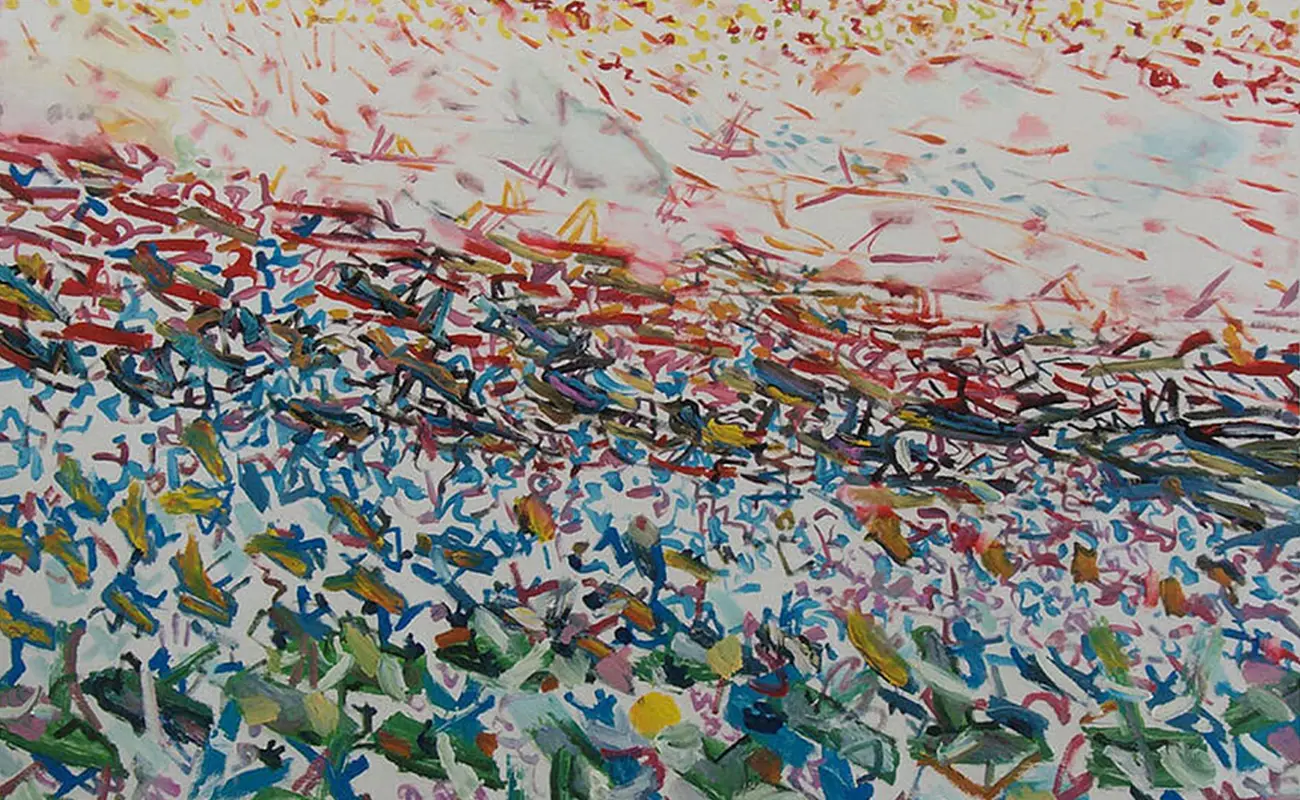
Today, his style can be understood as an advanced expressionism marked by vivid color, layered symbolic frameworks, and dreamlike atmospheres. Movement and stillness coexist within his compositions, creating visual environments that feel simultaneously dynamic and contemplative. Tany often focuses on moments of transition, whether personal, psychological, or spiritual, paying particular attention to processes of healing and renewal. The visible world in his paintings frequently brushes against the invisible, suggesting points where perception opens into something more expansive and less easily named.
Transformation remains the driving force behind each work. Emotion, recollection, and fragments of lived or inherited experience are reconfigured into elevated visual concepts that aim toward clarity rather than resolution. Every painting carries an internal rhythm and a narrative pulse, even when representation gives way to abstraction. These stories are not didactic; they reveal themselves quietly, inviting the viewer into shared reflection. Through this method, Tany positions painting as an active exchange, one that allows both artist and audience to encounter moments of recognition and subtle change.
He is deeply connected to his paintings. Their creation is an act of love, and their presence in the world is a vital part of his ongoing dialogue with others.

Sources of Vision and Thought
The depth of Tany’s work is closely tied to the range of influences that inform his visual and conceptual vocabulary. His engagement with other artists spans land-based practices, abstraction, and expressive figuration. Figures such as Andy Goldsworthy and Wassily Kandinsky contributed to his understanding of form, movement, and spiritual resonance. The imaginative force of Max Ernst, the scale and wit of Claes Oldenburg, and the chromatic sensitivity of Henri Matisse further expanded his sense of possibility. Historical painters including Paul Braque, Paul Gauguin, Gustave Courbet, El Greco, and Francisco Goya offered lessons in structure, intensity, and the emotional weight an image can carry.
Literary and philosophical sources play an equally central role. The Gospel of Thomas holds particular importance for Tany, reflecting what he understands as his Christ lineage and offering a framework for interior knowledge and spiritual immediacy. Dante Alighieri’s vision of moral ascent and cosmic order informs his sense of movement through psychological and ethical states. Thinkers such as Jiddu Krishnamurti and Ken Wilber shaped his attention to consciousness, intelligence, and integral human development, providing language for experiences that resist simple categorization.
Critical inquiry also enters through writers like Michel Foucault, whose examinations of power and rupture sharpened Tany’s awareness of structure and discontinuity, and Kurt Vonnegut, whose existential clarity and anti-war perspective reinforced the ethical dimension of creative work. These varied influences do not appear as direct references but as underlying currents that shape how Tany approaches image-making. Together, they support a practice that is spiritually grounded, psychologically attentive, and aesthetically expansive.

The Alegre Pyramid: A Vision of Conscious Living
In addition to painting, Tany is the visionary force behind The Alegre Pyramid, a cultural, ecological, and spiritual landmark designed in collaboration with architect Heine Cronje. Conceived as a seven-level pyramid structure to be built in Portugal, it is intended to serve as a living sanctuary for music, art, learning, and regeneration. The project integrates sacred geometry, acoustic architecture, renewable energy systems, and a surrounding spiral garden and edible forest co-designed with Noa Levin.
More than a building, The Alegre Pyramid is envisioned as a low-capacity, high-quality habitat—hosting musicians, artists, thinkers, and seekers—where creative expression, ecological stewardship, and inner alignment converge. Rooted in long-term settlement, care for the land, and a gradual opening to the public, the project stands as a model for conscious living and peaceful coexistence between human creativity and the living Earth.
Paulus: The Apostle as Cultural Bridge
Tany’s commitment to visual storytelling continues to expand into new domains. He recently completed the cover drawing for a forthcoming academic volume titled Paulus, authored by historian Professor Shalom Ratsabi. Scheduled for publication in early 2026, the book explores the life and legacy of the Apostle Paul, whose writings reshaped faith across cultures and generations. Tany’s involvement in this project reflects his deep engagement with lineage, belief, and transformative vision.
Healing Images and the Work Ahead
Among the many works that define Tany’s journey, one painting holds particular personal significance. Titled The Lost Heartbreak, the piece began not as a blank canvas but as a found painting abandoned on the street. The image bore the emotional residue of another artist’s sorrow, and Tany felt entrusted with its unresolved pain. Rather than erase the original, he entered into a respectful dialogue with it, allowing the existing marks to guide his response. This act of engagement transformed the work into a collaboration across time and experience.
Working in oil, he introduced elements of motion and renewal, including wind-like movement, oversized flowers, and a reawakened sense of landscape. What had once communicated absence was reshaped into an image of recovery and resilience. The process served as an act of restoration not only for an unknown creator but also for Tany himself. The Lost Heartbreak stands as a clear expression of his belief that art can carry grief toward beauty and return neglected stories to visibility.
Alongside his painting practice, Tany’s work has developed along a parallel and equally formative trajectory: more than twelve years of immersive research into plasma-field energy systems. Since 2013, he has been deeply involved in studying, modeling, sketching, and building MAGRAV devices, inspired by the KF Spaceship global research and development initiative. His studio has gradually become a hybrid space—both atelier and laboratory—filled with instruments and copper-based constructions that function as tangible articulations of plasma fields.
This sustained engagement with plasma dynamics has profoundly reshaped his artistic understanding of structure, circulation, and material intelligence. Working with copper as both conductor and form has refined his perception of arterial systems in physical reality, creating a direct parallel between energetic architectures and pictorial composition. This convergence has not merely accompanied his artistic path; it has recalibrated and expanded it.
In parallel, he continues to document his close encounters—an ongoing visual and experiential archive that feels increasingly like a widening threshold. This process carries a sense of preparation, an opening toward communion and eventual union with the star peoples.
Tany’s daily practice remains a continuous flow of visual and conceptual discovery, where each work acts as a pivot within a broader spiritual field. Looking forward, his next major effort involves a comprehensive collaborative project with artists who have shared his path for decades. This expanding vision welcomes engagement from collectors, galleries, and creative partners who recognize art as a living process of connection and renewal.
Online gallery: https://fineartamerica.com/profiles/joseph-tany