
“Most people talk around the kitchen table. I paint at mine, standing up.”
An Instinctive Path Toward Abstraction
John Roomer’s artistic identity is inseparable from his lived experience, shaped by a lifelong relationship with making that never required permission or justification. Born in central New York in 1983, Roomer approaches painting not as a career choice but as an essential, ongoing activity that exists alongside his daily life. His practice centers on abstraction, using non representational forms to articulate emotional states, internal pressures, and fleeting sensations that resist literal description. Rather than constructing images that explain or illustrate, his paintings function as visual equivalents of feeling, translating experience into color, movement, and layered surfaces. This orientation places Roomer within a lineage of artists who value immediacy and sincerity over polish, yet his work remains distinctly personal, grounded in the specifics of his routines and perceptions.
Autism plays a meaningful role in how Roomer navigates both life and art, informing his sensitivity to environment, emotion, and repetition. Painting offers a structured yet flexible space where these sensitivities can be acknowledged rather than corrected. He works primarily with acrylic paint and ink, appreciating their responsiveness and capacity for revision, but he does not restrict himself to a fixed set of tools or procedures. Materials are chosen through curiosity and necessity, not allegiance to tradition. This openness allows each painting to find its own logic, emerging through attention and responsiveness rather than through premeditated design.
Roomer’s background in graphic design at Mohawk Valley Community College contributes a subtle but important influence, particularly in his awareness of color relationships and spatial tension. While his paintings are not exercises in design, they reveal an understanding of balance, contrast, and visual rhythm that comes from years of observing how elements interact on a surface. These skills are never foregrounded as technique; instead, they support an intuitive process that prioritizes emotional truth. From this foundation, Roomer has developed a body of work that feels both grounded and exploratory, rooted in everyday life while remaining open to uncertainty.
Home
Feel the Love. Feel the Pain
John Roomer: A Practice Shaped by Process and Patience
Roomer’s working rhythm resists conventional expectations of productivity, favoring incremental engagement over daily output. He paints in small stretches of time, often returning to a single canvas over the course of several weeks. This gradual pace allows the work to accumulate meaning through repeated encounters, with each session responding to what is already present rather than forcing resolution. There is no preparatory sketching or advance planning. A painting begins when it begins, prompted by an internal readiness rather than an external deadline. This approach keeps the focus on the present moment, encouraging attentiveness to subtle shifts in mood, color, and gesture.
The physical setting of Roomer’s practice is equally significant. His kitchen table serves as both domestic surface and creative site, a place where many people gather to talk but where he stands to paint. This choice collapses the distance between art making and everyday living, reinforcing the idea that creativity does not require separation from ordinary routines. Working without internet access, professional photography equipment, or digital editing tools, Roomer relies on direct engagement with materials and space. Photographs of his work are taken with a smartphone, not refined or staged, reflecting the same honesty that characterizes the paintings themselves.
Balancing a full time job alongside his artistic practice further shapes Roomer’s relationship to time and attention. Painting becomes a necessary act rather than a performative one, something done for grounding and expression rather than visibility. This context lends the work a sense of urgency and sincerity. Each painting carries the weight of limited time and focused intention, resulting in surfaces that feel lived in and responsive. The absence of long term project planning reinforces this immediacy, ensuring that the work remains tied to lived experience rather than abstract ambition.

Dress
Cat
Surfaces of Emotion and Accumulated Time
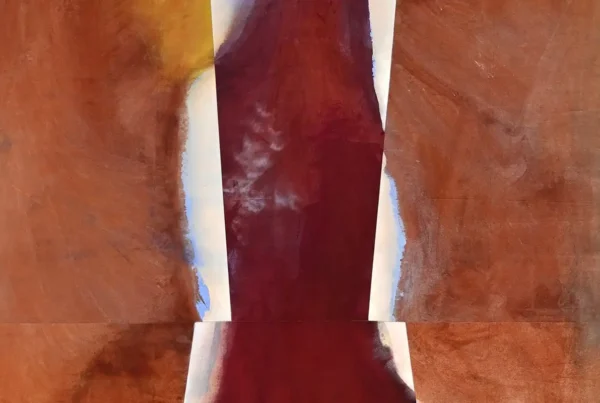
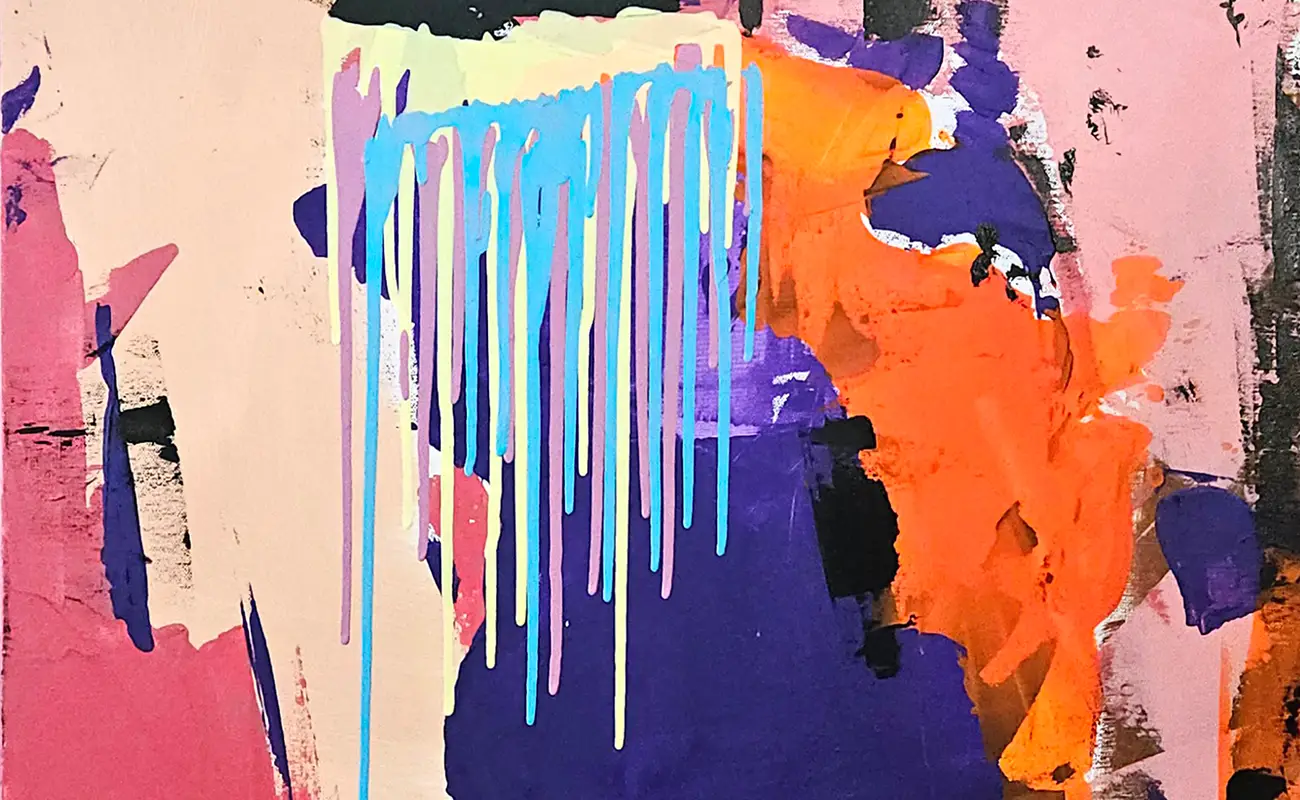
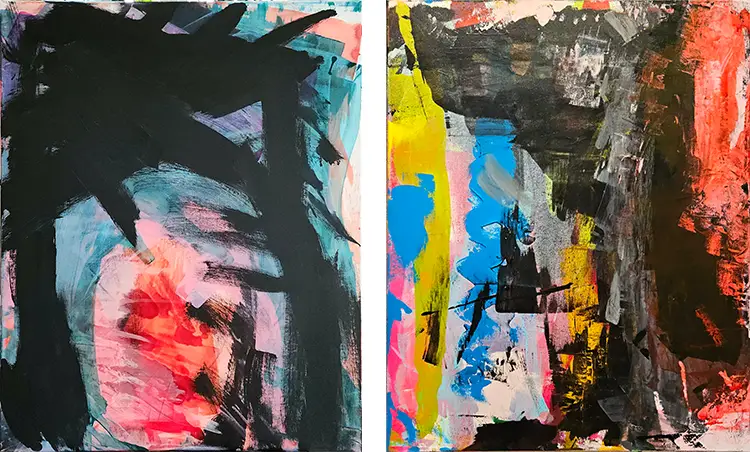
Formally, Roomer’s paintings are built through layering, interruption, and revision, allowing earlier decisions to remain visible beneath later ones. Acrylic fields are overlaid with assertive gestures, scraped areas, and passages of ink that cut through color rather than decorate it. These marks register moments of hesitation and assertion, creating surfaces that record emotional movement over time. Color operates through feeling instead of symbolism, with saturated hues and darker tones coexisting in ways that suggest tension, containment, and release. Rather than resolving these relationships, Roomer allows them to persist, giving the paintings a psychological charge.
A recurring dynamic in the work is the balance between control and surrender. Some compositions feature dominant blocks of color or repeated structural elements that suggest an effort to stabilize experience. Others fracture into restless marks, drips, and stains that resist containment. This oscillation keeps the viewer aware of process, emphasizing that the painting is not a single moment but an accumulation of many. Because Roomer returns to his canvases over weeks, duration becomes palpable. Earlier layers are not erased; they remain as evidence of time spent, decisions reconsidered, and emotions revisited.
Occasionally, lines appear that hint at diagrams or fleeting profiles, but these suggestions never settle into representation. They dissolve back into abstraction, reinforcing the non literal nature of the work. These marks feel less like descriptions of objects and more like traces of attention, mapping where focus landed rather than what was seen. Through this approach, Roomer positions abstraction as a form of emotional regulation and exploration. The paintings do not ask to be decoded; they invite viewers to sit with complexity, recognizing instability and persistence as shared human conditions.

Legs
The Lights Out in the Bathroom
John Roomer: Falling Down and the Courage of Exposure
A defining moment in Roomer’s public practice came with Falling Down, an international online solo painting exhibition that opened on January 29 and concluded on March 29, 2025. Created at his kitchen table, the works in this exhibition emerged from a deeply personal space, shaped by the realities of living as an autistic artist with limited resources. The title captured both vulnerability and motion, suggesting not a final collapse but an ongoing process of losing and regaining balance. Painting functioned as therapy, exploration, and connection, transforming private emotional states into visible forms that others could encounter.
Each painting in Falling Down was created without a predefined outcome, embracing uncertainty as a working condition. Textured layers, vivid color interactions, and dynamic gestures formed a visual language rooted in lived experience. Moments of isolation appeared alongside flashes of resilience, creating a body of work that felt unresolved yet sincere. The absence of digital mediation emphasized the purity of the process, underscoring that the work was made out of necessity rather than a desire for validation. Viewers were encouraged to slow down, engaging with the paintings beyond surface impressions.
The exhibition later extended into a June presentation in the Bristol Room, including a meet the artist event that allowed direct conversation about process and motivation. All works were made available for purchase, reinforcing the idea that these paintings were part of an ongoing exchange rather than static artifacts. Through Falling Down, Roomer demonstrated that vulnerability can be a source of strength, and that uncertainty can hold possibility. His work affirms art’s capacity to steady, heal, and create connection, even when created under modest conditions and shared without pretense.