
“A friend asked, ‘Are you still photographing?’ I answered, ‘Are you still breathing?'”
A Life Formed Through Movement, Curiosity, and the Camera
Photography entered Hans Fleischner’s life not as a distant ambition but as an immediate necessity, arriving at a moment when conventional education no longer held meaning for him. Born in Vienna in 1948, he began studying photography at the age of sixteen, drawn by a desire for something tangible and expressive rather than abstract instruction. The atmosphere surrounding his early years was marked by curiosity and exchange, shaped by international magazines, conversations, and a cultural openness that extended far beyond Austria’s borders. Within this environment, the camera became a tool for thinking, feeling, and responding to the world. Each photograph represented not an endpoint but a continuation, a gradual awakening that unfolded image by image.
The year 1968 marked a decisive shift when Fleischner traveled to New York City, an experience he later described as irreversible. The city offered intensity, contrast, and a sense of unlimited possibility that reshaped both his artistic and personal trajectory. From Manhattan studios to the streets of Harlem during the music festival later known as the Black Woodstock, his early images absorbed the charged atmosphere of social change and collective presence. Subsequent periods in Chicago, along Lake Michigan, and later in Tokyo deepened this engagement with urban life, revealing how cities imprint themselves onto perception and memory. Movement across continents became inseparable from creative growth, reinforcing his belief that photography thrives through lived experience.
Over time, this nomadic existence established Fleischner as an attentive observer of cultural intersections and historical undercurrents. Living and working in Tokyo from 1975 to 1995 proved especially influential, offering a prolonged immersion in a city where tradition and modernity coexist in constant tension. These decades sharpened his sensitivity to rhythm, fragmentation, and silence within the photographic frame. Rather than documenting places as destinations, he approached them as ongoing conversations. Each relocation expanded his visual language while preserving a consistent commitment to authenticity, presence, and the quiet authority of seeing.
Hans Fleischner: A Practice Beyond Categories and Boundaries
Attempts to confine Hans Fleischner’s work within a single genre quickly fall short, since his practice consistently resists rigid classification. Photography forms its foundation, yet it operates alongside writing, drawing, text-based compositions, objects, and multimedia projects that together shape a unified creative current. This fluid approach reflects his conviction that expression cannot be segmented without losing vitality. For him, photographing is as instinctive as breathing, a continuous absorption of visual experience that sustains both body and thought. The resulting work carries a sense of urgency grounded in necessity rather than ambition.
Long-term projects such as Zero, VUDU, Note Art, and especially The Red Bag illustrate this expansive mindset. These bodies of work move freely between direct observation and conceptual reflection, addressing perception, language, and the limits of knowledge. The Red Bag holds particular significance, functioning as a sustained meditation on the Holocaust, exile, and the unresolved weight of twentieth-century history. Initiated in Vienna in 1998, the series transforms a simple object into a charged vessel of memory and absence. Its repetition across time emphasizes continuity rather than closure, allowing meaning to accumulate through persistence.
Equally important is Fleischner’s belief that art emerges from necessity, a view shaped by intellectual influences ranging from photographer Bill Brandt to writer Kobo Abe and musician Max Roach, as well as Ernst Fischer’s Necessity of Art with a foreword by John Berger. These references inform his thinking without dominating it, contributing to a practice that remains intuitive and unforced. By rejecting borders between disciplines, he sustains a creative process that mirrors life itself, adaptive, interconnected, and resistant to final definitions.

Memory, Objects, and the Ethics of Looking
Visual language in Hans Fleischner’s work oscillates between directness and abstraction, often within the same series. Early street photographs from New York, Chicago, and Tokyo demonstrate an acute awareness of gesture, spacing, and partial presence. Figures appear cropped or turned away, environments feel unsettled, and moments seem suspended rather than concluded. This approach invites viewers to sense the surrounding context without being instructed how to interpret it. The images imply social realities and emotional climates through suggestion, encouraging ethical proximity instead of spectacle.
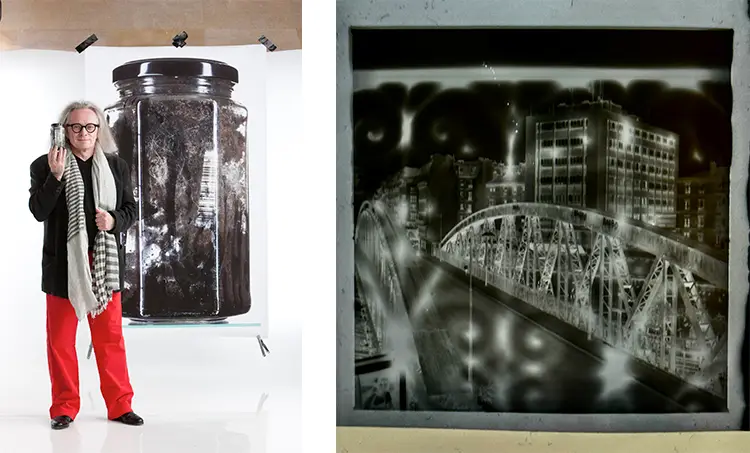
Objects and recurring motifs play a central role in his later projects, functioning as carriers of remembrance and displacement. The Golden Attache Case, conceived as a memorial project, and Water Scriptures, initiated in Portbou and continued in cities such as Barcelona and Paris, extend this investigation into how surfaces and materials hold traces of history. Bridges, water, and found elements recur across decades, reinforcing ideas of passage, loss, and connection. Pont Photographique, centered on a bridge in Paris, eventually became a conceptual structure linking disparate periods of his career into a single continuum.
Family history also enters the work with restraint and gravity. References to his parents, who were forced to leave Vienna and later reunited in London in 1939, situate personal memory within broader historical forces. These moments never dominate the imagery, yet they resonate quietly beneath it. By allowing such elements to coexist without hierarchy, Fleischner maintains a balance between intimacy and universality, demonstrating how photography can honor memory without claiming to resolve it.

Hans Fleischner: Continuity, Teaching, and an Ever-Expanding Archive
Exhibition history forms an essential but not defining aspect of Hans Fleischner’s career. Over more than five decades, his work has been shown widely across Europe and Asia, with solo and group exhibitions in cities including Tokyo, Vienna, Paris, Manila, and Barcelona. Collaborations with galleries, museums, designers, and musicians expanded the contexts in which his images could be encountered. These presentations emphasized process and continuity rather than retrospective finality, aligning with his belief that artistic work remains perpetually unfinished.
Education has played a parallel role, particularly during the 1980s when he led English-language photography workshops in Tokyo, later extending this commitment across Europe. Teaching provided another avenue for exchange, reinforcing his understanding of photography as shared inquiry rather than isolated production. Dialogue with students and peers enriched his own practice, keeping it responsive and open-ended. This pedagogical engagement complemented his studio work, offering structure without imposing limitation.
Since 2022, Fleischner has concentrated on organizing and publishing his extensive archive through an ambitious series of digital books. More than thirty volumes have already been released, forming an evolving retrospective that mirrors the breadth of his life’s work. Projects such as Pont Photographique and the Library of Photography continue to grow through carefully assembled A5 paperbacks. Working from Vienna, he remains active as a photographer and writer, guided by a conviction that knowledge cannot simply be learned but must be lived, observed, and continually questioned.
Hans Fleischner with the VUDU #1 object photographed by Franz Helmreich