
Between Instinct and Expression
There are artists who train to master technique, and there are those who create because they must. Enrique Pichardo belongs unequivocally to the latter. Born in Mexico City in 1973, Pichardo discovered early in life that art was not a pursuit, but a compulsion—a way to live, feel, and connect to the world. Rather than treating creativity as a formal discipline, he embraced it as a spontaneous language, one best spoken with the unfiltered voice of childhood. Pichardo doesn’t paint for approval or acclaim; he paints because it is the most honest form of expression available to him. His career, spanning more than three decades, has remained faithful to this principle, resisting artistic trends and eschewing cerebral detachment in favor of raw, emotional intensity.
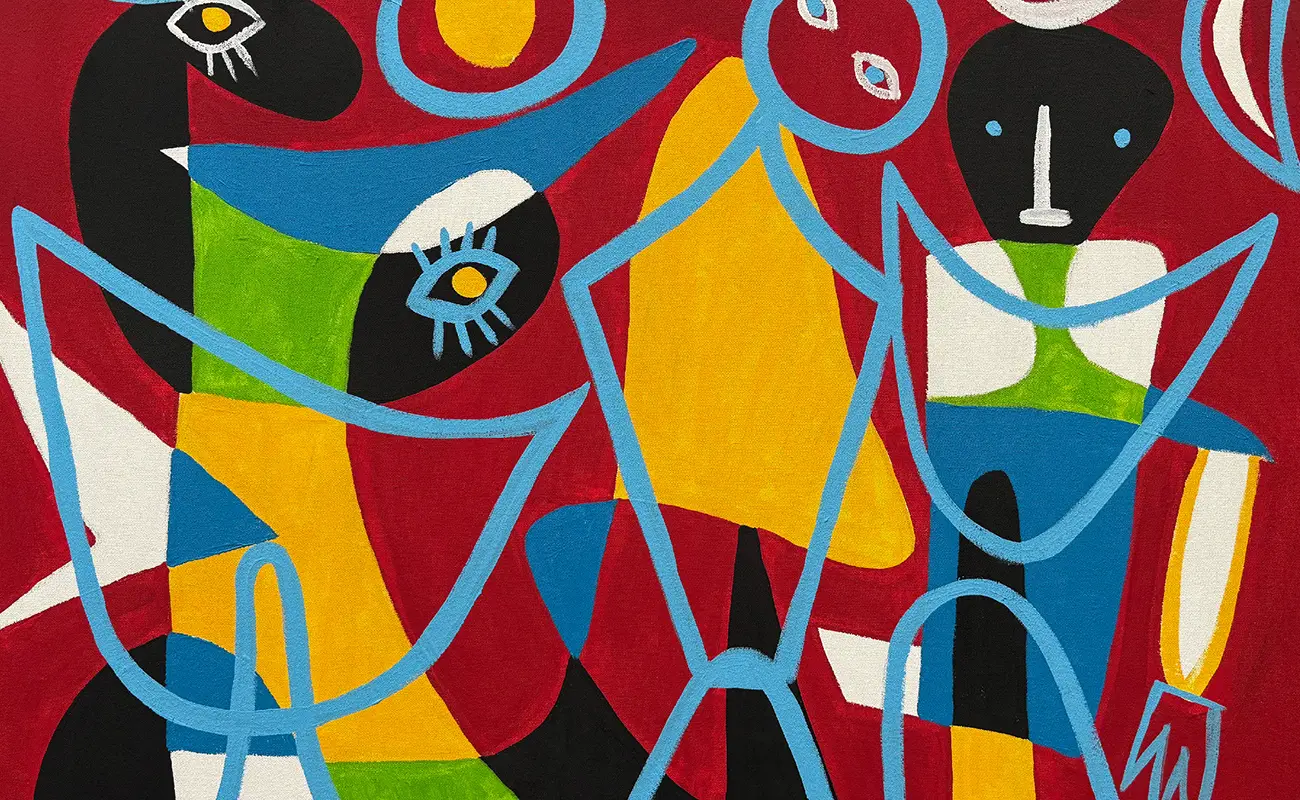
From the beginning, his work has been characterized by an insistence on intuitive creation. His paintings, brimming with curious figures and vibrant geometries, evoke the playfulness of a child’s drawings without sacrificing depth. He never abandoned the visual language of youth, instead refining it into something profound. His process is impulsive, but not careless; expressive, but not random. With a technique he describes as “naive expressionism,” Pichardo has built an artistic identity that favors feeling over form and narrative over structure. He prioritizes sincerity and impulse, even at the cost of convention, and in doing so, his canvases radiate with an infectious energy that transcends cultural or intellectual boundaries.
A central philosophy drives his work: return to the beginning. For Pichardo, that means painting as if discovering the medium for the first time. It is not nostalgia but a deliberate creative choice, a decision to preserve the purity of instinctive creation. His pieces are populated with whimsical, sometimes mythical figures that seem simultaneously ancient and newborn. Whether depicting densely layered compositions or pared-down urban landscapes in muted tones, his signature remains the same—an uncompromising pursuit of emotional authenticity. Each painting becomes a time capsule of lived experience, filtered through the lens of a child’s wonder and an adult’s insight.

Enrique Pichardo: Reclaiming the Untrainable
During the mid-1990s, Pichardo found himself at a crucial crossroads. His deep love for painting led him to pursue formal education at La Esmeralda, Mexico’s esteemed National School of Painting, Sculpture, and Engraving. The institution, known for training icons like Diego Rivera and Frida Kahlo, promised rigor and structure. But within its halls, Pichardo encountered a creative tension that threatened to dull his artistic voice. The rigid curriculum and technical expectations, while well-intentioned, clashed with the intuitive, emotive core of his practice. Rather than compromise his vision, he chose to walk away from imposed systems, reaffirming a commitment to the freedom that first drew him to art.
This decision became a defining moment in Pichardo’s trajectory. It marked not a rejection of learning but a reorientation toward a different kind of education—one driven by observation, admiration, and reinterpretation. He turned to the works of great modernists and unknown street artists alike, absorbing their influences not as templates to imitate, but as tools to sharpen his personal style. He describes this phase as a period of visual thievery: borrowing, adapting, and experimenting until his own voice could no longer be ignored. He painted feverishly, using his body and spirit as instruments, channeling the intuitive wisdom he had cultivated since childhood.
By choosing to unlearn convention, Pichardo reconnected with the essential core of his creativity. He didn’t strive to become a master; he sought to remain an explorer. His work flourished outside institutional boundaries, giving birth to a visual language entirely his own. That language speaks through energetic brushstrokes, deliberate imperfections, and compositions that seem to breathe with life. Over time, he evolved into a distinctive figure within contemporary Mexican art, not by chasing originality, but by refusing to abandon the child within. His return to what he calls his “first traces” wasn’t regression—it was a bold act of reclamation.

Totems of Light and Memory
Enrique Pichardo’s visual universe is inhabited by a fascinating constellation of beings—primordial figures, archaic faces, and abstracted creatures that hover between dream and ritual. These characters emerge not from fantasy, but from an instinctive memory bank, one shaped by Mesoamerican mythology, personal history, and collective unconscious. They are not characters with biographies; they are symbols with pulses. Totems, spirits, humans, and animals coexist in energetic compositions that blur the line between the sacred and the playful. This interplay of mystery and lightness imbues his work with an emotional immediacy that draws the viewer in before they can rationalize it.
His stylistic inspirations are many, and they live visibly on his canvases. Echoes of Paul Klee, Jean Dubuffet, Joan Miró, and Jean-Michel Basquiat mingle with the influence of aboriginal art, cave paintings, and Mexican folk traditions. Yet his work resists categorization. Pichardo integrates these references not to situate himself in a lineage, but to converse with it, offering his own visual dialect in return. His figures may remind one of tribal masks or ritual artifacts, yet they dance with a modern rhythm, rendered in lines that are at once confident and childlike. The texture of his compositions—whether lush with color or stripped down to greys and whites—reveals a deliberate embrace of contradiction.
In 1998, he established “La Casa del Alebrije,” a studio focused on papier-mâché sculptures, particularly alebrijes—fantastical creatures rooted in Mexican craft traditions. This extension of his practice reinforced his commitment to both the ancestral and the experimental. Whether through painting or sculpture, his creations echo with the vibrancy of folk celebration and the introspection of existential inquiry. Critics often note how his childlike aesthetic conceals layers of sophistication; behind every playful stroke lies an invitation to encounter the profound. His works are not puzzles to be solved, but sensations to be experienced—a tribute to the innocence of seeing without expectation.

Enrique Pichardo: Where Joy Becomes Resistance
At the heart of Enrique Pichardo’s art lies an unshakable belief: joy is not frivolous, it is defiant. In a world often marked by cynicism and fragmentation, his vibrant canvases serve as acts of resistance through celebration. Pichardo’s paintings do not ask for interpretation; they ask for presence. When faced with one of his compositions, viewers are met with a surge of feeling—one that bypasses logic and speaks directly to the senses. It is this emotive power that anchors his practice and continues to captivate audiences across continents. His work is not merely to be viewed, but lived.
Internationally, Pichardo’s reach has expanded steadily over the years. He has exhibited in significant institutions such as the Museo de Arte Popular, Palacio de Bellas Artes, and the Frida Kahlo Museum, while also gaining a foothold in cities from Miami to Singapore. His paintings are held in collections throughout the Americas, Europe, and Asia, yet this recognition has not diluted his authenticity. Regardless of where his work is displayed, its core remains untouched—a direct communication from soul to canvas, from artist to viewer. That purity of intent is what resonates across languages and borders, making his art universally felt.
Pichardo often speaks of painting as necessity rather than vocation. He moves with urgency and freedom, creating with the same impulsive grace that first guided his hand as a boy. He paints with the full force of his being, allowing mind, body, and emotion to work in unison. In doing so, he transforms each piece into a living extension of himself—a record of not just what he sees, but how he exists. The figures he conjures are not just images; they are invitations to remember the primal joy of creating without fear. In this way, Enrique Pichardo offers not merely paintings, but a worldview in which honesty, instinct, and playfulness become the most radical forms of expression.