
“Transformation is not a metaphor. It is material reality.”
Between Structure and Silence
Bernd Caspar Dietrich describes his path not as a career choice but as an inevitability, a condition that preceded language and professional definition. Long before public recognition or institutional validation, painting functioned as the quiet axis around which his life revolved. Even during years defined by entrepreneurial responsibility and economic engagement, artistic work continued in parallel, sustained by an inner necessity rather than external expectation. This coexistence of structured obligation and intuitive creation shaped a biography that feels less linear than evolutionary. What appears from a distance as a sequence of professional stages reveals itself more accurately as a gradual unfolding of an identity that was always present, waiting for full articulation through material and form.
His early formation under Georg Hoppenstedt, Professor of Free Painting at the Hochschule der Künste in Berlin, proved decisive. Accepted as a child into this academic environment, Dietrich encountered painting as a discipline grounded in perception and concentration rather than ornamentation. The lessons he absorbed emphasized reduction, clarity, and attentiveness to essence. In 1993, the publication of his first book, Auf Pfauenschwingen, coincided with the opening of his Düsseldorf studio, a space that soon became a site of experimentation. There, surface transformed into terrain, pigment assumed the weight of memory, and matter emerged as narrative substance rather than passive support.
A pivotal encounter with Antoni Tàpies during his Düsseldorf years redirected Dietrich’s understanding of the pictorial ground. Tàpies demonstrated that painting begins not with representation but with the raw condition of material itself, with dust, sand, and the physical residue of the world. From this insight grew Dietrich’s conviction that matter carries its own voice. Approximately thirty five years ago, he sold a successful company and committed himself entirely to art. This decisive gesture did not mark a new beginning but removed resistance from an already flowing current, allowing the latent force of his practice to expand without compromise.

Bernd Caspar Dietrich: Matter as Memory, Surface as Event
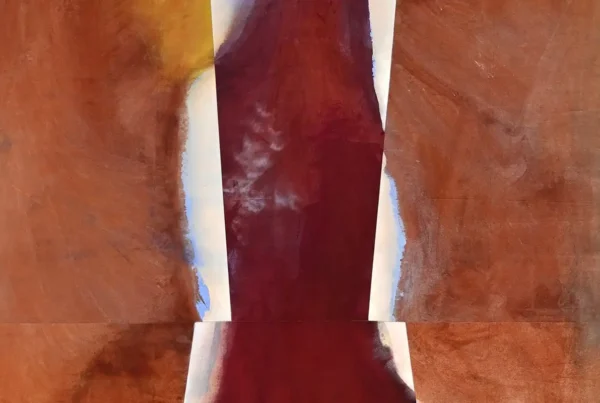
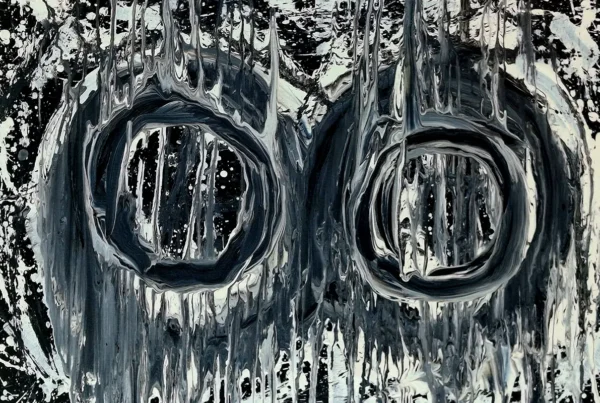
Material defines Dietrich’s language. Frequently described as a Sandmaler, he treats sand as both origin and remainder, a substance that contains geological time within its granules. His works incorporate sand, cement, clay, mineral pigments, glass powder, phosphorus, and gold leaf, often ground by hand to create customized chromatic intensity. He constructs his surfaces in layers, building an underground before the visible image can emerge. Cycles such as WHEELS, Metamorphosen, BetonGold, and Klimabilder reflect this structural approach. In WHEELS, circular forms suggest repetition and historical motion without guaranteed direction. Metamorphosen involves the physical fracturing and reconstruction of canvases, exposing transformation as process rather than metaphor. BetonGold juxtaposes raw concrete with shimmering gold, confronting material reality with symbolic value.
Concrete and clay are not neutral carriers in his work but active participants. The series Wohnmaschine from 2021, part of BetonGold, arose from his encounter with Le Corbusier’s architecture in Firminy. By day, the embedded floor plans within massive residential structures suggested social aspiration. By night, illuminated windows resembled theatrical staging. Incorporating phosphor that intensifies and fades, the painting shifts between visibility and obscurity, inviting viewers to imagine the hidden biographies behind its façade. In Klimabild 123 from 2025 and works such as Wheel 109, clay is permitted to dry, crack, and contract naturally. The resulting fissures evoke eroded reservoirs and tectonic stress, transforming shrinkage into aesthetic principle and ecological commentary.
The painting Neun Versuche Rot, und dann doch Blau from the fairy tale series, created between 2003 and 2023, embodies allegory through material layering. Nine red attempts at love culminate in a return to blue, an allusion to the Frog King and the impossibility of forcing transformation. Sand and pigment on canvas carry this narrative of desire and resignation, suggesting that not every declaration results in metamorphosis. Similarly, Golden Zeiten Opal, completed in 2022 after an extended gestation, combines concrete, clay, glass powder, pigment, and gold leaf. The interplay of opacity and shimmer questions the durability of prosperity and the seduction of radiant surfaces.
In recent years, this material driven language has entered a wider international discourse. Two consecutive auctions at Christie’s marked a significant moment in Dietrich’s artistic trajectory. The works Metamorphose Magelone III and later Opal achieved results far beyond their estimates, drawing international attention. Christie’s, one of the world’s most established auction houses, operates within a global ritual of value and recognition. To see works born from sand, fracture, and metamorphosis enter that arena and resonate there was not merely a commercial milestone. It confirmed that material truth can cross borders, cultures, and markets, and that transformation as a language is understood beyond geography.

Landscapes of Power, Myth, and Illusion
Dietrich’s biography unfolds across Europe, North America, Australia, and the Asia Pacific region, each context sharpening his sensitivity to geological time and cultural construction. Invitations as Artist in Residence at the Alberta College of Art and Design and teaching positions at the Alberta University of the Arts and the University of Calgary intensified his investigation into fresco techniques and mineral based pigments. Exchange with students and international colleagues reinforced his understanding of painting as layered construction. Exposure to vast Canadian and Australian landscapes heightened his awareness of erosion, sedimentation, and compression, slow forces that operate beyond human control yet shape every visible structure.
Political and social systems occupy an equally significant place in his inquiry. The triptych Die Urbanisten from 2023, composed of cement, pigment, acrylic, phosphor, and gold on canvas, examines how communities form, expand, and justify domination. Beginning with a group unified under black, red, and gold, the work traces the progression from solidarity to invasion, from aspiration to demagoguery. Under black light, gold darkens and brilliance fades, revealing the instability of promises framed as salvation. Paris 2015, completed in 2022, addresses the global climate conference and its symbolic 1.5 degree target. Abstracted hands cradle a dissolving geometric core reminiscent of a dried riverbed. Coated in gold and transformed under ultraviolet illumination, the work exposes spectacle and contradiction within political theater.
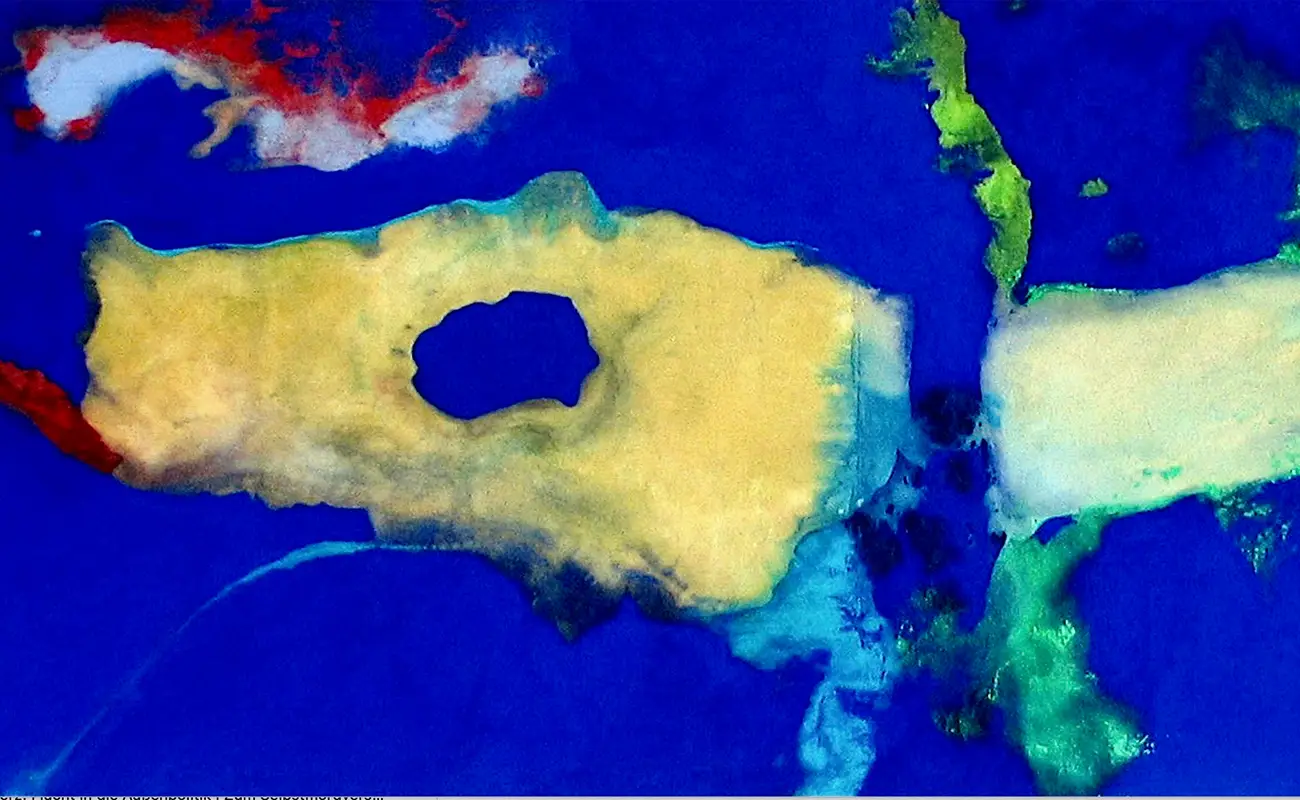
Mythological memory surfaces in Odysseus from 2024, a large scale canvas structured through rugged textures and shifting blues and greens. Referencing Homer’s epic, Dietrich questions the cost of heroic narratives and the suffering concealed behind celebrated cunning. The landscape opens like an archaic field of memory, inviting reflection on destruction and responsibility. Through such works, he translates ancient stories into contemporary tension, asking where Troy exists today and how inherited myths shape present conflicts.
Dietrich’s artistic path has also been documented in film. The cinema documentary Hella & Bernd, released in November 2021 and directed by Fitore Muzaqi, follows the artistic and personal journey of Bernd Caspar Dietrich and Hella Sinnhuber. Over the course of three years, the film team accompanied them while documenting the development of artpark Hoher Berg and the realization of a lifelong dream. The documentary reflects on their shared vision of art as a social and transformative force and offers insight into the intersection of artistic practice, partnership, and cultural engagement.

Bernd Caspar Dietrich: Presence, Resilience, and the Cathedral of the Nameless
Daily practice for Dietrich centers on sustained physical engagement with material. Long studio sessions involve layering, compressing, fracturing, and rebuilding surfaces until tension and balance emerge. Living with hemiparesis introduced a profound rupture that reshaped his bodily relationship to art. The struggle to regain movement infused each gesture with heightened awareness. Fragility and resilience now coexist within every mark. He does not seek to dominate unpredictable materials but to enter dialogue with them, allowing cracks and shifts to register lived experience. Transformation therefore functions not as abstract theme but as embodied reality, inscribed into clay and cement through effort and persistence.
The founding of artpark Hoher Berg together with his wife, journalist and cultural scientist Hella Sinnhuber, expanded his practice into a dynamic field of exchange. Artpark operates as an experimental site where landscape, international collaboration, and discourse intersect. Visiting artists, students, and cultural initiatives introduce friction that generates new energy. The space resists functioning as mere backdrop. It acts as catalyst. This ongoing interaction reinforces Dietrich’s conviction that art can extend beyond object status into social and spatial experience, engaging viewers not only visually but physically and intellectually.
This expanded vision culminates in the project Kathedrale der Namenlosen, conceived as a large scale outdoor installation at artpark Hoher Berg. Located near Gahlen on the edge of the Ruhr Metropolitan Region, the site occupies a symbolic borderland between urban memory culture and the often overlooked rural landscape. The work responds to the tradition of Stolpersteine, the commemorative stones embedded in city pavements that remember victims of National Socialist persecution. In contrast, the Cathedral of the Nameless asks how remembrance might take place in quieter landscapes, where histories of displacement, persecution, and disappearance remain largely unmarked.
The structure takes the form of a cube containing a central three step platform with a single chair, the ritual seat that gives the installation its designation as a cathedral. Six openings in the ceiling allow shafts of light to fall onto the chair, while a suspended rod coated with red phosphorus floats between ceiling and platform. Visitors are invited to activate the space through spoken word, music, reading, or performance. Benches placed along the interior walls allow audiences to become part of these acts of remembrance. Stories may be spoken even without listeners, emphasizing reflection as a shared yet deeply personal act.
Symbolic elements within the structure address contemporary tensions and historical memory simultaneously. The platform’s colors refer to the Palestinian flag, while blue stripes near the ceiling evoke the Star of David. The suspended red rod marks the repeated crossing of a symbolic red line, referencing the violence of October 7, 2023 and the cycles of response that followed. Through these layered signs, the installation does not dictate a single narrative but creates a space where remembrance, political awareness, and ethical responsibility intersect.
The project will be presented publicly in March 2026 and is scheduled for completion in time for the artpark summer festival in June. Its realization has also inspired collaborative gestures within the artpark community. To support the project financially, Hella Sinnhuber developed a series of works titled “letters of indulgence,” historical certificates transformed through eco printing techniques using leaves, flowers, and herbs collected from the surrounding landscape. The process combines natural pigments, tea, vinegar, copper elements, and rusted metal to create delicate prints that echo the park’s ecology while symbolically linking artistic practice, memory, and communal participation.
Across decades of work, from Urbanisten to Klimabild 123, from Neun Versuche Rot to Odysseus, one principle remains constant: transformation, not as metaphor, but as lived material reality. Within Dietrich’s work, light reveals what lies beneath the surface, and matter itself becomes the archive through which time, memory, and human experience remain visible.