“This was one of the most complete things I have done artistically, emotionally, and philosophically.”
A Practice Shaped by Observation and Movement
Oliver Buchino’s artistic path began long before he considered the idea of becoming an artist. Drawing has been a constant presence throughout his life, evolving naturally from childhood fascination into a sustained creative discipline. Early interests centered on cityscapes and internationally recognized landmarks, subjects that occupied much of his attention through his school years. These architectural environments encouraged close observation, patience, and a commitment to accuracy that continues to define his work today. Rather than emerging from a single turning point, his artistic identity developed gradually through years of continuous practice. Over time, the focus of his drawings expanded beyond buildings and urban spaces toward the complexity of the human figure. This shift introduced new challenges and opportunities, allowing him to apply the same dedication to precision while exploring personality, symbolism, and emotional resonance. The result is a body of work that balances technical control with conceptual ambition, revealing an artist interested not only in what is seen, but also in what can be communicated beneath the surface of an image.
The transition from architectural subjects to portrait-based work became increasingly significant during college and has remained central to Buchino’s practice ever since. Friends initially served as subjects, offering opportunities to study expression, proportion, and character. Gradually, his interests widened to include athletes, public figures, models, and social media personalities whose images and cultural presence presented compelling visual material. While many of these works begin from photographic references, Buchino’s goal extends beyond simple replication. He seeks a balance between realism and interpretation, creating drawings that feel recognizable while carrying additional layers of meaning. This approach reflects an interest in how contemporary identities are shaped and perceived. The individuals featured in his work often exist within highly visible digital environments, making them suitable subjects for explorations of image, influence, and personal narrative. Through these portraits, Buchino examines the relationship between appearance and symbolism, transforming familiar faces into vehicles for broader reflections on modern culture.
Travel has also become a major force behind the evolution of his artistic thinking. During the last five years, Buchino has undertaken repeated journeys across Europe, consciously echoing the historical Grand Tour tradition once pursued by artists and scholars. His travels through England, France, Germany, and Italy provided direct encounters with major works of art and architecture, offering experiences that photographs and books cannot fully replicate. Exposure to classical sculpture, historical collections, and centuries of artistic achievement broadened his visual vocabulary and strengthened his appreciation for artistic lineage. These experiences have informed recent projects in visible ways, influencing both composition and thematic direction. Rather than treating travel as passive sightseeing, Buchino uses it as a method of artistic education, absorbing ideas from different periods and locations. Encounters with historic masterpieces have reinforced his commitment to craftsmanship while encouraging new conceptual possibilities, creating an ongoing dialogue between contemporary portraiture and enduring artistic traditions.

Oliver Buchino: Classical Influence in Contemporary Portraiture
A defining characteristic of Buchino’s work is his commitment to highly precise draftsmanship. Most of his drawings are created with graphite mechanical pencils, a medium that supports the level of detail and control he seeks. His images frequently approach photorealism, demonstrating careful attention to anatomy, texture, and tonal variation. Tracing plays a role in his process, helping establish accurate structures and proportions before further interpretation occurs. Yet despite the technical rigor of these drawings, Buchino does not view realism as an end in itself. Instead, he uses precision as a foundation from which symbolic and conceptual ideas can emerge. This combination of accuracy and imagination distinguishes his approach. The visual credibility of his portraits creates a strong connection with viewers, while subtle distortions, historical references, and thematic interventions invite deeper consideration. Through this balance, he positions realism not as mere documentation but as a framework for exploring larger questions surrounding identity, perception, and meaning.
One of the clearest examples of this method is Butterfly Boy, a portrait depicting German influencer Nils Kuesel. At first glance, the drawing demonstrates the technical qualities associated with Buchino’s practice, presenting a convincing likeness rendered with remarkable attention to detail. However, the image extends well beyond straightforward portraiture. Butterflies appear throughout the composition, functioning as symbols of transformation, impermanence, and renewal. Their presence also connects to personal references associated with Kuesel and to the memory of influencer Cooper Noriega, whose death at a young age adds another emotional layer to the work. Meanwhile, visual distortion introduces commentary on the pressures and altered perceptions often generated within social media environments. Rather than portraying a static public figure, Buchino presents a subject shaped by memory, symbolism, and cultural context. The result is a portrait that combines contemporary subject matter with broader reflections on mortality, connection, and the fragile nature of digital identity.
Historical influence plays an equally important role in the construction of Butterfly Boy. Buchino intentionally drew from traditional medieval portraiture when developing the work’s visual character, creating a dialogue between contemporary internet culture and artistic traditions centuries older. This merging of historical and modern references demonstrates how he approaches portraiture as a space where multiple timelines can coexist. Similar interests appear in Mattheus Lapis, a work inspired by a visit to the Borghese Gallery in Rome. Encountering classical sculpture firsthand left a lasting impression, encouraging him to reflect on the enduring power of idealized form and historical craftsmanship. The drawing channels those experiences into a contemporary context, illustrating how direct engagement with cultural heritage can shape present-day creative production. Rather than imitating historical works, Buchino adapts elements from them, using the past as a source of inspiration while maintaining a distinctly personal voice. This process allows his drawings to engage simultaneously with tradition, modernity, and individual interpretation.

Technology, Symbolism, and Human Connection
Among Buchino’s recent works, The Running Man holds particular significance. The piece depicts German runner and influencer Julien Brown and represents an important development in the artist’s creative process. It was the first major work in which artificial intelligence played a role during preparation. Beginning with a photograph of Brown participating in the 2024 Berlin Marathon, Buchino used the image as the basis for a photorealistic portrait. He then experimented with AI-generated visual concepts to explore possible effects and compositional ideas. Rather than replacing drawing, these tools served as exploratory instruments that helped him imagine new visual possibilities. The final work remained rooted in traditional draftsmanship, with Buchino translating selected concepts into graphite through careful execution. This combination of emerging technology and manual skill reflects an openness to experimentation while maintaining a strong commitment to craftsmanship. The project illustrates how contemporary artists can incorporate new tools without abandoning the foundational practices that define their work.
Central to The Running Man is the dynamic visual structure surrounding the figure. Buchino developed a motion bubble effect inspired by the concept of a warp drive, imagining the runner positioned within a stable center while the surrounding environment bends and stretches around him. This visual language seeks to communicate the subjective sensation of movement rather than merely depict physical action. By emphasizing altered perception, the drawing invites viewers to consider how experiences are felt internally as well as observed externally. The work transforms a marathon runner into a symbol of focus, momentum, and personal endurance. Through the interaction of realism and distortion, Buchino captures both the physical reality of running and the psychological intensity associated with sustained effort. The image demonstrates his continuing interest in combining accurate representation with conceptual interpretation, creating works that operate simultaneously as portraits and symbolic narratives.
The importance of The Running Man extends beyond the drawing itself. After completing the work, Buchino traveled to Berlin to ensure it reached its subject. Through connections associated with a running community linked to Brown and his friends, he participated in events in the city and ultimately arranged for both The Running Man and Butterfly Boy to be delivered. This act transformed the project into something more expansive than the production of an artwork. It became an experience involving travel, personal engagement, and direct human connection. For Buchino, the gesture represented a movement away from passive observation toward active participation. The drawings were no longer confined to private creation or online presentation. Instead, they entered the lives of the people who inspired them. This combination of artistic effort, emotional investment, and philosophical reflection made the experience especially meaningful, demonstrating how creative work can bridge distances and establish genuine connections across cultures and communities.

Oliver Buchino: Expanding from Portraits to Urban Futures
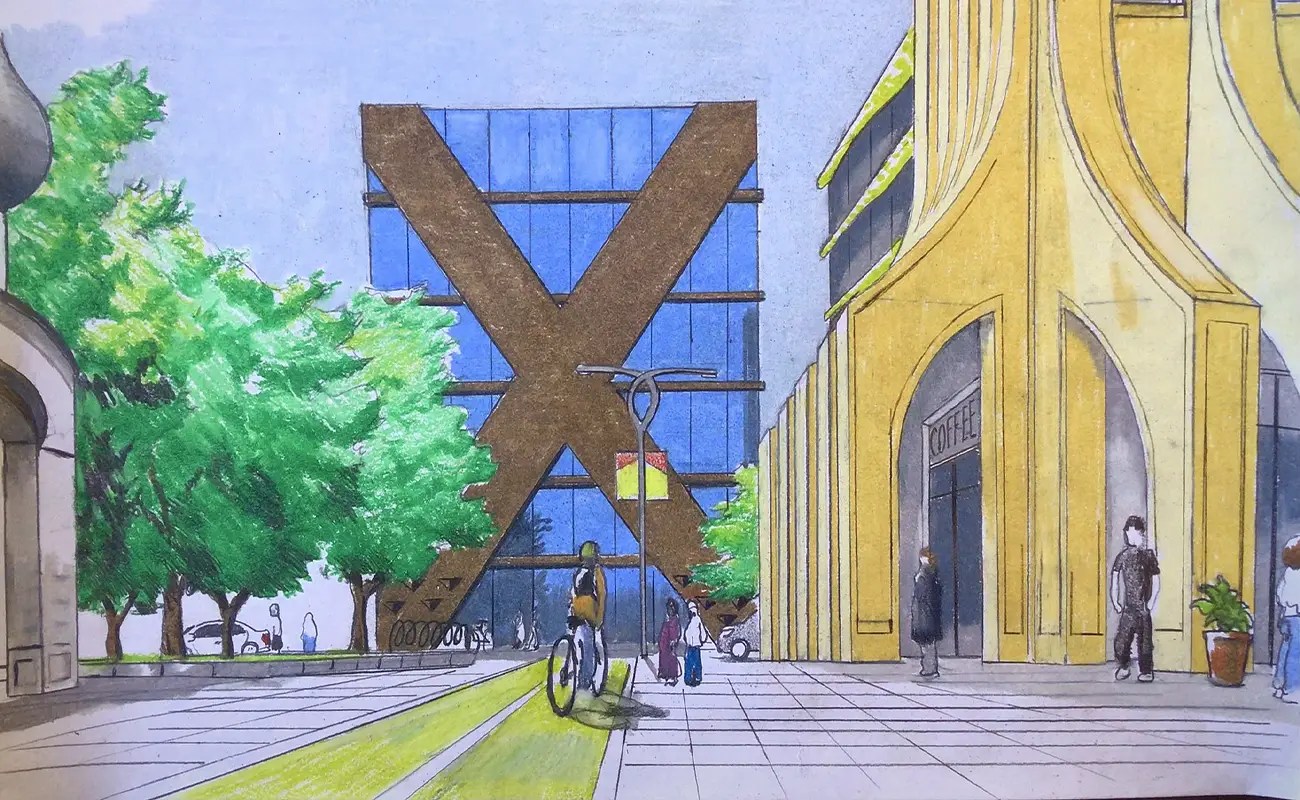
While portrait drawing remains central to Buchino’s practice, his longstanding interest in architecture continues to influence his creative ambitions. Before concentrating on people, he spent years drawing cityscapes and landmarks, developing a fascination with the built environment that never disappeared. Recently, this interest has reemerged in new forms through conceptual design studies and speculative architectural proposals. Unlike his portrait work, these projects examine how spaces function and how urban environments might be reimagined. One example is Public Housing for a Sci-Fi Dystopia, a fictional architectural study that explores imagined futures through design. Another is the Icelandic Renewable Energy Center, created as a cover image for a design competition. These projects reveal a different side of Buchino’s creative thinking, one focused on systems, infrastructure, and public space. Despite differences in subject matter, they share the same attention to structure, visual clarity, and thoughtful composition that characterizes his portrait drawings.
Competition participation has also become a meaningful aspect of his recent activity. Although drawing remains secondary to his professional career and he produces relatively few finished works each year, Buchino has increasingly submitted projects to contests and public opportunities. Several of these entries have achieved recognition, providing external validation while exposing his work to wider audiences. This development reflects a growing willingness to place personal creations within broader public conversations. Competitions offer opportunities not only for exposure but also for experimentation, encouraging artists to respond to themes and challenges beyond their usual areas of focus. For Buchino, these experiences have helped connect private artistic interests with larger communities. Whether through portraiture, conceptual design, or architectural proposals, he continues to seek new contexts in which creative work can engage viewers and stimulate discussion.
A particularly notable example emerged through an open challenge organized by Sustain Charlotte, which invited public ideas for transforming Interstate 77 through downtown Charlotte. Buchino responded by producing conceptual sketches that envisioned capping portions of the freeway and introducing new plazas, parks, and buildings. Although he was unable to attend the associated event in person, the initiative attracted significant media attention, and some of his drawings appeared on local television coverage. This outcome demonstrated how artistic and design thinking can contribute to conversations about civic development and urban quality of life. The project also highlighted the versatility of Buchino’s skills, showing that the observational discipline developed through drawing can be applied to public planning concepts as effectively as portraiture. By moving between individual subjects and large-scale environments, he continues to explore how images can communicate ideas, inspire dialogue, and encourage audiences to imagine alternative possibilities for both people and places.