
Origins Written in Landscape and Motion
Laura Fauvel stands among contemporary abstract painters whose work transforms lived experience into atmosphere, sensation, and luminous form. Born on the island of Papua New Guinea and raised between France and England, she grew up within shifting geographies that encouraged sensitivity to place, change, and identity. Those early years were filled with forests, beaches, outdoor freedom, painting, baking, swimming, and long hours in nature with siblings. Such experiences did not disappear into nostalgia. Instead, they became the emotional ground of her mature practice. Her paintings often feel open, spacious, and alive with weather because they are rooted in remembered encounters with the natural world. Rather than illustrating childhood scenes, she carries forward their emotional imprint. Viewers sense freshness, movement, and a quiet intimacy with landscape. This combination of early freedom and later cultural movement gave Fauvel an instinct for art that values feeling above literal description, allowing her abstractions to communicate states of being that language often cannot hold with the same grace or depth.
Her move to England after her parents separated introduced a contrasting chapter marked by adaptation and difficulty. Entering a new school as the only foreign child, she experienced not fitting in, mixing languages, and navigating unfamiliar social pressures. Those experiences of displacement matter because they echo in the way her paintings resist fixed categories. Identity, for Fauvel, was never simple or singular. Later, boarding school offered a more welcoming environment, where diversity felt natural and friendships flourished. She has described those years as deeply positive, shaped by supportive teachers and creative growth. Strong results in ceramics and fine art followed, suggesting that artistic expression had already become an important language of confidence and belonging. This journey through challenge and renewal helps explain the emotional intelligence visible in her work today. Her paintings often balance fragility with strength, calm with undercurrents of motion, and softness with structure. They do not dramatize hardship, yet they carry the wisdom of someone who learned early that transformation is rarely linear.
What distinguishes Fauvel’s artistic identity is the way biography becomes atmosphere rather than autobiography. Many artists tell stories directly, but she converts memory into color, pressure, rhythm, and space. The beaches and woods of childhood may return as airy expanses or softened horizons. The experience of moving across cultures may reappear through surfaces that seem in transition, never fully settled, always responsive. This is why her abstraction feels intimate rather than distant. It emerges from real encounters while avoiding anecdote. Even viewers unfamiliar with her history can recognize sensations of longing, renewal, uncertainty, and wonder. Such accessibility gives the work broad resonance. Fauvel’s paintings ask people to sense before they interpret, to feel before they classify. In a period often dominated by speed and instant explanation, that invitation is powerful. Her origins across continents and landscapes did more than shape her biography. They trained her to notice mood, subtle shifts, and emotional weather, all of which remain central to her visual language.

Laura Fauvel: From Fashion Precision to Painterly Freedom
Before fully committing to painting, Laura Fauvel built an accomplished foundation in art and design education. She attended foundation studies in London, including time connected to Central Saint Martins, before continuing at Ravensbourne. There she pursued fashion print design, a discipline that demands sensitivity to surface, proportion, pattern, and color relationships. Her talent was recognized through a first prize from the Society of Dyers and Colourists, confirming both technical skill and visual intelligence. Professional experiences followed, including an internship at Alexander McQueen, freelance print work, and positions connected to high-end fashion retail and wholesale. She also witnessed major fashion presentations in Paris, absorbing environments where spectacle, precision, and image carry immense weight. This chapter is important not simply as biography, but because its influence remains visible in her paintings. Her compositions reveal a practiced understanding of balance, cropping, chromatic harmony, and the importance of edges. Even when paint appears spontaneous, there is a designer’s awareness guiding the total field with elegance and control.
Yet success within fashion did not satisfy deeper values that later emerged through personal upheaval. After becoming a mother, Fauvel’s son faced prolonged illness for several years, bringing exhaustion, caregiving demands, and emotional strain. During that difficult period, priorities changed. The pace and culture of fashion no longer matched the life she wanted to build or the meaning she sought in work. Such moments often fracture identity, but they can also clear space for reinvention. Around her son’s first birthday, she chose not to return to fashion and instead examined the skills she had gathered, the time available, and what genuinely brought joy. The answer was abstract art. She purchased paints and began experimenting, not as a strategic career move but as an urgent act of renewal. Painting became restorative, a place where fatigue and pressure could be transformed into movement, color, and attention. In this sense, her practice was born not from trend but necessity, resilience, and instinct.
The transition from fashion to painting did not erase previous expertise. Instead, it redirected it toward a freer and more personal language. Fauvel brought discipline, visual refinement, and professional experience into a field where emotion could lead rather than follow market expectations. She has spoken about the difference between dreading work and waking eager to begin. That shift is visible in the energy of her paintings. They possess control without stiffness, polish without sterility, and intuition without chaos. Many artists spend years trying to unite structure with spontaneity. Fauvel arrived with one side already developed and used painting to awaken the other. Her story therefore carries wider relevance for creative professionals reconsidering inherited ambitions. It suggests that changing direction can produce not loss but integration. The precision learned in one industry may become the hidden architecture of another. In her case, the vocabulary of fashion evolved into atmospheric abstraction that feels both carefully resolved and deeply alive.

Material Alchemy on Synthetic Surfaces
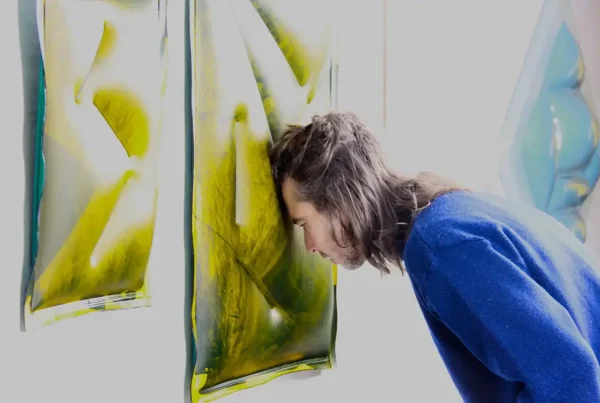
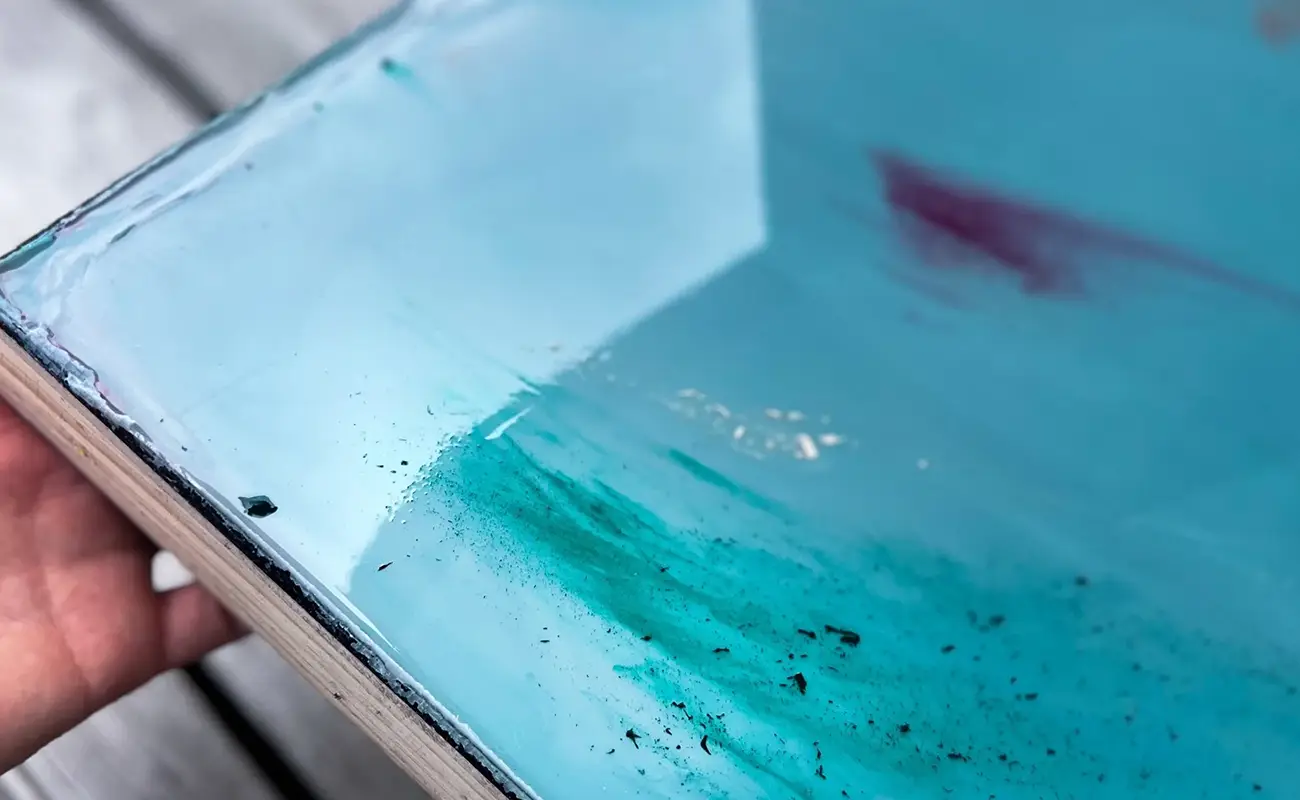
A defining feature of Laura Fauvel’s practice is her sophisticated use of synthetic papers such as Yupo and Monotex. Unlike absorbent traditional paper, these smooth non-porous surfaces keep acrylic paint on top rather than drawing it inward. That single material difference opens an expansive field of possibility. Pigment can be pushed, pooled, tilted, lifted, wiped away, diluted, or layered while still retaining mobility. Fauvel recognized that this surface was not merely a support but an active collaborator. She has described discovering Yupo and feeling immediate fascination with what it might allow. That instinct proved decisive. By choosing a material not yet overused, she entered a space where experimentation could lead to genuinely personal methods. The heavier 390 gsm Yupo particularly appealed to her because it could withstand washing and handling while offering greater body. This practical knowledge matters because her process is intensely physical. She often holds, turns, and manipulates the sheet itself as part of image making.
Her method depends on dialogue between gravity, gesture, touch, and timing. Rather than applying paint in a static upright format alone, Fauvel uses movement to sense the weight and flow of liquid pigment. She may guide color across the surface with her hands, shift the paper to redirect currents, or remove passages before they settle. Such actions create works that feel immediate while remaining carefully negotiated. Chance enters the studio, but chance is never left unattended. She responds to accidents, redirects them, preserves some, erases others, and allows forms to emerge through sustained attention. This is where the intelligence of process becomes clear. Soft gradients, suspended blooms, and drifting edges often appear effortless, yet they are the result of observation and decision. Her fascination with how things function and why forms arise gives the paintings a structural core beneath their softness. Viewers encounter serenity on the surface, but beneath it lies an alert conversation between artist, medium, and unfolding possibility.
There is also an ecological and practical dimension to this material choice. Because wet paint can be washed away without damaging the surface, sheets may be reused during experimentation. That flexibility supports risk taking, allowing ideas to be tested without the same level of waste associated with disposable trials. More importantly, it encourages a fearless studio mentality. When a mark can be altered, the artist is freer to attempt what might otherwise feel too uncertain. Fauvel has used this openness to accelerate her growth in confidence and process. The resulting paintings often seem suspended between drawing, staining, weather pattern, and reflective object. Their glossy surfaces can catch surrounding light and mirror nearby trees or sky, drawing viewers physically into the encounter. Material, image, and environment briefly merge. Few artists make support and subject converse so fluidly. In Fauvel’s hands, synthetic paper becomes more than an unconventional surface. It becomes a site where experimentation, presence, and emotional translation meet.

Laura Fauvel: Alpine Atmospheres and the Art of Feeling
Living in the Austrian Alps has deepened Laura Fauvel’s connection to landscape, yet she does not paint mountains as scenery. Instead, she translates the sensations of alpine life into abstraction. Snowfall, glacial clarity, dusk light, altitude, thaw, shadow, and shifting weather become emotional climates within the work. She has spoken of the muffled silence that arrives with snow, the thrill of descending slopes, and the freshness of seeing the world as if new. Such experiences reappear as veils of white, cool blue transitions, sudden energetic passages, or expansive stillness. A released series of fifteen works on Yupo paper drew directly from mountain life, including sunsets, storms, hikes, and recent challenges. This connection to place gives her paintings authenticity without trapping them in description. They are not postcards of the Alps. They are records of what it feels like to inhabit such environments physically and emotionally. That distinction allows local experience to become universally legible.
Color plays a central role in this transformation of environment into mood. Fauvel frequently uses blues, pinks, ambers, greens, violets, and reds, but these hues function less as decoration than carriers of sensation. Blue may suggest cold air, depth, or calm. Pink can hold warmth, tenderness, or fading evening light. Amber may evoke late sun or memory. Green can imply growth, mineral freshness, or forest shadow. Because colors often dissolve gradually into one another, emotional states feel fluid rather than fixed. Some paintings are nearly monochrome, animated by subtle tonal movement and surface tension. Others feature concentrated eruptions of pigment that resemble blossoms, storms, bruised clouds, or geological pressure. This ambiguity is one of her strengths. The viewer is not told what to see. Instead, meaning forms through attention and association. In a culture eager to label everything quickly, Fauvel restores the slower pleasure of uncertainty and personal response.
At the heart of her practice lies an ethics of intuition, resilience, and presence. She has encouraged emerging artists to listen to their own thoughts and feelings, arguing that excitement about one’s daily work matters deeply. Her own life demonstrates that principle. Through caregiving strain, career change, relocation, and the demands of family life, she built a practice sustained by commitment rather than glamour. She also speaks candidly about the business realities of art, from photographing work and managing websites to shipping, framing, and maintaining visibility. This honesty enriches the romantic image of the painter with practical truth. Yet the paintings themselves remain spacious, calm, and generous. They hold complexity without heaviness. Laura Fauvel’s achievement is to show that abstraction can be both intimate and expansive, disciplined and free, personal and open to others. Through color, motion, and surface, she creates works where memory meets immediacy and where viewers may briefly feel more awake to their own inner weather.