A Language of Layered Abstraction
Deborah T. Colter stands as a compelling voice within contemporary abstract painting, recognized for compositions that invite prolonged attention rather than immediate resolution. Her work unfolds through richly layered surfaces where color, form, and texture interact in ways that feel both intentional and exploratory. Based on Martha’s Vineyard, Massachusetts, she has cultivated a practice that reflects a deep commitment to painting as an evolving conversation rather than a fixed outcome. Viewers encountering her work often sense an underlying structure supporting moments of improvisation, a balance that situates her paintings within a broader dialogue of modern abstraction while remaining distinctly personal. Exhibited widely across the United States and internationally, her paintings have earned recognition for their ability to merge visual complexity with emotional clarity, offering spaces for reflection without dictating a singular narrative.
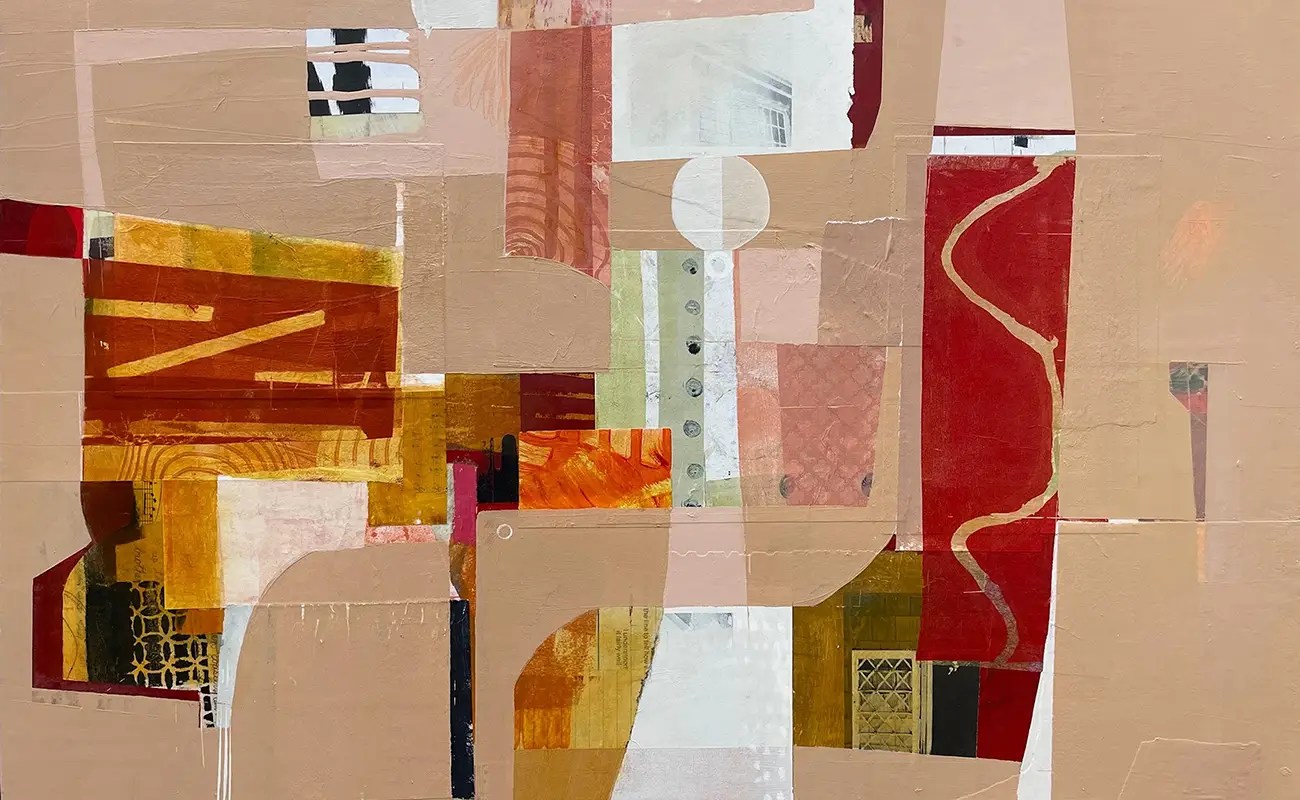
Central to Colter’s approach is her ability to weave together geometry and intuition in ways that feel lived in rather than imposed. Shapes such as blocks, arcs, circles, and irregular planes appear to shift and reconfigure across the picture surface, suggesting spatial relationships without settling into literal representation. These elements create a visual rhythm that draws the eye across the canvas, encouraging movement and pause in equal measure. Her paintings often suggest architectural fragments or remembered landscapes, not as depictions but as impressions shaped by memory and process. This ambiguity allows each viewer to engage the work from a personal vantage point, discovering connections that resonate individually while still sensing the cohesion of the overall composition.
Color plays a vital role in establishing the emotional tenor of Colter’s paintings. She frequently works within carefully tuned palettes where cool blues and greens converse with warmer ochres, rusts, and neutrals. Transparency is used to powerful effect, allowing earlier layers to remain visible and active within the finished surface. This interplay between opacity and translucence creates depth while preserving a sense of unity across the composition. Subtle patterns, drawn lines, and textured passages introduce tactile interest, reinforcing the physicality of the painting itself. Together, these elements contribute to works that feel constructed through time, bearing traces of revision and discovery that reward attentive looking.

Deborah T. Colter: Process as Discovery
Discovery functions as a guiding principle throughout Deborah T. Colter’s creative process, shaping both the method and meaning of her work. She often begins a painting by assembling multiple layers of collage materials, establishing a foundation that is intentionally open ended. Over this base, she applies acrylic polymer paint, drawn marks, circles, patterns, and a wide range of gestures that respond to what already exists on the surface. Each addition becomes part of an ongoing dialogue, prompting decisions that build, obscure, or transform what came before. Rather than following a predetermined plan, she allows the painting to evolve through interaction, trusting the process to reveal its own direction.
The act of construction and deconstruction plays a critical role in how Colter understands her paintings. Elements are added, adjusted, and sometimes removed as relationships within the composition shift. This constant reworking establishes a narrative that feels internal to the painting itself, one that continues to call her back for further exploration. She experiments with scale, balance, and contrast, searching for moments where disparate parts begin to speak to one another with clarity. The painting becomes a site of inquiry, reflecting a sustained engagement with uncertainty and possibility. Through this approach, the final image carries a sense of lived experience, shaped by choices made in response to the evolving surface.
A defining moment in Colter’s process occurs when a piece begins to coalesce in a way that feels unmistakable. She describes a physical sensation, a subtle shiver, that signals the work has reached a point of independence. At this stage, the painting no longer feels directed solely by her hand but appears to assert its own presence and logic. This moment of recognition marks the conclusion of the journey, not because every question has been answered, but because the painting has achieved its own internal coherence. Such experiences reinforce her trust in an approach that values openness, risk, and responsiveness over rigid control.

Place, Practice, and Professional Reach
Deborah T. Colter’s life and work are closely intertwined with the landscape and cultural environment of Martha’s Vineyard, where she lives and maintains her studio practice. Born in Ithaca, New York, she has spent most of her life on the island off the coast of Massachusetts, an experience that has shaped her sensibility without dictating explicit imagery. The rhythms of island life, the shifting light, and the balance between isolation and community contribute subtly to her way of working. Rather than appearing as direct references, these influences manifest as a sensitivity to space, balance, and transition within her paintings. The island setting supports a sustained studio practice grounded in reflection and continuity.
Her formal training at the Rhode Island School of Design, where she earned a Bachelor of Fine Arts degree in 1981, provided a strong foundation for her subsequent career. Since graduating, Colter has worked as a full time studio artist, developing a body of work that reflects decades of commitment to painting as a serious and evolving discipline. This long term dedication has allowed her to refine her visual language while remaining open to change and experimentation. The combination of rigorous education and sustained practice has contributed to a confident approach that balances technical understanding with intuitive responsiveness.
Colter’s work is held in numerous private and corporate collections throughout the United States and abroad, underscoring the broad appeal of her paintings. Notable collections include Adobe Systems, Biogen, J.W. Marriott, and Cisco Systems, each recognizing the ability of her work to engage diverse audiences and environments. In addition to these acquisitions, she has contributed to high profile projects such as the 2015 HGTV Dream Home on Martha’s Vineyard, where three of her pieces were placed in collaboration with the design team. These professional milestones reflect a career marked by both artistic integrity and meaningful engagement with the wider cultural landscape.

Deborah T. Colter: Trusting the Unknown
At the heart of Deborah T. Colter’s practice lies a profound trust in the unknown aspects of creation. She speaks of painting as a means of discovering places that feel simultaneously familiar and unfamiliar, suggesting that the act of making art opens pathways beyond conscious intention. Often, she experiences the arrival of a painting as unexpected, as though it emerges from a source beyond her immediate understanding. This perspective positions painting not as a task to be completed but as an encounter that unfolds through patience and attention. Her willingness to embrace uncertainty allows the work to remain open, responsive, and alive throughout its development.
Colter places significant value on what she describes as the messy nature of the creative process, complete with its inherent challenges and surprises. Rather than resisting these moments, she views them as essential to understanding her ongoing need to create. Each adjustment, misstep, or revision contributes to a deeper awareness of why she continues to paint. This acceptance fosters resilience and curiosity, enabling her to move forward even when outcomes remain unclear. The paintings become records of persistence, reflecting a commitment to showing up repeatedly and engaging with the work on its own terms.
Inspiration within Colter’s studio often begins modestly, sparked by a single mark, color, form, or layer. From this small starting point, the painting grows through accumulation and response, guided by pleasure in line, shape, and color. Her work speaks to this path of discovery, offering viewers a glimpse into a process driven by curiosity and gratitude. She has expressed a deep appreciation for the opportunity to spend her life painting, acknowledging that the journey continually leads her to new and unexpected places. This sense of gratitude and openness infuses her work with a quiet vitality, inviting others to share in the experience of exploration.