

“I am challenged by the watercolor medium and enjoy the collaboration, it moves naturally and so I work with it instead of trying to control it.”
A Life Shaped by Making and Meaning
Creative expression entered Rosa Silver’s life at an early age and never loosened its hold. From childhood onward, art, writing, and even baking functioned as essential tools for survival during a deeply emotional upbringing. These early acts of making were not hobbies but lifelines, forming a language through which experience could be processed when words alone were insufficient. Raised near Grand Central Station in New York City, she grew up surrounded by movement, density, and cultural friction, absorbing the charged atmosphere of a city that compresses countless stories into every block. That proximity to constant human exchange shaped her sensitivity to collective experience and planted the seeds for a practice that would later focus on shared histories, inherited memory, and emotional repair. Her work today still carries the imprint of those early years, rooted in the belief that creativity is not decorative but functional, capable of holding grief, fear, resilience, and care within a single gesture.
Silver’s formal education refined this instinctual drive without extinguishing its emotional core. She earned both a BFA and an MFA in metalsmithing, training within programs that valued traditional craftsmanship while also encouraging conceptual rigor. This dual emphasis sharpened her ability to think structurally and symbolically at the same time. While metal was her initial discipline, the conceptual frameworks she developed there extended far beyond material boundaries. Graduate school marked a turning point when her artistic focus aligned explicitly with healing, a direction intensified by personal loss. During her MFA studies, her father faced cancer and ultimately passed away on the day her graduate exhibition opened. That convergence of professional emergence and profound grief anchored healing as a lifelong concern within her work, not as a theme but as an ethical commitment to address suffering with presence and intention.
Over time, Silver’s practice expanded into installation, mixed media, watercolor, and printmaking, reflecting her refusal to remain confined by medium. Her approach is emotional and conceptual, guided by intuition yet supported by sustained research into medicine, science, and spiritual systems. Healing, for her, encompasses far more than physical repair. It includes unseen forces, inherited beliefs, emotional patterns, and the energetic imprint of place. She investigates how environments affect those who inhabit them, whether human, animal, or plant, and how creative acts can respond to that influence. This orientation situates her work within a broader dialogue that connects personal narrative to collective experience, establishing her as an artist whose output functions as both inquiry and offering.

Rosa Silver: Interdisciplinary Practice as Healing Method
Silver’s identity extends well beyond the studio, forming a multidisciplinary constellation that feeds directly into her art. She is a writer, radio personality, curator, and certified facilitator of The Work of Byron Katie, a mindfulness-based practice centered on self-inquiry. These roles are not separate pursuits but interconnected modes of engagement, each reinforcing her commitment to compassion and awareness. Her understanding of trauma and its neurological effects, combined with studies in Nonviolent Communication, Kabbalah, alchemy, and collective consciousness, informs how she structures both her creative process and her interactions with others. Rather than positioning the artist as an isolated producer, Silver operates as a connector, someone who creates frameworks for reflection and dialogue. Her work invites participation, whether through visual immersion or guided inner exploration.
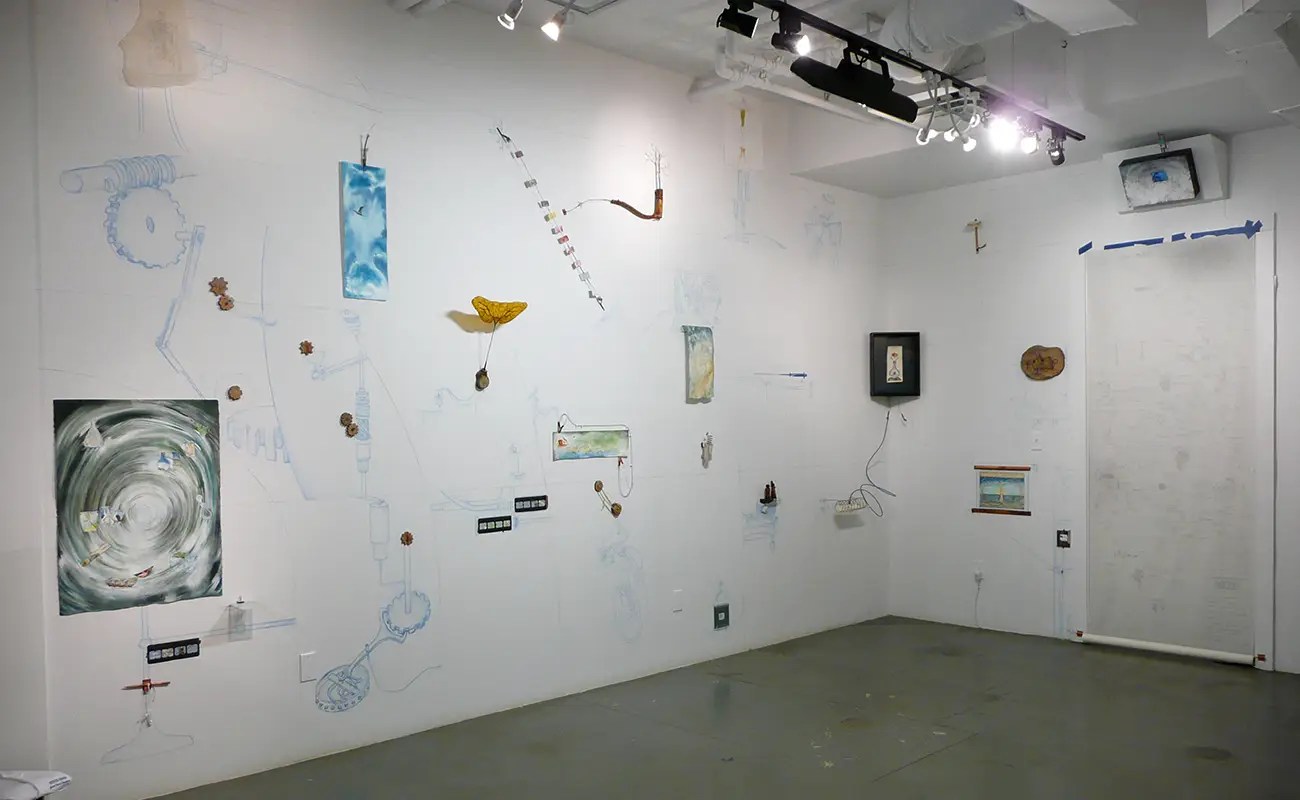
Social and environmental advocacy also occupy a central place in her life. Silver has initiated several nonprofit efforts and volunteers on a helpline, extending her focus on healing into direct action. These commitments underscore her belief that art does not exist apart from the conditions of the world but responds to them. Her installations often address damaged sites or wounded histories, attempting to acknowledge harm while offering symbolic repair. In 2012, she created an installation on Swan Island intended to energetically cleanse a Superfund site, using creative means to engage with environmental trauma. More recently, she has produced a purification machine installation in downtown Portland, incorporating water from the Willamette River and copper for conductivity, painted directly onto gallery walls. These projects reflect her interest in how scientific concepts, spiritual symbolism, and geographic specificity can converge within a single work.
Water functions as a recurring material and symbol throughout Silver’s practice, shaped by her Jewish heritage where water holds deep associations with purification. In her watercolor works and installations, water is not merely a medium but an active collaborator, guiding movement and mark-making beyond full control. She often sources water locally, embedding the physical character of a place directly into the artwork. This practice reinforces her belief that healing must address context rather than exist in abstraction. By combining elements such as copper, architectural references, and site-specific resources, Silver constructs visual systems that mirror the interconnectedness she studies. Her art becomes a working model of relationship, linking science, mysticism, environment, and empathy into a coherent yet open-ended structure.

Memory, Influence, and Ancestral Inheritance
Silver’s influences form a wide intellectual and visual field, spanning artists, spiritual traditions, and scientific inquiry. Figures such as Jenny Holzer, Francis Bacon, William Blake, Marlene Dumas, and Anselm Kiefer resonate with her for their willingness to confront vulnerability, history, and moral complexity. Alongside these contemporary and historical voices, she draws inspiration from old medical texts, science libraries, and archival imagery that reveal how humanity has attempted to understand the body and the world across time. Alchemy, physics, mechanics, Jewish symbology, and Kabbalah all contribute frameworks that inform her thinking—not as rigid systems but as evolving resources for the healing process. These sources allow her to approach art-making as a space for transformation.
Ancestry and inherited memory occupy a vital position in her work. Silver actively explores collective consciousness and what is passed down through generations, consciously engaging with her own Jewish lineage. This interest becomes particularly visible in her reflections on migration, survival, and convergence. She considers how ancestral journeys shape identity even when their details are only partially known. Her art does not attempt to resolve historical trauma but to acknowledge its presence within the body and psyche. By holding space for these layered histories, she creates works that resonate beyond individual biography. The focus remains on connection rather than closure, recognizing that healing often involves sustained attention rather than definitive answers.
Place remains a persistent influence, both geographically and energetically. Silver’s life has spanned urban Manhattan and the rural landscapes of Kauai, environments that could not differ more sharply in tempo and density. Rather than framing these locations as opposites, she treats them as complementary forces that sharpen her awareness of context. She understands that place has an influence and carries information; it affects us and adds to this moment whether we acknowledge it or not, whether we know about it or not. As part of her installation work, one scientific paper reads, “effects of place on subject”—she is the subject, and life is the experiment. Her sensitivity to land extends to ethical considerations around stewardship and belonging, particularly in Hawaii where indigenous relationships to land carry profound significance. These experiences deepen her commitment to working respectfully with place, understanding it as an active participant in creative exchange. The resulting artworks reflect a sustained effort to listen, observe, and respond rather than impose.

Rosa Silver: Meaningful Works and Ongoing Directions
Several works stand as touchstones within Silver’s practice, each embodying her approach to memory, symbolism, and transformation. Her long-standing fascination with water, the sky, and cloud formations reflects a unifying vision, noting that all beings share the same sky and dependence on water, regardless of borders or beliefs. This sense of shared existence deepened through her studies in Kabbalah and during a residency in Assisi, where walking in the footsteps of St Francis became a way to access spiritual perception across time. She walked with an intention to see the world as he did, to feel the sun, to see beyond what her eyes could take in, to look at the Earth in wonder, in awe of it as if all is a miracle. Kabbalah gives her a deep understanding that what she takes in through the five senses is only 1 percent of existence. Both perspectives explore the nature of being human and what it means to walk the Earth.
Originally, Silver was making large installations in New York City, but the material waste conflicted with her environmental beliefs and activism. Influenced by permaculture and the goal of making less waste, she shifted to creating small two-inch watercolor paintings, initially inspired by 1960s school science book illustrations. Her fascination with water has been long-standing, ever since being a little girl playing with the faucet.
One of her most powerful works, entitled Some Kind of Wonderful, arose from an encounter with photographs taken by Henryk Ross inside the Jewish ghetto during the Holocaust. Ross, forced to produce propaganda images, secretly buried thousands of negatives that later surfaced as historical testimony. Silver photographed these photographs, printed sections onto watercolor paper, and engaged them through meditative action using water, color, and ancient symbols. The piece centers on an image of a destroyed temple with a man holding the Torah amid rubble. Beginning with the question of how such cruelty occurs, she used the work as an energetic act of healing, recognizing that destruction and creation often coexist. And during the act of art-making with Kabbalah study, she was reminded of the story that Kabbalah arose from the destruction of the temple.
Another significant piece, Life & Death in Flight: What We’ve Carried, reflects on her family’s escape from antisemitism in Eastern Europe, tracing divergent migration paths that ultimately converged in her own life, begging to question what ancestral baggage do we carry? She is ResourceFULL, originating from a monoprint created in Hawaiʻi, charts stages of life through a series of windows, concluding with an image of release.
Silver’s daily working rhythm resists rigid scheduling, shaped by an awareness that forcing productivity leads to exhaustion rather than insight. Her current limited home studio has encouraged intimate, two-dimensional work in watercolor and printmaking while also fueling a desire to return to large-scale installations and sculptural forms. She continues to pursue projects that address the healing of place and its inhabitants, integrating quantum physics, geographic energy, alchemy, and spiritual study into tangible form. Concurrently, she is writing her memoir, viewing the act of storytelling as another mode of repair. Through radio interviews and broadcasts, including her appearance on KBOO FM, she treats voice and narrative as integral elements of her practice. In her work, she has said that life is an experiment and she is the subject; each medium is part of a unified whole. Each new direction grows organically from the last, sustaining a body of work that remains open, responsive, and deeply invested in care.


