“My work reflects a life lived in translation: from Eastern Europe to the United States, and now back to Western Europe.”
The Language of Borders and Memory
Elisabeth Ajtay‘s work occupies a singular space in contemporary photography and conceptual art, shaped by a lifelong navigation of migration, displacement, and cultural shifts. Though primarily known for her photographic work, her practice extends far beyond the frame. It includes elements of drawing, painting, sculpture, and bookmaking, revealing a mind compelled by questions rather than answers. Ajtay’s perspective has been forged across nations and ideologies, tracing a journey from Communist-era Romania to West Germany, then through the United States, before returning once again to Europe. Each transition she experienced is biographical and therefore foundational to her work’s conceptual roots.
Her artistic journey began in childhood, without a clear commitment to art as a profession. Initially envisioning herself as a doctor, she gradually turned toward creative fields, driven by a curiosity about the human condition and her own internal transformations. Trained in Communication Design with emphasis on photography in Dortmund and later earning her MFA from the San Francisco Art Institute, Ajtay’s evolution was shaped as much by geography and culture as it was by academia. She describes the East-to-West transitions of her childhood as “annual time travels,” underscoring the surreal experience of straddling vastly different realities. This duality—of living between systems, histories, and languages—remains a central thread that shapes her work’s aesthetic and thematic focus.
The cultural whiplash Ajtay experienced—from Cluj to Trier, from Budapest to San Francisco—acted as an open-ended initiation into artmaking as a way to re-map identity. These formative displacements made her acutely sensitive to the visual and emotional vocabulary of places. Her artworks resist static classification, instead functioning as evolving responses to her environment. They articulate the subtle tensions between presence and absence, language and silence, permanence and impermanence. Her voice as an artist emerges from these thresholds, from the fluid space between adaptation and estrangement.

Elisabeth Ajtay: Material as Metaphor
Ajtay’s approach to media reflects her broader experience of navigating change. Initially rooted in traditional analog techniques, she began to explore digital photography as a way to address abstraction and ambiguity in her work. This transition paralleled a broader philosophical shift in her practice: a move away from representation toward evocation. Her acclaimed piece Ginnungagap (Yawning Void) / Cycles, which took four years to complete, exemplifies this transformation. Initially started in Germany in 2008, the work integrates a series of photographs with the cyclical imagery of twelve full moons, unfolding over an entire year. Through this project, Ajtay found the means to convey complex emotional and existential states without literal narrative.
The title Ginnungagap, drawn from Norse mythology, alludes to the primordial void—a metaphor that resonated with her sense of in-betweenness. The moons, carefully arranged in a sequence, act as symbols of time’s relentless passage and the cyclical nature of inner transformation. Ajtay’s use of digital photography, a medium she initially found challenging, became an invitation to slow down, to resist the instantaneity it typically promises. This piece marked a moment of realization: that artistic meaning could be cultivated through patience, ambiguity, and the willingness to trust in gradual emergence.
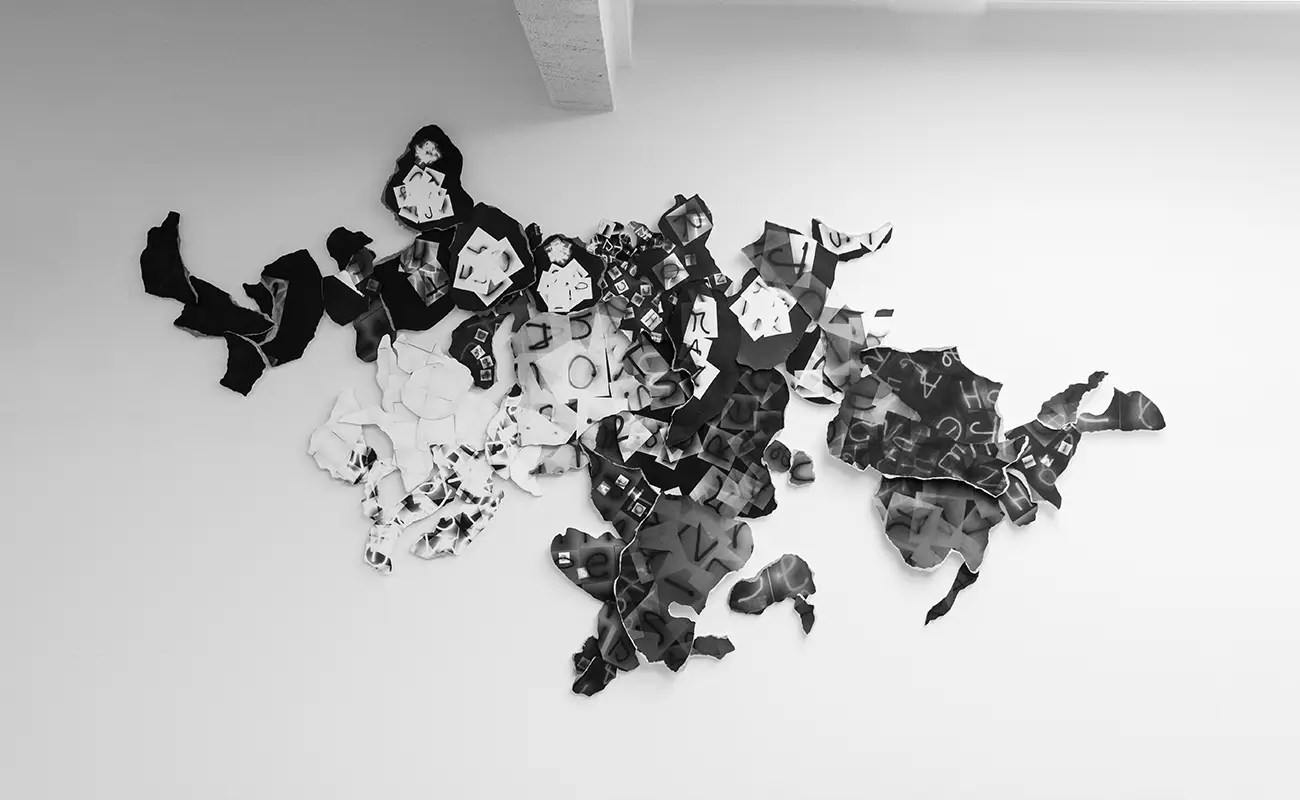
Another pivotal work in her practice is Dialog (Dialogue), created between 2017 and 2020. This series continues her engagement with the moon alphabet, an earlier work where she used moonlight to create an alphabet. Rather than moving a light source as in traditional light drawing, Ajtay reversed the process by keeping the moon fixed and moving her camera to inscribe each character. In Dialog (Dialogue), she constructs torn and reassembled sculptural photograms using digital negatives of the moon alphabet, basing the compositions on migration patterns. These forms echo linguistic characters and human motion, oscillating between the familiar and the obscure. The hard edges of her photograms, combined with organic movement, reflect the structural and emotional duality of language; it holds the power both to divide and to unite. Awarded an Honorable Mention by the International Photography Awards, this series highlights Ajtay’s ability to translate deeply personal and political experiences into a visual language that resists simplification.

Cartographies of Displacement and Perception
Ajtay’s artistic identity is intrinsically linked to her sense of being a perpetual outsider—a position she neither resents nor glorifies but investigates through her evolving body of work. Each city she has lived in, from Budapest to San Francisco, has contributed not only to her aesthetic vocabulary but also to her internal lexicon of meaning. She often describes the start of new projects as intuitive encounters—moments when an object or idea finds her, prompting a slow unraveling of inquiry. These encounters are followed by intense research, drawing, painting, and collage. Such mind maps serve as a bridge between her emotional states and the emerging work, anchoring her process in visual experimentation before photography ever enters the frame.
Her day-to-day practice reflects the multifaceted reality of an artist working conceptually. While much of her creative activity is bound to the studio, just as much occurs in thought, correspondence, and careful reflection. She resists the romantic idea of constant productivity, recognizing instead that artistic labor often unfolds in nonlinear time. This approach is particularly evident in her recent return to casting techniques during the summer months, which she describes as a meditative exercise. That body of work remains in early development, gestating alongside other projects, including a long-awaited book.
The upcoming book project marks a major pivot in Ajtay’s trajectory. Spanning nearly two decades of photographic work, the book emerged from a sudden realization: she no longer felt the same urgency to photograph. Rather than treat this as a creative impasse, she embraced it as a shift in perception—a signal that something new was taking shape. Compiling and editing images became a reflective act, allowing her to see threads she hadn’t previously recognized. The book serves not just as a retrospective but as a point of transition, drawing a line between past modes of seeing and new ones she has yet to fully articulate.

Elisabeth Ajtay: Reframing Home and Otherness
Themes of home, language, and belonging are constants in Ajtay’s conceptual vocabulary. Yet, she rarely addresses these ideas directly. Instead, her work invites viewers into layered experiences—visual meditations that explore the quiet power of abstraction, motion, and materiality. Her artist book Change (2024), created in an edition of fifty, encapsulates this ethos. Structured around her own complex journey between continents and cultural identities, the book acts as both document and mirror. Written in the wake of her return to Europe following a decade in the United States, Change charts the emotional upheaval that accompanied her attempt to resettle in a place that had ceased to feel familiar.
This project reflects on what it means to transform while the external world remains static. The dissonance Ajtay felt upon returning to Europe—between who she had become and what her environment expected her to be—gave shape to the book’s core inquiry. Her writing navigates the paradox of migration: how it both broadens vision and isolates the migrant from any singular sense of home. Through visual and textual cues, Change prompts the reader to examine their own relationship to transition and permanence, making it one of her most introspective works to date.
Her exploration of otherness continues through her formal experimentation. The reassembled photograms in Dialog (Dialogue), for example, resist linguistic clarity while referencing the very structures of language itself. This contradiction is central to Ajtay’s practice: the need to speak in a visual dialect when verbal language fails. The forms she creates operate like echoes of forgotten alphabets or traces of displacement mapped through light and shadow. They invite the viewer not to decipher but to experience, to sense rather than decode.
Ultimately, Elisabeth Ajtay’s work does not offer tidy resolutions. It asks difficult questions about movement, estrangement, and identity without reducing them to narrative tropes. Her art is an act of continual orientation, one that resists fixed meaning and instead embraces the shifting terrains of culture, history, and perception. Through photography and beyond, she opens a visual dialogue that speaks to anyone who has ever had to redefine where they belong.