A Vocabulary of Motion and Intuition
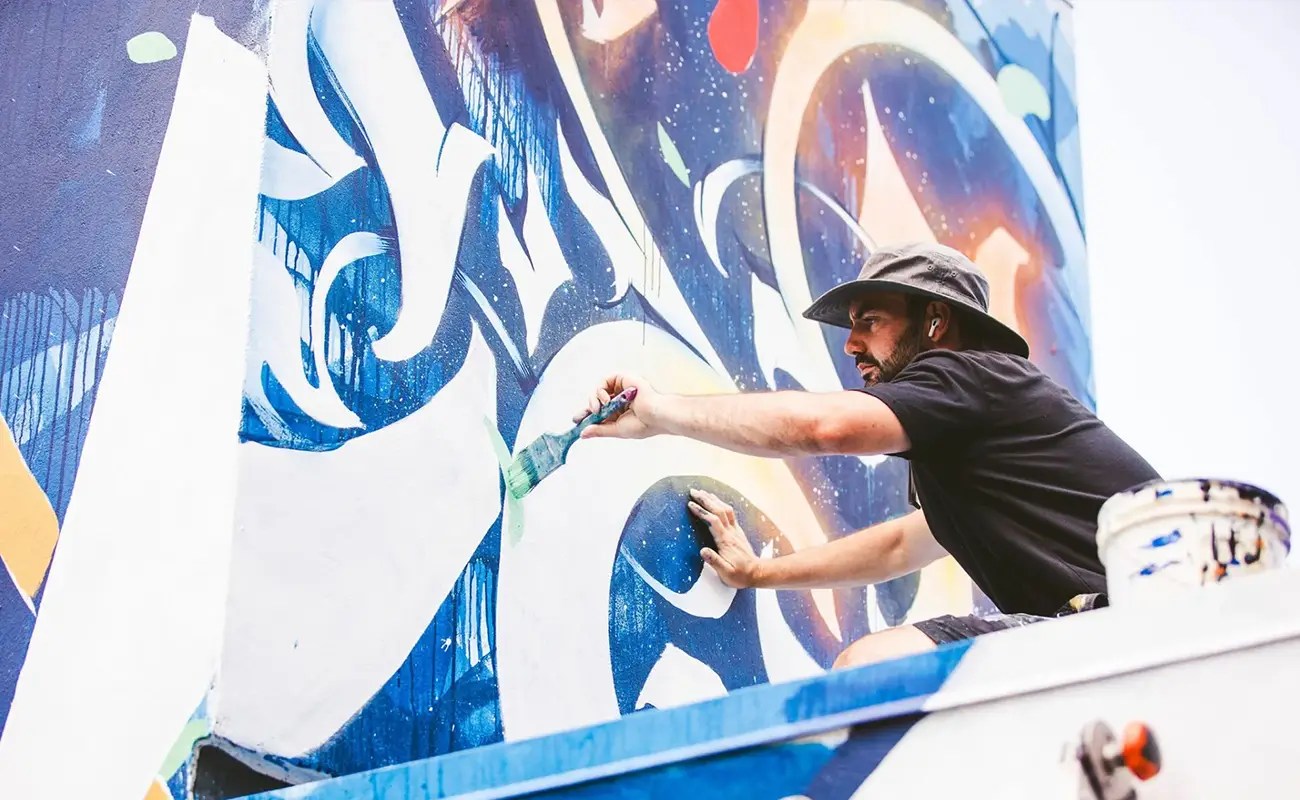
Leo Shallat, a Seattle-born visual artist, has carved out a distinctive voice within contemporary art by merging calligraphy, graffiti, and abstract expression into a unified visual language. His work resists easy classification, balancing between fine art traditions and the raw energy of street culture. With sweeping brushstrokes, flowing forms, and a focus on movement rather than message, his pieces do not seek to be read but to be felt. This fusion, known in part as Calligraffiti, gives his practice both immediacy and depth, inviting viewers to experience his paintings on a visceral level. In large-scale murals, custom commissions, and site-specific installations, Leo pushes beyond legibility, creating compositions that resonate like music — less about what is said and more about how it’s conveyed.
While much of his career centers around abstraction, Leo’s foundation is grounded in the precision of European Gothic calligraphy. This formal discipline came into focus during a pivotal year-long scholarship in 2018, when he studied under acclaimed calligraphy master Paul Antonio Attong. That period marked a turning point, catalyzing a shift from controlled lettering into freer, more expressive gestures. Through this process, he began deconstructing the alphabet into spontaneous strokes that emphasize form and rhythm over linguistic meaning. His approach gradually became less about typographic structure and more about cultivating presence through brushwork, inviting contemplation rather than analysis.
What makes Leo’s artistic journey compelling is not only the transformation of style but the internal shift that accompanied it. Originally drawn to art through graffiti, his early work reflected the chaotic intensity of street culture. But over time, particularly in response to personal and global uncertainty in 2020, Leo pivoted toward simplicity and stillness. He began exploring the power of a single brushstroke, using negative space and deliberate composition to communicate calm in contrast to earlier explosive works. This evolution underscored a deeper search — not for statements, but for sensations. It’s this sensitivity to feeling, not form, that defines his work and continues to guide its trajectory.

Leo Shallat: Breaking Letterforms, Building Atmospheres
At the core of Leo Shallat’s practice lies the principle of deconstruction — not as destruction, but as transformation. By stripping letterforms of their semantic function, he turns them into vehicles of gesture, rhythm, and mood. His calligraphic abstractions are less about reading than witnessing movement captured in time. The brushstroke becomes the protagonist, and the resulting compositions pulse with energy. These shapes, often gestural and unrecognizable as language, serve as an emotional interface between the viewer and the work. By abandoning literal interpretation, Leo opens the door to intuitive experience, allowing each viewer to form their own narrative.
This deliberate abstraction does not exist in isolation. Leo’s background in formal calligraphy ensures that every stroke, however fluid, carries the weight of disciplined practice. The tension between control and release gives his work its potency. It’s a dance between the structured beauty of tradition and the chaotic improvisation of contemporary expression. His use of space — both filled and empty — plays a vital role in how his work interacts with its environment. Whether on canvas or architectural wall, his compositions feel alive, adapting their energy to the scale and context in which they exist. In this way, his art integrates seamlessly into both personal and public spaces.
Leo’s collaborations reflect this adaptability. He has worked with a wide range of clients, from commercial developers to art consultants, creating works that complement and elevate their surroundings. His murals and installations appear in tech campuses, hospitality settings, and public environments, each uniquely tailored to its context. With a refined sense of materiality and spatial awareness, Leo doesn’t impose his style onto a space — he listens to it. His work brings rhythm to architecture, infusing static surfaces with a pulse that resonates visually and emotionally. The result is not just decoration, but a dialogue between structure and spirit.

Cultivating Flow Through Practice and Process
The consistency in Leo Shallat’s evolution is deeply connected to his rigorous studio routine and experimental approach. His creative process begins not with grand gestures, but with small, intimate acts of repetition. Each day, he produces modest works on paper — exercises he calls “brush meditations” — where he explores color, movement, and composition on a manageable scale. These daily studies serve as both technical warmups and conceptual laboratories, allowing ideas to emerge organically without pressure. Over time, select pieces are expanded into medium and large canvases, and sometimes further into mural-scale projects. This cyclical practice sustains the freshness and integrity of his larger works.
Leo’s focus on intuition is supported by an intellectual curiosity that feeds his artistic growth. Long hours in the studio are accompanied by an auditory diet of philosophy, science, self-development lectures, and interviews. This continuous learning is not just background noise; it informs the emotional tone and intention behind his art. Additionally, his social environment plays a vital role in shaping his perspective. Close friendships and meaningful conversations contribute as much to his creative world as solitary study. Together, these influences form a personal feedback loop, where both internal reflection and external interaction inform each new mark.
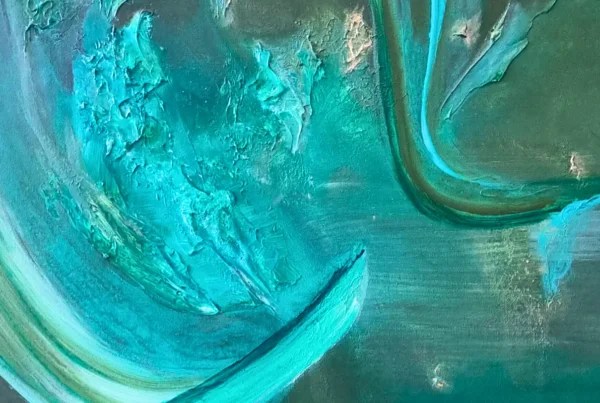
The shift in Leo’s work since 2020 exemplifies how personal and collective experiences filter into artistic choices. During a season marked by emotional heaviness and global disorientation, Leo responded not by amplifying noise but by distilling silence. His choice to strip back layers of visual information and focus on single, intentional brushstrokes was an act of resistance against chaos. This quieter style prioritized composition and spaciousness, aiming to evoke serenity and balance. It marked a new phase in his practice, one that continues to unfold through both introspective paintings and large-scale murals that maintain a sense of internal stillness even at monumental scale.

Leo Shallat: Gesture as Sculpture, Language as Presence
Leo Shallat’s artistic inquiry is expanding into new territories, with a focus on material exploration and multi-dimensional forms. As he prepares for his first major solo exhibition, he is synthesizing years of painting techniques with sculptural elements that extend his gestural language into physical space. These new works reflect a convergence of everything he has developed so far: the disciplined spontaneity of his brushwork, the contemplative minimalism of his recent pieces, and a growing interest in form beyond the flat surface. Among his upcoming projects are a series of 3D-printed sculptures and his debut collection of limited edition prints, marking a deliberate broadening of his artistic vocabulary.
At the heart of this expansion is a desire to engage viewers not just visually, but spatially. By transforming gesture into sculptural presence, Leo is exploring how movement can be preserved and felt in three dimensions. These works offer a tactile dimension to the visual experience, allowing his calligraphic language to inhabit physical space in a way that deepens its emotional resonance. The fluid lines that once danced across walls and paper now gain volume and shadow, challenging the boundaries between painting and sculpture. This shift speaks to Leo’s ongoing commitment to pushing the limits of his medium while remaining anchored in his core artistic values.
Despite these new directions, Leo’s focus remains consistent: creating work that resonates with the emotional undercurrents of human experience. Whether through a single brushstroke or a cast form, his art is rooted in the idea that language, in its most primal sense, is movement. It is this movement — stripped of literal meaning yet full of expressive force — that defines his practice. By choosing to prioritize gesture, presence, and feeling over interpretation, Leo Shallat invites his audience into a space where silence speaks and form becomes poetry. His work reminds us that meaning does not always require words, and that sometimes, the most profound expressions are the ones we cannot read.