Industrial Poetics in Motion
Zimoun, a Swiss artist based in Bern, has carved a distinct niche in contemporary art through his immersive installations that blur the lines between sculpture, architecture, and sound. Working entirely outside of academic traditions, he has forged his practice through self-guided exploration, driven by an early and enduring fascination with both sonic and visual expression. Utilizing an array of everyday and industrial materials, his mechanical works engage the senses and intellect alike, creating environments that oscillate between mechanical repetition and organic resonance. His compositions often evoke natural phenomena, such as rainfall or rustling foliage, though they originate from artificial, man-made processes. This interplay offers audiences a unique encounter with sound and space, pushing the boundaries of how art is perceived and experienced.
Instead of employing high-tech equipment or software to control his installations, Zimoun relies on simple systems powered by rotation and oscillation. DC motors, filler wires, ventilators, and cardboard are recontextualized into functioning sculptures that hum, flutter, or tap in rhythmic unison or chaotic disarray. Despite the apparent simplicity of his tools, the outcomes are complex and layered. Each work becomes a study in contrast: identical components arranged systematically often yield unpredictable behaviors once activated. These sonic sculptures are neither random nor entirely determined; they inhabit the tension between order and entropy. By refusing to direct the precise output of his machines, Zimoun invites natural variability to shape each performance, framing what he terms “primitive complexity” as a central creative principle.

A significant but often unseen dimension of Zimoun’s practice is his long-standing commitment to sustainability. For more than 25 years, his studio has followed a rigorous internal recycling policy. Despite working on monumental scales, his installations produce virtually no waste. Mechanical components are consistently reused in new works, circulating through a closed-loop system within the studio. Other materials, such as cardboard, are given a second life after exhibitions—often redistributed by partnering institutions to NGOs, artists, educators, or community organizations. These practices not only reflect a deep ethical engagement with materiality but also underscore Zimoun’s belief in the continued potential of the simplest elements.
Zimoun’s international acclaim is reflected in the wide-ranging exhibitions of his work across museums and galleries globally, including institutions such as the Reina Sofia in Madrid, the Nam June Paik Art Museum in Seoul, and the Taipei Fine Arts Museum. Whether constructing walls of plastic bags stirred by fans or assembling dozens of motors that delicately strike cardboard boxes, his installations resonate with a global audience attuned to the sensory and philosophical inquiries his work proposes. These exhibitions are more than visual spectacles; they are immersive zones where visitors can slow down, listen carefully, and engage with time, materiality, and motion in new ways.

Zimoun: Mechanized Ecosystems and Chaotic Precision
Zimoun’s approach to creation often begins with an obsession for repetition and uniformity, though this quickly transforms into a meditation on variability and difference. His installations are frequently built from multiples of a single element—motors, wires, boxes—that are arranged with mathematical precision. Yet once activated, these elements generate patterns that defy predictability. Each motor, prepared by hand, contains minute irregularities that alter its motion and sound. This departure from exact uniformity introduces individuality into what initially appears as mechanical sameness. Such subtle divergence is integral to Zimoun’s aesthetic, allowing micro-events within the system to emerge and evolve. The result is a dynamic choreography of sounds and movements that cannot be replicated exactly, even with identical components.
Works like 150 prepared dc-motors, fille wire 1.0mm, 2009/2010, composed of 150 DC motors and filler wire, exemplify how Zimoun uses simple tools to evoke rich emotional and sensory landscapes. In this piece, motors gently tap wires against walls, generating a cascade of sound akin to a rainstorm. The Boston Globe noted the auditory illusion of falling water, highlighting how mechanical noise can invoke a sense of natural immersion. Zimoun does not attempt to mimic nature in a literal sense, but rather reinterprets its patterns through industrial language. The spatial arrangement of his works encourages visitors to move within them, listening from different vantage points and observing how slight changes in placement affect the experience. This spatial interactivity positions the viewer as both witness and participant in an unfolding sonic environment.
Central to Zimoun’s philosophy is the refusal to manipulate his installations through digital control. Instead, he simply initiates them by turning on their power source. There is no intervention through programming or remote command. This hands-off methodology further underlines his concept of “primitive complexity,” where mechanical elements are allowed to act out their own behavior within a pre-defined structure. The systems may appear automated, but they are ultimately autonomous within the bounds set by their design. This limited control yields an aesthetic that feels both accidental and intentional, merging the predictability of design with the liveliness of chance. It is precisely this tension that breathes vitality into his works and positions them within broader discussions on systems theory, behavior, and technology.

The Sound of Repetition and the Material of Thought
Rather than naming his installations in poetic or metaphorical terms, Zimoun consistently titles them by listing the materials used. This practice draws attention to the physicality and function of the elements involved. For instance, his piece 30,000 Plastic Bags, 16 Ventilators (2010) makes its components explicit. The act of titling in this manner foregrounds the importance of matter itself, insisting that materials are not just means to an end but integral to the experience. In this work, layers of plastic bags are animated by directed airflow from industrial fans, producing a textured sonic surface that surrounds the viewer. The movement of air through plastic evokes both artificial and organic associations, producing a dense wall of sound that is as much physical as it is auditory. These installations operate like acoustic sculptures, where form and function are indivisible.
At times, Zimoun’s work engages directly with biological life, as seen in 25 Woodworms, Wood, Microphone, Sound System (2009). In this piece, the faint sound of woodworms burrowing is amplified, drawing attention to processes typically unnoticed or unheard. This subtle intrusion of living presence into his otherwise mechanical vocabulary extends his exploration of sonic behavior into the domain of biology. Such intersections reveal how sound, regardless of origin, holds the power to alter perception. In both mechanical and biological examples, Zimoun composes environments where listeners must become attuned to detail, recognizing that even minimal stimuli can yield rich acoustic experiences when magnified. The immersive quality of these environments often redefines conventional understandings of sculpture as static or visual, proposing instead a spatial experience constructed in time and movement.
Zimoun’s audio works further demonstrate his sensitivity to sound as material. These pieces, often created for multi-channel sound systems, are designed not as background audio but as three-dimensional experiences that envelop the listener. Drawing from lowercase music and minimal techno traditions, these recordings are composed from tiny sonic events that accumulate into larger structures. Released through Leerraum, a label he co-founded, these works share the same aesthetic concerns as his installations: reduction, repetition, and spatial complexity. Despite their different formats, both his physical installations and recorded pieces are rooted in the creation of environments. These are not narrative compositions but acoustic spaces to be inhabited, inviting listeners to discover depth in what initially appears to be simplicity.

Zimoun: Repetition as Spatial Experience
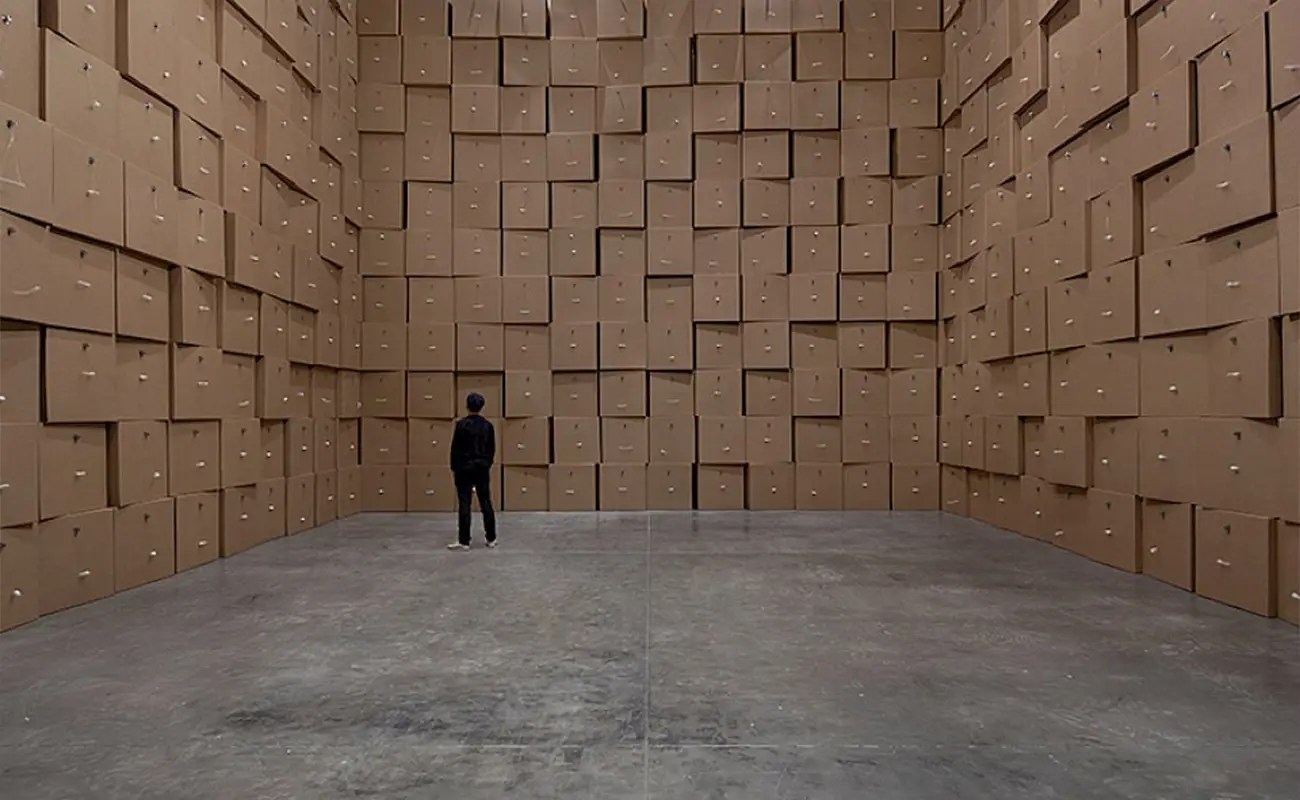
A Zimoun exhibition held in NYC, Volume (2012), exemplifies his ability to transform commonplace materials into elaborate sensory experiences. In this work, he assembled 294 DC motors, each swinging a cork ball within a cardboard box measuring 41 x 41 x 41 cm. The boxes, stacked nearly floor-to-ceiling, formed a towering architectural structure filled with rhythmic, percussive sound. As each cork ball tapped against the cardboard, a soft cascade of noise emerged, filling the space with an ambient hum that was both hypnotic and ephemeral. Though the components were standardized, the timing and impact of each element introduced subtle variations, creating an atmosphere that oscillated between mechanical repetition and organic evolution. Visitors found themselves surrounded by sound, enveloped within a structure that seemed to breathe and pulse.
This focus on creating walkable, explorable environments is key to Zimoun’s practice. His installations often span entire rooms or halls, requiring movement and time from viewers to fully perceive the shifting sonic patterns. As curator Maya Allison has noted, these spatial arrangements serve as interventions, altering how individuals perceive and inhabit architectural space. Modular repetition plays a crucial role here, not only in terms of sound production but also in shaping how viewers navigate the work. Rather than observing from a fixed point, audiences are invited to wander, to listen closely, and to discover subtle differences within seemingly uniform fields. This experiential engagement elevates the work beyond mere installation into a participatory process of discovery and contemplation.
Critics and curators have frequently remarked on the dual nature of Zimoun’s work: it is at once austere and emotional, methodical yet unpredictable. The acoustic element introduces a vitality that static sculpture often lacks, while the repetitive structures suggest meditative states akin to those found in minimal music or algorithmic art. Works such as 600 Prepared DC-Motors, 58 kg Wood (2017) emphasize these polarities, using familiar objects to explore how repetition and variation can evoke complex emotional responses. As Karine Tissot observed, these ordinary, functional materials become tools for investigating time, resonance, and the intricacies of material behavior. Within each piece, sound becomes a medium not just for listening but for thinking—challenging audiences to reconsider the sensory and conceptual boundaries of contemporary sculpture.
Tull impact of Zimoun’s work is best experienced through both sight and sound in motion. Readers are encouraged to view this compilation video on Vimeo, which presents many of his works in action. Watching the machines activate, hearing their intricate rhythms, and seeing the materials come alive offers a richer understanding of the dynamic, immersive nature of his art.