
Thresholds of Presence and Withdrawal
Photography becomes, in Natasha Antipova-Kaploukhaya’s practice, a charged site where external observation meets internal reverberation. Her images reveal an attentiveness to fleeting psychological atmospheres rather than to spectacle or event. Portraits unfold within ambient urban spaces, cafés, fashion districts, or nocturnal streets, yet the surrounding environment functions less as narrative context and more as a stage upon which emotional states quietly materialise. Light plays a decisive role in shaping these tensions. Warm sunset illumination resting on a contemplative youth at a restaurant table establishes an intimate sensory register that suggests fatigue without theatrical exaggeration. The camera lingers rather than intrudes, producing a visual tempo that feels meditative. This compositional restraint positions her work within a lineage of photographers who prioritise mood over plot, inviting viewers to inhabit moments of suspended interiority.
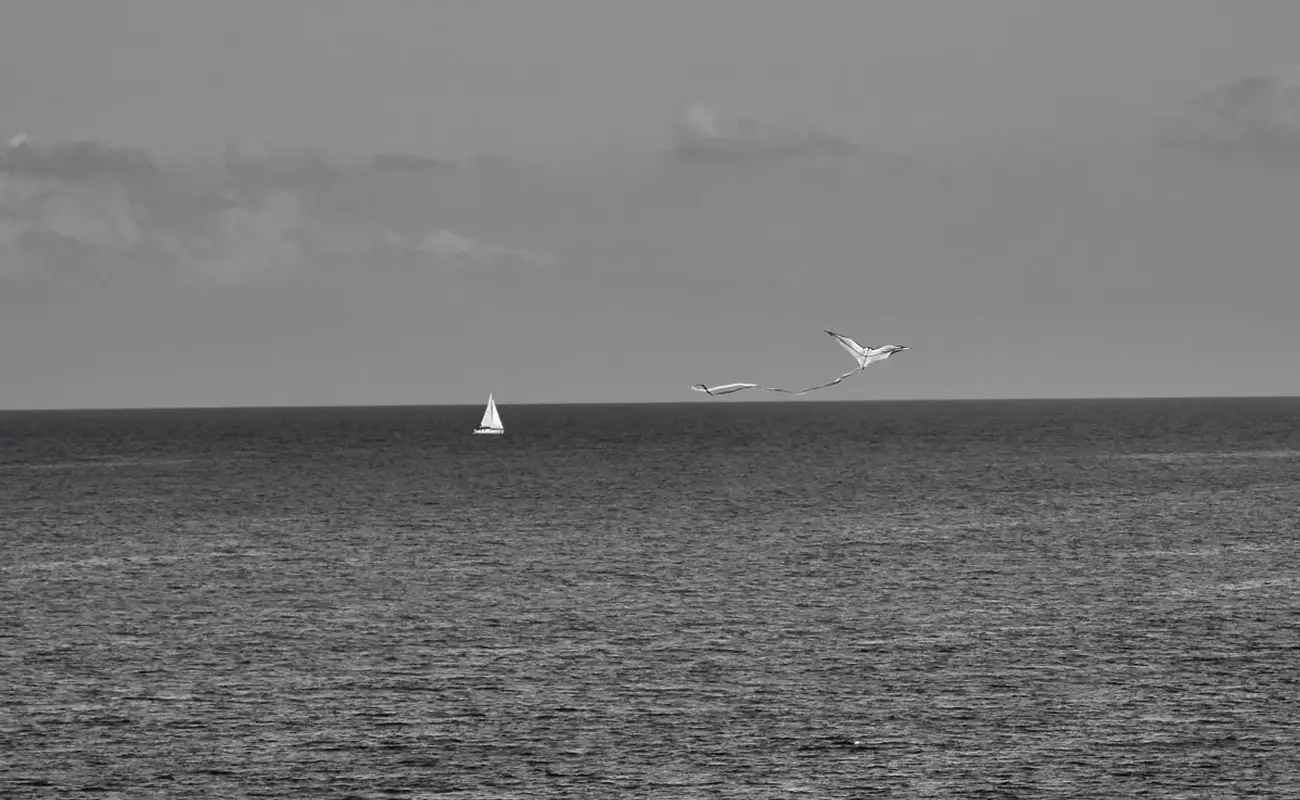
Across the series, a visual rhythm emerges through alternating proximity and distance. Close portraits focus on nuanced gestures, such as a hand partly covering a mouth or eyes drifting toward an unseen horizon, while expansive landscapes introduce emptiness as an emotional counterpoint. Stark monochrome images of skeletal trees or an open sea punctuated by a solitary sailboat articulate psychological solitude through spatial metaphors. These scenes resonate with the artist’s psychoanalytic training, translating psychic states into environmental form. Natasha Antipova-Kaploukhaya does not present the psyche as abstract theory but as a lived terrain. Her photographs propose that vulnerability and withdrawal are not merely private experiences but perceptible conditions shaping how bodies inhabit space and light.
Urban street imagery featuring elaborately dressed individuals further complicates this emotional register. Figures adorned with vintage hats, parasols, tailored suits, or flamboyant nightlife costumes become embodiments of identity as performance. Rather than satirical commentary, these portraits suggest an empathetic fascination with self-fashioning as a defensive or liberating act. Through carefully framed compositions, the artist foregrounds the paradox of visibility and concealment. Clothing, gesture, and pose become psychological armour. Such scenes establish continuity with her stated interest in metaphors that encourage viewers to pause and reflect. Each frame operates as a quiet invitation to recognise emotional states that often remain socially masked.

Natasha Antipova-Kaploukhaya: Psychoanalytic Vision in Photographic Form
The influence of psychoanalysis manifests not through overt symbolism but through a sustained attentiveness to detachment and inner retreat. The studio portrait of a young woman experiencing profound personal crisis stands as a conceptual anchor within the broader body of work. Draped in feathered wings and positioned beneath angled architectural beams, the subject appears simultaneously grounded and poised for escape. This duality articulates the artist’s intention to represent fatigue as a protective mechanism. Gesture, posture, and spatial framing collaborate to evoke an atmosphere of suspended time. Natasha Antipova-Kaploukhaya constructs a visual language where emotional overwhelm becomes legible through subtle corporeal signals rather than dramatic expression.
Her engagement with the ethical complexity of depicting vulnerability enriches the work’s intellectual dimension. Photographing individuals in moments of psychological exposure requires a negotiation between intimacy and distance. The artist acknowledges this challenge, and the resulting images reflect a sensitive calibration of proximity. Faces are neither sensationalised nor anonymised. Instead, they occupy a liminal zone where viewers encounter traces of personal struggle without being granted full narrative access. This ambiguity enhances the emotional resonance of the series. It transforms the act of looking into a reflective process, encouraging audiences to recognise their own experiences of withdrawal, fatigue, or silent resistance to external pressures.
Connections to the practices of Francesca Woodman, Sally Mann, and Cindy Sherman become visible through Natasha Antipova-Kaploukhaya’s exploration of identity as mutable psychological terrain. Woodman’s introspective spatial performances, Mann’s complex negotiations of intimacy, and Sherman’s constructed personas all find echoes in her approach. Nevertheless, the artist distinguishes herself through her clinical sensitivity to emotional nuance. Rather than foregrounding conceptual spectacle or autobiographical mythology, she prioritises empathy as a methodological principle. This orientation situates her photography within contemporary discourses surrounding mental health, selfhood, and the politics of visibility. Her images function not only as aesthetic objects but also as contemplative tools that question how inner freedom may be visually articulated.

Landscapes of Mind and City
Beyond portraiture, Natasha Antipova-Kaploukhaya extends her psychological inquiry into landscape and architectural imagery. Monochrome photographs of coastal horizons, drifting birds, and barren terrain evoke a meditative stillness that parallels the introspective mood of her human subjects. The absence of vibrant colour directs attention toward texture, tonal contrast, and compositional balance. Such choices emphasise the emotional potential of minimalism. A lone seagull captured mid-flight becomes emblematic of fragile autonomy, while distant urban skylines suggest both aspiration and alienation. Through these environmental metaphors, the artist articulates how inner states shape perceptions of physical surroundings.
The photograph of Parisian rooftops punctuated by the iconic vertical silhouette of a tower introduces a historical dimension to her work. Architectural continuity and atmospheric cloud formations create a sense of temporal layering, reminding viewers that personal crises unfold within broader cultural frameworks. Natasha Antipova-Kaploukhaya’s attention to perspective transforms familiar cityscapes into psychological theatres. Elevated viewpoints foster detachment, mirroring the emotional withdrawal described in her conceptual statement. Such images subtly challenge romanticised notions of metropolitan life, revealing instead a quieter narrative about solitude amid density. The city becomes both refuge and source of existential tension.
Interspersed with these contemplative vistas, scenes of vibrant nightlife and public gatherings inject kinetic energy into the series. A costumed figure moving through a crowded street at night disrupts the otherwise subdued tonal palette. Neon signage, wet pavement reflections, and the choreography of passersby introduce an atmosphere of performative excess. Yet even here, Natasha Antipova-Kaploukhaya maintains her commitment to psychological inquiry. The spectacle of costume and celebration appears tinged with ambiguity. Joy and estrangement coexist within the same frame. This interplay enriches the series by preventing a singular emotional narrative. Instead, viewers encounter a spectrum of states ranging from exuberance to quiet exhaustion.

Natasha Antipova-Kaploukhaya: Positioning Vulnerability in Contemporary Photography
Originality within Natasha Antipova-Kaploukhaya’s practice emerges through her synthesis of clinical insight and aesthetic sensitivity. While many contemporary photographers address themes of identity and emotional fragility, her work distinguishes itself through a consistent metaphorical framework. Fatigue, withdrawal, and protective self-concealment recur across diverse visual contexts. Portraits in cafés, stylised fashion streets, intimate studios, and desolate coastlines all contribute to a cohesive exploration of how individuals negotiate psychic pressure. This conceptual continuity strengthens the work’s institutional relevance. Curators attentive to interdisciplinary dialogues between psychology and visual culture may find her practice particularly compelling.
Technical execution demonstrates a confident command of natural light, compositional layering, and tonal modulation. Warm highlights and deep shadows sculpt faces with painterly precision, while monochrome sequences reveal an acute sensitivity to form and rhythm. Nevertheless, certain images risk aestheticising vulnerability to the point of distancing viewers from its raw immediacy. Greater experimentation with compositional disruption or temporal sequencing could intensify the experiential impact. Natasha Antipova-Kaploukhaya might consider exploring serial narratives that allow emotional states to unfold across multiple frames. Such developments could deepen audience engagement and expand the interpretive possibilities of her psychoanalytic themes.
Within the contemporary art market and exhibition landscape, her work occupies a nuanced position between documentary observation and staged psychological theatre. This hybridity offers both opportunity and challenge. Collectors often gravitate toward clearly defined genres, yet the conceptual richness of her images invites slower forms of appreciation aligned with gallery and institutional contexts. Natasha Antipova-Kaploukhaya’s emphasis on inner freedom resonates strongly with current cultural conversations about mental resilience and selfhood. By continuing to refine her visual language while maintaining her empathetic gaze, she stands poised to contribute meaningfully to ongoing dialogues about the ethics and aesthetics of representing the human psyche in photographic form.