
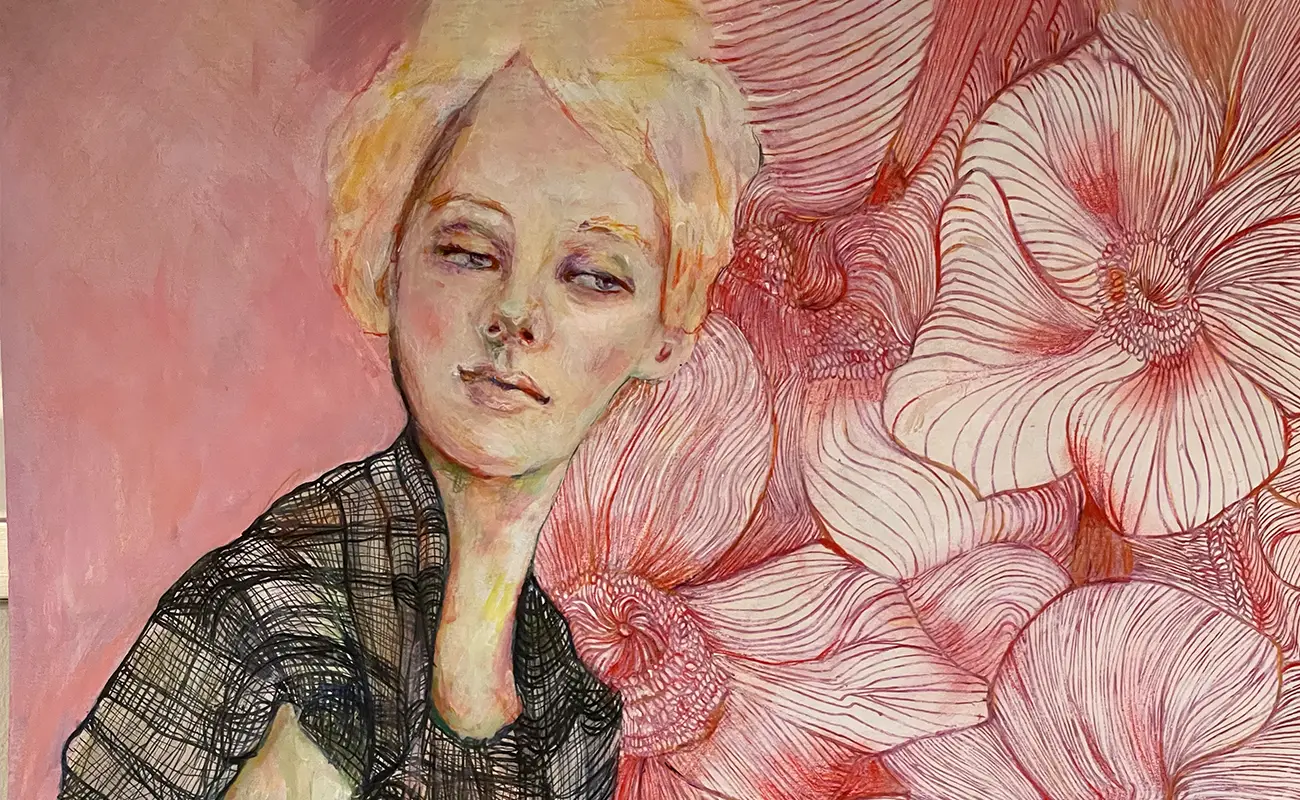
“I use vulnerability and sensitivity in my art, shaped by feeling like a foreigner in my own country.”
Language, Identity, and the Borderline Experience
Growing up in Southern Jutland, where Denmark meets Germany, Kirsten Hammond Andersen’s childhood unfolded in a region marked by a complex linguistic and cultural duality. This geographical and historical intersection deeply influenced her personal identity and, ultimately, her artistic voice. For Andersen, being raised in a place where two languages coexisted—Danish and German—meant more than just bilingual fluency. It was a cultural layering that shaped her perception of nationality, identity, and communication. The region’s dialect, infused with German vocabulary and rhythm, differs so significantly from standard Danish that it often creates a disconnect from the rest of the country. This dissonance, felt from a young age, cultivated a persistent sense of being slightly apart, even within her own nation.
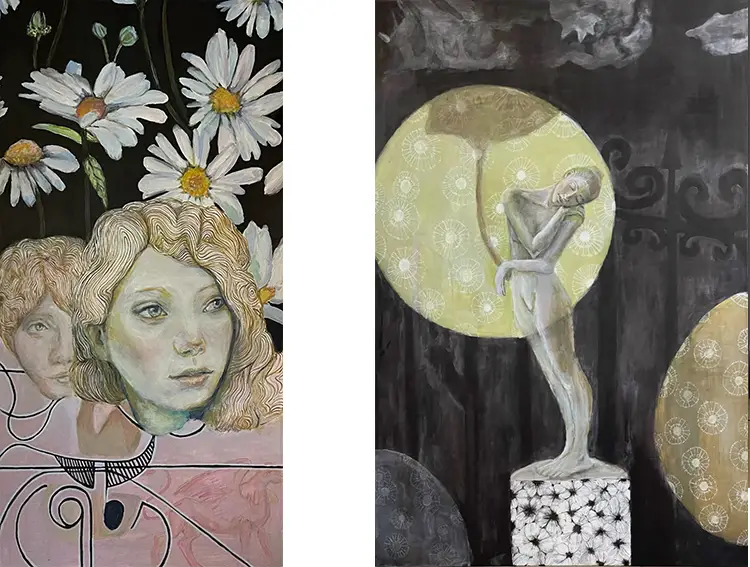
That feeling of partial foreignness became a foundational element in Andersen’s creative work. The challenge of having to learn formal Danish (rigsdansk) in school, while still thinking and speaking in her native dialect at home, often made her feel vulnerable, as if her voice didn’t quite belong. This sensitivity—born from navigating cultural and linguistic identity—found an outlet in visual art. Andersen channels this emotional complexity into her creative practice, drawing upon the internal conflict of national affiliation and self-expression. The layers of identity she carries are reflected in her art, not only in the subjects she chooses but in the emotional weight and subtle tension embedded in each piece.
Rather than viewing this cultural friction as a limitation, Andersen sees it as a rich source of inspiration. Her exposure to multiple languages, histories, and perspectives gives her a broader canvas on which to work, and she often finds herself drawn to literature and poetry from beyond Danish borders. English texts, in particular, resonate with her, perhaps because they offer a third linguistic space—one that isn’t bound by the expectations and judgments she has experienced in Denmark. This global literary curiosity feeds directly into the textures and narratives she weaves into her artwork, shaping her visual storytelling in nuanced and unpredictable ways.
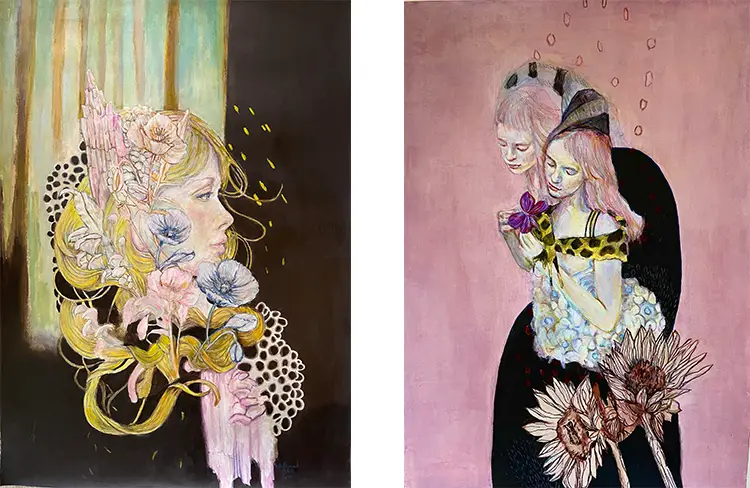
Kirsten Hammond Andersen: The Return to Visual Storytelling
Andersen’s journey into art began during her teenage years, where a growing passion for visual expression took root in high school art history classes. At around sixteen, her fascination with artistic techniques and historical works ignited a deeper curiosity, one that would later evolve into a lifelong pursuit. While working in the United States for three years, she took the opportunity to study part-time at The Pennsylvania Academy of the Fine Arts in Philadelphia. This experience offered her structured artistic training, even though she still considers herself largely self-taught. Andersen sees this blend of formal and informal education as integral to her voice as an artist, giving her the freedom to experiment while grounding her in foundational skills.
After stepping away from art for roughly a decade, Andersen made a conscious effort to reconnect with her practice. This return was not simply a re-engagement with technique, but an act of reclaiming a part of herself that had been dormant. She revisited early memories of drawing fantastical places and characters, a creative outlet that had once allowed her to explore alternate realities. That childhood habit of building imagined worlds on paper has quietly endured and now informs the conceptual depth of her work. Whether creating abstract pieces or figurative scenes, she often builds her compositions as if she’s opening a portal into another world—a practice rooted in those early explorations.
The sense of wonder and introspection that initially drew her to art continues to influence her direction today. She approaches each project as a new opportunity to explore perception, memory, and the quiet truths that reside within small, often overlooked details. For Andersen, drawing is not only about image-making but about connection: to self, to the past, and to emotions that cannot always be spoken. Her artistic development may not have followed a conventional path, but its rhythm has been steady and deeply personal, reflecting a resilience and curiosity that shape each new creation.
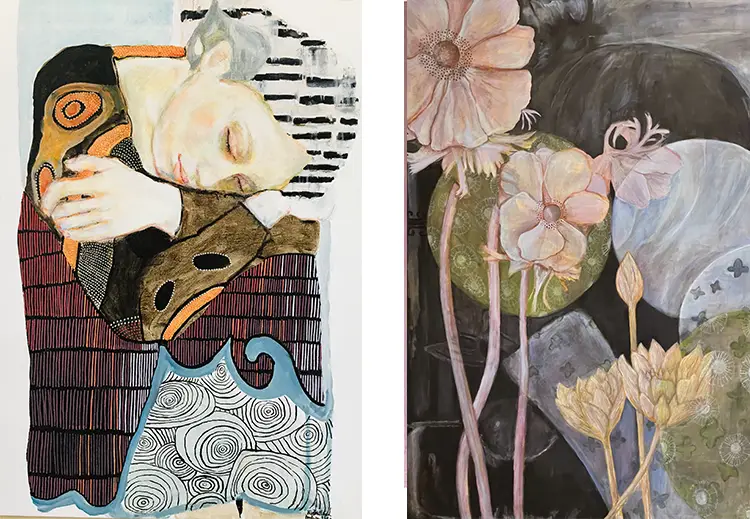
The Slow Construction of Image and Meaning
Andersen’s artistic process is deliberate, patient, and grounded in a profound respect for line and structure. Her work, often produced in mixed media, begins with sketches that evolve slowly into more defined compositions. Rather than rushing toward a final result, she allows each piece to unfold over time. The initial phase typically includes rough outlines drawn directly on the canvas or paper. These early lines are not meant to be perfect; instead, they serve as visual scaffolding for the more refined layers that follow. Through repeated erasing and redrawing, she gradually defines her forms, nudging them toward their final shape.
This approach underscores her belief that precision comes through repetition and reflection. Andersen often spends an entire week on a single drawing, not necessarily for the purpose of using it in a final piece, but as a way to better understand the image she’s trying to capture. These preliminary drawings, which may never be exhibited, are essential to her creative process. They function as visual meditations—spaces where she can test ideas, let her mind wander, and observe how forms evolve under her hand. The physical act of drawing, for her, is inseparable from emotional presence. Patience isn’t just a virtue in her studio; it’s a methodology that gives space for vulnerability and intuition to surface.
She’s also deeply attuned to her working environment. Sound plays an important role in maintaining her focus and creative rhythm. Whether it’s music or ambient white noise frequencies found on YouTube, she carefully curates an audio atmosphere that supports sustained attention and emotional immersion. This acoustic backdrop becomes part of the artwork in a way, shaping her mood and influencing the energy she brings to each piece. While distractions are inevitable, her ability to tune in to subtle soundscapes helps her maintain a meditative focus, allowing her to stay connected to the emotional undercurrents of her subject matter.
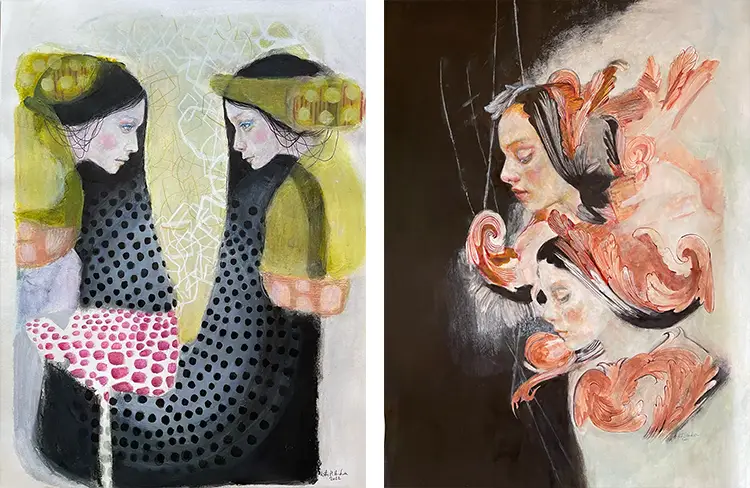
Kirsten Hammond Andersen: Influences, Ideals, and Unfinished Dreams
Art history remains a vital source of inspiration for Andersen, whose appreciation for classical and experimental styles spans centuries. Among the figures that have left a lasting impression on her are Michelangelo, Hieronymus Bosch, and Henri de Toulouse-Lautrec. Michelangelo’s intricate, emotive drawings are of particular interest to her; she regards his mastery of line and anatomical precision as the pinnacle of artistic grace. The way his sketches carry both force and fragility resonates with her own approach to drawing, where each mark carries emotional weight. She has even expressed a deep admiration for the idea of owning one of his works, not for its prestige, but for the sheer beauty it holds.
Bosch, known for his surreal and often unsettling narratives, also intrigues Andersen with his ability to craft complex, symbolic worlds. Though her own work doesn’t mirror his aesthetic directly, the conceptual ambition of his art speaks to her as a fellow builder of imaginary spaces. Toulouse-Lautrec, with his diverse technique and ability to shift between caricature, figurative studies, and illustrative art, exemplifies the kind of versatility Andersen aspires to. She admires how he navigated different artistic territories without compromising his unique voice, a trait she finds both rare and courageous.
Beyond established influences, Andersen continues to explore personal fascinations that she hopes to further develop in future projects. One enduring interest lies in perspective drawing and calligraphy, both of which she engaged with earlier in her artistic life. These disciplines appeal to her not just for their technical demands, but for their ability to shape perception and guide the viewer’s eye in deliberate ways. Letterforms and spatial structures have long captivated her, and she dreams of incorporating these elements more fully into her visual language. Whether through layered text, architectural studies, or imagined alphabets, these ideas remain close to her heart, waiting for the right moment to surface in her work.